Thank you for visiting SNEWPapers!
Sign up free
Daily National Intelligencer
Washington, District Of Columbia
What is this article about?
In 1814, during the War of 1812, Massachusetts Governor Caleb Strong corresponds with Secretary of War James Monroe about reimbursing state militia costs for coastal defense, as federal troops were withdrawn. Monroe explains federal policy limits reimbursement to forces under U.S. command. Rhode Island's Governor Jones offers mutual aid. A Massachusetts legislative committee reports on inadequate federal defense, praises state militia response, criticizes war policy, and proposes raising troops, borrowing funds, and convening a New England conference to address grievances and potentially revise the Constitution.
Clipping
OCR Quality
Full Text
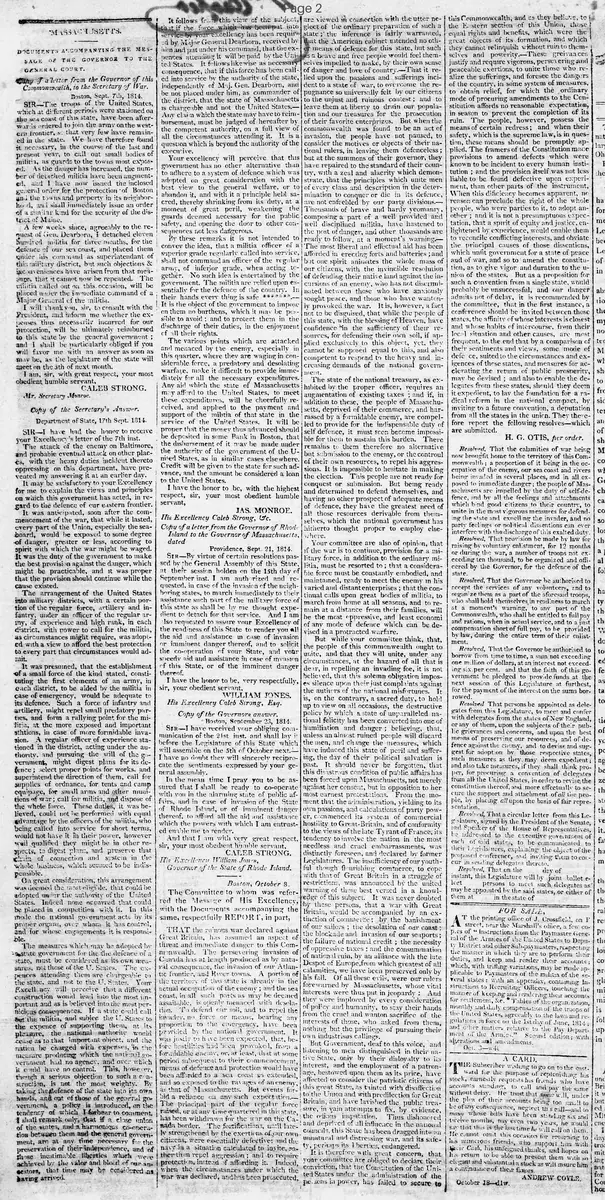
DOCUMENTS ACCOMPANYING THE MESSAGE OF THE GOVERNOR TO THE GENERAL COURT.
Copy of a letter from the Governor of this Commonwealth, to the Secretary of War.
Boston, Sept. 7th, 1814.
SIR--The troops of the United States which at different periods were stationed on the sea coast of this state, have been afterwards ordered to join the army on the western frontier, so that very few have remained in the state. We have therefore found it necessary, in the course of the last and present year, to call out small bodies of militia, as guards to the towns most exposed. As the danger has increased, the number of detached militia have been augmented, and I have now issued the enclosed general order for the protection of Boston and the towns and property in its neighborhood, and shall immediately issue an order of a similar kind for the security of the district of Maine.
A few weeks since, agreeably to the request of Gen. Dearborn, I detached eleven hundred militia for three months, for the defence of our sea coast, and placed them under his command as superintendent of this military district, but such objections & inconveniences have arisen from that measure, that it cannot now be repeated. The militia called out on this occasion, will be placed under the immediate command of a Major General of the militia.
I will thank you, sir, to consult with the President, and inform me whether the expenses thus necessarily incurred for our protection, will be ultimately reimbursed to this state by the general government: and I shall be particularly obliged if you will favor me with an answer as soon as may be, as the legislature of the state will meet on the 5th of next month.
I am, sir, with great respect, your most obedient humble servant,
CALEB STRONG.
Mr. Secretary Monroe.
Copy of the Secretary's answer.
Department of State, 17th Sept. 1814.
SIR--I have had the honor to receive your Excellency's letter of the 7th inst. The attack of the enemy on Baltimore, and probable eventual attack on other places, with the heavy duties incident thereto oppressing on this department, have prevented my answering it at an earlier day.
It may be satisfactory to your Excellency for me to explain the views and principles on which this government has acted, in regard to the defence of our eastern frontier. It was anticipated, soon after the commencement of the war, that while it lasted, every part of the Union, especially the seaboard, would be exposed to some degree of danger, greater or less, according to spirit with which the war might be waged. It was the duty of the government to make the best provision against the danger, which might be practicable, and it was proper that the provision should continue while the cause existed.
The arrangement of the United States into military districts, with a certain portion of the regular force, artillery and infantry, under an officer of the regular army, of experience and high rank, in each district, with power to call for the militia, as circumstances might require, was adopted with a view to afford the best protection to every part that circumstances would admit.
It was presumed, that the establishment of a small force of the kind stated, constituting the first elements of an army, in each district, to be aided by the militia in case of emergency, would be adequate to its defence. Such a force of infantry and artillery, might repel small predatory parties, and form a rallying point for the militia, at the more exposed and important stations, in case of more formidable invasion. A regular officer of experience stationed in the district, acting under the authority, and pursuing the will of the government, might digest plans for its defence; select proper points for works, and superintend the direction of them, call for supplies of ordnance, for tents and camp equipage, for small arms and other munitions of war; call for militia, and dispose of the whole force. These duties, it was believed, could not be performed with equal advantage by the officers of the militia, who being called into service for short terms, would not have it in their power, however well qualified they might be in other respects, to digest plans, and preserve that chain of connection and system in the whole business, which seemed to be indispensable.
On great consideration, this arrangement was deemed the most eligible that could be adopted under the authority of the United States. Indeed none occurred that could be placed in competition with it. In this mode the national government acts by its proper organs, over whom it has control, and for whose engagements it is responsible.
The measures which may be adopted by a state government for the defence of a state, must be considered as its own measures, not those of the U. States. The expenses attending them are chargeable to the state, and not to the U. States. Your Excellency will perceive that a different construction would lead into the most important and as is believed into the most pernicious consequences. If a state could call out the militia, and subject the U. States to the expense of supporting them, at its pleasure, the national authority would cease as to that important object, and the nation be charged with expenses, in the measure producing which the national government had no agency, and over which it could have no control. This, however, though a serious objection to such a construction, is not the most weighty. By taking the defence of the state into its own hands, and out of those of the general government, a policy is introduced, on the tendency of which I forbear to comment. I shall remark only, that if a close union of the states, and a harmonious co-operation between them and the general government, are at any time necessary for the preservation of their independence, and of those inestimable liberties which were achieved by the valor and blood of our ancestors, that time may be considered as having arrived.
It follows from this view of the subject, that if the force which has been put into service by your excellency has been required by Major General Dearborn, received by him and put under his command, that the expenses attending it will be paid by the United States. It follows likewise as necessary consequence, that if this force has been called into service by the authority of the state, independently of Maj. Gen. Dearborn, and be not placed under him, as commander of the district, that the state of Massachusetts is chargeable and not the United States.
Any claim which the state may have to reimbursement, must be judged of hereafter by the competent authority, on a full view of all the circumstances attending it. It is a question which is beyond the authority of the executive.
Your excellency will perceive that this government has no other alternative than to adhere to a system of defence which was adopted on great consideration with the best view to the general welfare, or to abandon it, and with it a principle held sacred, thereby shrinking from its duty, at a moment of great peril, weakening the guards deemed necessary for the public safety, and opening the door to other consequences not less dangerous.
By these remarks it is not intended to convey the idea, that a militia officer of a superior grade regularly called into service, shall not command an officer of the regular army, of inferior grade, when acting together. No such idea is entertained by the government. The militia are relied upon essentially for the defence of the country. In their hands every thing is safe *******.
It is the object of the government to impose on them no burthens, which it may be possible to avoid: and to protect them in the discharge of their duties, in the enjoyment of all their rights.
The various points which are attacked and menaced by the enemy, especially in this quarter, where they are waging in considerable force, a predatory and desolating warfare, make it difficult to provide immediately for all the necessary expenditures. Any aid which the state of Massachusetts may afford to the United States, to meet these expenditures, will be cheerfully received, and applied to the payment and support of the militia of that state in the service of the United States. It will be proper that the money thus advanced should be deposited in some Bank in Boston, that the disbursement of it may be made under the authority of the government of the United States, as in similar cases elsewhere. Credit will be given to the state for such advance, and the amount be considered a loan to the United States.
I have the honor to be, with the highest respect, sir, your most obedient humble servant,
JAS. MONROE.
His Excellency Caleb Strong, &c.
Copy of a letter from the Governor of Rhode Island to the Governor of Massachusetts, dated
Providence, Sept. 21, 1814.
SIR--By virtue of certain resolutions passed by the General Assembly of this State, at their session holden on the 15th day of September inst. I am authorized and requested, in case of the invasion of the neighboring states, to march immediately to their assistance such part of the military force of this state as shall be by me thought expedient to detach for that service. And I am also requested to assure your Excellency of the readiness of this State to render you all the aid and assistance in case of invasion or imminent danger thereof, and to solicit the co-operation of your State, and your speedy aid and assistance in case of invasion of this State, or of the imminent danger thereof.
I have the honor to be, very respectfully, sir, your obedient servant,
WILLIAM JONES.
His Excellency Caleb Strong, Esq.
Copy of the Governor's answer.
Boston, September 23, 1814.
SIR--I have received your obliging communication of the 21st inst. and shall lay it before the Legislature of this State which will assemble on the 5th of October next. I have no doubt they will sincerely reciprocate the sentiments expressed by your general assembly.
In the mean time I pray you to be assured that I shall be ready to co-operate with you in the alarming state of public affairs, and in case of invasion of the State of Rhode Island, or of imminent danger thereof, to afford all the aid and assistance which the powers with which I am entrusted enable me to render.
And that I am with very great respect, sir, your most obedient humble servant,
CALEB STRONG.
His Excellency William Jones, Governor of the State of Rhode Island.
Boston, October 8.
The Committee to whom was referred the Message of His Excellency, with the Documents accompanying the same, respectfully REPORT, in part,
THAT the ruinous war declared against Great Britain, has assumed an aspect of threat and immediate danger to this Commonwealth. The persevering invasion of Canada has at length produced as by natural consequence, the invasion of our Atlantic frontier, and River towns. A portion of the territory of this state is already in the actual occupation of the enemy; and the sea coast, in all such parts as may be deemed assailable, is openly menaced with desolation. To defend our soil, and to repel the invader, no force or means, bearing any proportion to the emergency, have been provided by the national government. It was justly to have been expected, that, before hostilities had been provoked from a formidable enemy, or, at least, that at some period subsequent to their commencement, means of defence and protection would have been afforded to a sea coast so extended, and so exposed to the ravages of an enemy, as that of Massachusetts. But events forbid a reliance on any such expectation.
The principal part of the regular force raised, or at any time quartered in this state, has been withdrawn for the war on the Canada border. The fortifications, until lately strengthened by the exertions of our own citizens, were essentially defective; and the navy in a situation calculated to invite, rather than repel aggression; and to require protection, instead of affording it. Indeed, when the circumstances under which the war was declared, and has been prosecuted, are viewed in connection with the utter neglect of the ordinary preparation of such a state; the inference is fairly warranted, that the American cabinet intended no other means of defence for this state, but such as a brave and free people would feel themselves impelled to make, by their own sense of danger and love of country. That it relied upon the passions and sufferings incident to a state of war, to overcome the repugnance so universally felt by our citizens to the unjust and ruinous contest; and to leave them at liberty to drain our population and our treasures for the prosecution of their favorite enterprizes. But when the commonwealth was found to be an act of invasion, the people have not paused, to consider the motives or objects of their national rulers, in leaving them defenceless: but at the summons of their governor, they have repaired to the standard of their country, with a zeal and alacrity which demonstrate, that the principles which unite men of every class and description in the determination to conquer or die in its defence, are not enfeebled by our party divisions.
Thousands of brave and hardy yeomanry, composing a part of a well provided and well disciplined militia, have hastened to the post of danger, and other thousands are ready to follow, at a moment's warning. The most liberal and effectual aid has been afforded in erecting forts and batteries; and but one spirit animates the whole mass of our citizens, with the invincible resolution of defending their native land against the incursions of an enemy, who has not discriminated between those who have anxiously sought peace, and those who have wantonly provoked the war. It is, however, a fact not to be disguised, that while the people of this state, with the blessing of Heaven, have confidence in the sufficiency of their resources, for defending their own soil, if applied exclusively to this object, yet, they cannot be supposed equal to this, and also competent to respond to the heavy and increasing demands of the national government.
The state of the national treasury, as exhibited by the proper officer, requires an augmentation of existing taxes; and if, in addition to these, the people of Massachusetts, deprived of their commerce, and harassed by a formidable enemy, are compelled to provide for the indispensable duty of self defence, it must soon become impossible for them to sustain this burden. There remains to them therefore no alternative but submission to the enemy, or the control of their own resources, to repel his aggressions. It is impossible to hesitate in making the election. This people are not ready for conquest or submission. But being ready and determined to defend themselves, and having no other prospect of adequate means of defence, they have the greatest need of all those resources derivable from themselves, which the national government has hitherto thought proper to employ elsewhere.
Your committee are also of opinion, that if the war is to continue, provision for a military force, in addition to the ordinary militia, must be resorted to; that a considerable force must be constantly embodied, and maintained, ready to meet the enemy in his varied and distant enterprizes; that the continual calls upon great bodies of militia, to march from home at all seasons, and to remain at a distance from their families, will be the most oppressive, and least economical of any mode of defence which can be devised in a protracted warfare.
But while your committee think, that the people of this commonwealth ought to unite, and that they will unite, under any circumstances, at the hazard of all that is dear, in repelling an invading foe, it is not believed, that this solemn obligation imposes silence upon their just complaints against the authors of the national misfortunes. It is, on the contrary, a sacred duty, to hold up to view on all occasions, the destructive policy by which a state of unparalleled national felicity has been converted into one of humiliation and danger: believing, that, unless an almost ruined people will discard the men, and change the measures, which have induced this state of peril and suffering, the day of their political salvation is past. It should never be forgotten, that this disastrous condition of public affairs has been forced upon Massachusetts, not merely against her consent, but in opposition to her most earnest protestations. From the moment that the administration, yielding to its own passions, and calculations of party power, commenced its system of commercial hostility to Great-Britain, and of conformity to the views of the late Tyrant of France, its tendency to involve the nation in the most needless and cruel embarrassments, was distinctly foreseen, and declared by former Legislatures. The insufficiency of our youthful though flourishing commerce, to cope with that of Great Britain in a struggle of restrictions, was announced by the united warning of those best versed in a knowledge of this subject. It was never doubted by these persons, that a war with Great Britain, would be accompanied by an extinction of commerce: by the banishment of our sailors; the desolation of our coast; the blockade and invasion of our seaports; the failure of national credit; the necessity of oppressive taxes: and the consummation of national ruin, by an alliance with the late Despot of Europe, from which greatest of all calamities, we have been preserved only by his fall. Of all these evils, were our rulers forewarned by Massachusetts, whose vital interests were thus put in jeopardy: And they were implored by every consideration of policy and humanity, to stay their hands from the cruel and wanton sacrifice of the interests of those, who asked from them, nothing but the privilege of pursuing their own industrious callings.
But Government, deaf to this voice, and listening to men distinguished in their native State, only by their disloyalty to its interest, and the employment of a patronage, bestowed upon them as its price, have affected to consider the patriotic citizens of this great State, as tainted with disaffection to the Union and with predilection for Great Britain, and have lavished the public treasure, in vain attempts to fix, by evidence, the odious imputation. Thus dishonored and deprived of all influence in the national councils, this State has been dragged into an unnatural and distressing war, and its safety, perhaps its liberties, endangered.
It is therefore with great concern, that your committee are obliged to declare their conviction, that the Constitution of the United States under the administration of the persons in power, has failed to secure to this Commonwealth, and as they believe, to the Eastern section of this Union, those equal rights and benefits, which were the great objects of its formation, and which they cannot relinquish without ruin to themselves and posterity. These grievances justify and require vigorous, persevering and peaceable exertions, to unite those who realize the sufferings, and foresee the dangers of the country, in some system of measures, to obtain relief, for which the ordinary mode of procuring amendments to the Constitution affords no reasonable expectation, in season to prevent the completion of its ruin. The people, however, possess the means of certain redress; and when their safety, which is the supreme law, is in question, these means should be promptly applied. The framers of the Constitution made provisions to amend defects which were known to be incident to every human institution; and the provision itself was not less liable to be found defective upon experiment, than other parts of the instrument. When this deficiency becomes apparent, no reason can preclude the right of the whole people, who were parties to it, to adopt another: and it is not a presumptuous expectation, that a spirit of equity and justice, enlightened by experience, would enable them to reconcile conflicting interests, and obviate the principal causes of those dissensions, which unfit government for a state of peace and of war, and so to amend the constitution, as to give vigor and duration to the union of the states. But as a proposition for such a convention from a single state, would probably be unsuccessful, and our danger admits not of delay, it is recommended by the committee, that in the first instance, a conference should be invited between those states, the affinity of whose interests is closest and whose habits of intercourse, from their local situation and other causes, are most frequent, to the end that by a comparison of their sentiments and views, some mode of defence, suited to the circumstances and exigencies of those states, and measures for accelerating the return of public prosperity, may be devised; and also to enable the delegates from these states, should they deem it expedient, to lay the foundation for a radical reform in the national compact, by inviting to a future convention, a deputation from all the states in the union. They therefore report the following resolves--which are submitted.
H. G. OTIS, per order.
Resolved, That the calamities of war being now brought home to the territory of this Commonwealth: a proportion of it being in the occupation of the enemy, our sea coast and rivers being invaded in several places, and in all exposed to immediate danger; the people of Massachusetts are impelled by the duty of self-defence, and by all the feelings and attachments which bind good citizens to their country, to unite in the most vigorous measures for defending the state and expelling the invader, and no party feelings or political dissensions can ever interfere with the discharge of this exalted duty.
Resolved, That provision be made by law for raising by voluntary enlistment, for 12 months or during the war, a number of troops not exceeding ten thousand, to be organized and officered by the Governor, for the defence of the state.
Resolved, That the Governor be authorised to accept the services of any volunteers, and to organize them as a part of the aforesaid troops, who shall hold themselves in readiness to march at a moment's warning, to any part of the Commonwealth, who shall be entitled to full pay and rations, when in actual service, and to a just compensation short of full pay, to be provided by law, during the entire term of their enlistment.
Resolved, That the Governor be authorised to borrow from time to time, a sum not exceeding one million of dollars, at an interest not exceeding six per cent. and that the faith of this government be pledged to provide funds at the next session of this Legislature at furthest, for the payment of the interest on the sums borrowed.
Resolved That persons be appointed as delegates from this Legislature, to meet and confer with delegates from the states of New England, or any of them, upon the subjects of their public grievances and concerns, and upon the best means of preserving our resources, and of defence against the enemy, and to devise and suggest for adoption by those respective states, such measures as they may deem expedient; and also take measures, if they shall think proper, for procuring a convention of delegates from all the United States, in order to revise the constitution thereof, and more effectually to secure the support and attachment of all the people, by placing all upon the basis of fair representation.
Resolved, That a circular letter from this Legislature, signed by the President of the Senate, and Speaker of the House of Representatives, be addressed to the executive government of each of said states, to be communicated to their Legislatures, explaining the object of the proposed conference, and inviting them to concur in sending delegates thereto.
Resolved, That on the ... day of ... instant, this Legislature will by joint ballot elect ... persons to meet such delegates as may be appointed by the said states, or either of them at ... in the state of ...
What sub-type of article is it?
What themes does it cover?
What keywords are associated?
What entities or persons were involved?
Where did it happen?
Story Details
Key Persons
Location
Massachusetts, Boston, Sea Coast, District Of Maine, Rhode Island, Providence
Event Date
1814
Story Details
Massachusetts Governor Caleb Strong seeks federal reimbursement for state militia defending the coast amid War of 1812 invasions; Secretary Monroe outlines policy limiting payments to U.S.-commanded forces and urges state-federal cooperation. Rhode Island offers mutual aid. Legislative committee reports federal neglect, praises militia zeal, proposes raising 10,000 troops, borrowing $1M, and convening New England conference for defense and constitutional reform.