Thank you for visiting SNEWPapers!
Sign up free
Gazette Of The United States, & Philadelphia Daily Advertiser
Philadelphia, Philadelphia County, Pennsylvania
What is this article about?
An anonymous editorial urges Pennsylvania electors to reject Thomas McKean as gubernatorial candidate, accusing him of lifelong political inconsistency and opportunism, shifting allegiances from Whig to Tory, Constitutionalist to Republican, and Federalist to Anti-Federalist based on personal gain, contrasting him with a liberty-adhering opponent amid a pivotal state election.
Merged-components note: This is a continuation of the same editorial piece across pages 2 and 3, discussing the character of a political candidate.
Clippings
1 of 2
OCR Quality
Full Text
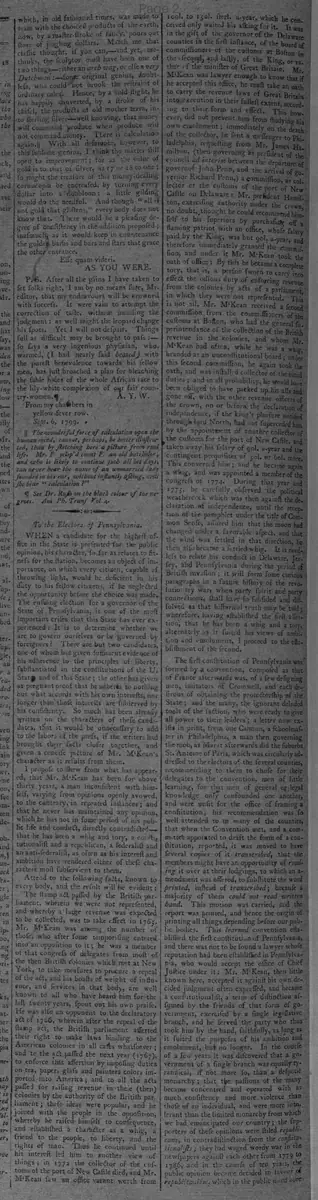
WHEN a candidate for the highest office in the State is presented for the public opinion, his character, so far as relates to fitness for the station, becomes an object of importance, on which every citizen, capable of throwing light, would be deficient in his duty to his fellow citizens, if he neglected the opportunity before the choice was made.
The ensuing election for a governor of the State of Pennsylvania, is one of the most important crises that this State has ever experienced: It is to determine whether we are to govern ourselves or be governed by foreigners? There are but two candidates. one of whom has given sufficient evidence of his adherence to the principles of liberty, substantiated in the constitutions of the U. States and of this State; the other has given as pregnant proof that he adheres to nothing but what accords with his own interests, nor longer than those interests are observed by his consistency. So much has been already written on the characters of these candidates, that it would be unnecessary to add to the labors of the press, if the writers had brought their acts closer together, and given a concise picture of Mr. M'Kean's character as it results from them.
I propose to shew from what has appeared, that Mr. M'Kean has been for above thirty years, a man inconsistent with himself, varying from opinions openly avowed. to the contrary, in repeated instances; and that he never has maintained any opinion, which he has not in some period of his public life and conduct, directly contradicted— that he has been a whig and tory, a constitutionalist and a republican, a federalist and an anti-federalist, as often as his interest and ambition have rendered either of these characters most subservient to them.
Attend to the following facts, known to every body, and the result will be evident:
The stamp act passed by the British parliament, wherein we were not represented, and whereby a large revenue was expected to be collected, was to take effect in 1765. Mr. M'Kean was among the number of those, who after some temporizing entered into an opposition to it; he was a member of that congress of delegates from most of the then British colonies which met at New York, to take measures to procure a repeal of the act, and his boasts of weight of influence, and services in that body, are well known to all who have heard him for the last twenty years, pour out his own praise. He was also an opponent to the declaratory act of 1766, wherein after the repeal of the stamp act, the British parliament asserted their right to make laws binding to the American colonies in all cases whatsoever; and to the act passed the next year (1767), to enforce this assertion by imposing duties on tea, paper, glass and painters colors imported into America; and to all the acts passed for raising revenue in these (then) colonies by the authority of the British parliament; these ideas were popular, and he joined with the people in the opposition, whereby he raised himself to consequence, and established a character as a whig, a friend to the people, to liberty, and the rights of man. Thus he continued until his interest led him to another view of things; in 1772 the collector of the customs of the port of New Castle died, and Mr. M'Kean saw an office vacant worth from 100l. to 150l. sterling a-year, which he conceived only waited his asking for it. It was in the gift of the governor of the Delaware counties in the first instance, of the board of commissioners of the customs at Boston in the second, and lastly, of the King, or rather of the minister of Great Britain. Mr. M'Kean was lawyer enough to know that if he accepted this office, he must take an oath to carry the revenue laws of Great Britain into execution in their fullest extent, according to their form and effect. This however, did not prevent him from studying his own emolument; immediately on the death of the collector, he sent a messenger to Philadelphia, requesting from Mr. James Hamilton, (then governing as president of the council ad interim between the departure of governor John Penn, and the arrival of governor Richard Penn,) a commission, as collector of the customs of the port of New Castle on Delaware: Mr. president Hamilton, exercising authority under the crown, no doubt, thought he could recommend himself to his superiors by purchasing off a flaming patriot with an office, whose salary paid by the King, was but 90l. a-year, and therefore immediately granted the commission, and under it Mr. M'Kean took the oath of office: By this he became a complete tory, that is, a person sworn to carry into effect the odious duty of enforcing revenue from the colonies by acts of a parliament in which they were not represented. This is not all, Mr. M'Kean received a second commission from the commissioners of the customs at Boston, who had the general superintendance of the collection of the British revenue in the colonies, and whom Mr. M'Kean had often, while he was a whig, branded as an unconstitutional board; under this second commission, he again took the oath, and was installed collector of the hated duties; and in all probability, he would have been obliged to have packed up his alls and gone off, with the other revenue officers of the crown, on or before the declaration of independence, if the king's pleasure notified through lord North, had not superseded him by the appointment of another collector of the customs for the port of New Castle, and taken away his salary of 90l. a-year and the contingent perquisites of 20l. or 30l. more. This converted him; and he became again a whig, and was appointed a member of the congress of 1774. During that year and 1775, he carefully observed the political weathercock which was then against the declaration of independence, until the reception of the pamphlet under the title of Common Sense, assured him that the moon had changed under a favorable aspect, and that the wind was settled in that direction, he then also became a settled whig. It is needless to relate his conduct in Delaware, Jersey, and Pennsylvania during the period of British invasion; it will form some curious paragraphs in a future history of the revolutionary war when party spirit and party connections, shall have so subsided and dissolved as that historical truth may be told; wherefore, having established the first assertion, that he has been a whig and a tory, alternately as it suited his views of ambition and emolument, I proceed to the establishment of the second.
The first constitution of Pennsylvania was formed by a convention, composed as that of France afterwards was, of a few designing men, imitators of Cromwell, and each desirous of obtaining the protectorship of the State; and the many, the ignorant deluded tools of the faction, who were ready to give all power to their leaders; a letter now exists in print, from one Cannon, a schoolmaster in Philadelphia, a man then governing the mob, as Marat afterwards did the suburbs St. Antoine of Paris, which was circularly addressed to the electors of the several counties, recommending to them to choose for their delegates to the convention, men of little learning, for that men of general or legal knowledge only confounded one another, and were unfit for the office of framing a constitution; his recommendation was so well attended to in many of the counties, that when the Convention met, and a committee appointed to draft the form of a constitution, reported, it was moved to have several copies of it transcribed, that the members might have an opportunity of reading it over at their lodgings, to which an amendment was offered. to substitute the word printed, instead of transcribed; because a majority of them could not read written hand. This motion was carried, and the report was printed, and hence the origin of printing all things depending before our public bodies. This learned convention established the first constitution of Pennsylvania, and there was not to be found a lawyer whose reputation had been established in Pennsylvania, who would accept the office of Chief Justice under it: Mr. M'Kean. then little known here, accepted it against his own decided judgment often expressed, and became a constitutionalist, a term of distinction applied by the friends of that form of government, exercised by a single legislative branch, and he served the party who thus took him by the hand, faithfully, as long as it suited the purposes of his ambition and emolument, but no longer. In the course of a few years it was discovered that a government of a single branch was equally tyrannical, if not more so, than a despotic monarchy; that the passions of the many became concentred and operated with as much consistency and more violence than those of an individual, and were more intolerant than the limited monarchy from which we had emancipated our country; the supporters of these opinions were styled republicans, in contradistinction from the constitutionalists; they had waged wordy war in the newspapers against each other from 1779 to 1786, and in the course of ten years, the public opinion became decided in favour of republicanism, which in the public mind bore
the idea of a representative government, divided into three branches, elected by and accountable at certain fixed periods to the people, by periodical elections. In 1786 a project originating in Virginia, was hearkened to by many of the other states, who sent representatives to Annapolis, in Maryland, to consider of some plan to render the federal government, then weak, from its composition of all power in one branch, more efficient in its administration of the affairs of Thirteen States; this meeting could effect nothing; their defective powers were however enlarged and the states more fully represented, at a meeting the next year (1787) at Philadelphia; when the present constitution of the United States was framed and recommended to the people of the several states for consideration, a convention of each to be called in the manner recommended. Mr. M'Kean clearly perceiving that the tide of popular opinion was coming with a full swell in favour of this constitution, suffered himself to be carried like a feather along with it, and when, in the year following its adoption, the constitution of the state was proposed to be rendered more conformable to that of the United States, he deserted his old friends the constitutionalists, who had raised him to the Chief Justiceship, who had dubbed him with (to use his own expression from the Bench) the title of Doctor of Laws, the highest dignity attainable in the profession, and became a republican.
The contest about the new constitutions of the United States and of this state, at this time, gave new names to the contending parties without any alteration in their views. The Constitutionalists were men who, despising all order in government, and contending for an exact equality among men, whether rich or poor, learned or unlearned, whether wise or idiots, insisted that their representatives should meet in one chamber, and by a majority of persons decide on all acts of legislation; while the Republicans insisted that the wiser and better part should be elected from the people at large, and be placed in two chambers with powers of negative over the acts of each other, in order to prevent that simultaneous effusion of passion which a single branch was commonly affected with by the impulse of some aspiring demagogue who would always by popular flattery be able to insinuate himself into their good opinion, and become their leader, their Cromwell. This difference of opinion gave new names to the parties, and Federalists was substituted for Republicans, Antifederalists for Constitutionalists: while the contest was doubtful, the latter submitted to the appellation and even assumed the title, but when by the loud acclaim of the people the constitutions were ratified, they wished to change it, and many arts have been tried to bring about a reform—Newspapers have been set up and fallen down in the attempt, and yet it has not succeeded but in jargon of the party. The Antifederalists have assumed the name of Republicans, but none beside themselves understand them as meant by it, and it is left to the Aurora and a few of its followers to designate them by it; while the true character of Republicans is maintained by the Federalists, who first assumed and always deserved the honored name: during this change of the Shibboleth of Party it was not difficult for Mr. M'Kean to turn with the tide; he thought his interest to be, to swim with the current, and he suffered himself to be enrolled in the list of Federalists: he advocated the cause of the new constitution of this state with energy; nay, he exceeded the excess of those of his compeers who are now called Monarchists, and advocated principles of inequality among the people which would, be too tedious to enumerate—here he was a Federalist in the extreme, but his services soon passed into oblivion—he was left to be merely Chief Justice of a single state—he was not promoted to the bench of the Union—he conceived himself neglected—he waited the next change of the moon, the next turn of tide, in hope that he might meet a favorite weed or straw to attach himself to, and flow into the port of an higher office. The clamours excited by Genet and the French party, and by his Reporter, Dallas, seemed to fum a fit opportunity to serve his purpose; he embraced the occasion, and from a firm supporter of Federalism, he became an Antifederalist; and ever since he presided at the meeting in the State-house Yard, when M'Clenachan proposed to kick the British treaty to Hell, he has been the most inveterate enemy to the people and the government of the United States, wholly attached to a foreign nation which has nothing to recommend it but the assumed names which he has discarded of liberty and republicanism.
FELLOW-CITIZENS,
This is the man recommended to your suffrages as Governor of the state, and I call upon all who shall vote for him to reflect within their own minds in which of his characters they mean to patronize him; whether as a Whig before 1772, a Tory and Custom-house officer in 1772 and 1773, a timid member of Congress till 1776, a Constitutionalist from thence till 1787, a Federalist of the highest tone from thence till 1793, or an Antifederalist, a Jacobin, a Foreigner, a Frenchman from thence to the present time.
What sub-type of article is it?
What keywords are associated?
What entities or persons were involved?
Editorial Details
Primary Topic
Critique Of Thomas M'kean's Political Inconsistency In Pennsylvania Gubernatorial Election
Stance / Tone
Strongly Anti M'kean, Accusatory Of Opportunism
Key Figures
Key Arguments