Thank you for visiting SNEWPapers!
Sign up free
Weekly National Intelligencer
Washington, District Of Columbia
What is this article about?
The Convention of Southern Rights Associations of South Carolina met in Charleston from May 5-8, 1851, electing officers including President J. P. Richardson, adopting resolutions affirming the right of secession and urging resistance to federal aggressions, and forming a Central State Committee. A letter from Langdon Cheves was read, advising against separate secession.
Clipping
OCR Quality
Full Text
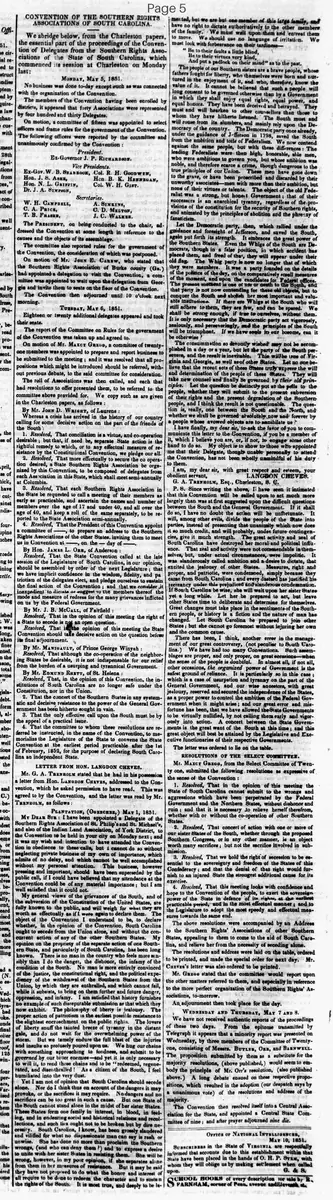
We abridge below, from the Charleston papers, the essential part of the proceedings of the Convention of Delegates from the Southern Rights Associations of the State of South Carolina, which commenced its session at Charleston on Monday last:
Monday, May 5, 1851.
No business was done to-day except such as was connected with the organization of the Convention.
The members of the Convention having been enrolled by districts, it appeared that forty Associations were represented by four hundred and thirty Delegates.
On motion, a committee of fifteen was appointed to select officers and frame rules for the government of the Convention.
The following officers were reported by the committee and unanimously confirmed by the Convention:
President.
Ex-Governor J. P. Richardson.
Vice Presidents.
Ex-Gov. W. B. Seabrook, Col. R. H. Goodwyn,
Hon. J. S. Ashe,
Hon. B. K. Hennegan,
Hon. N. L. Griffin,
Col. W. H. Gist.
Dr. J. A. Simpson,
Secretaries.
W. H. Campbell,
A. Simkins,
C. A. Price,
C. D. Melton,
T. B. Fraser,
J. C. Walker.
The President, on being conducted to the chair, addressed the Convention at some length in reference to the causes and the objects of its assemblage.
The committee also reported rules for the government of the Convention, the consideration of which was postponed.
On motion of Mr. John E. Carter, who stated that the Southern Rights Association of Burke county (Ga.) had appointed a delegation to visit the Convention, a committee was appointed to wait upon the delegation from Georgia and invite them to seats on the floor of the Convention.
The Convention then adjourned until 10 o'clock next morning.
Tuesday, May 6, 1851.
Eighteen or twenty additional delegates appeared and took their seats.
The report of the Committee on Rules for the government of the Convention was taken up and agreed to.
On motion of Mr. Macey Gregg, a committee of twenty-one members was appointed to prepare and report business to be submitted to the meeting; and it was resolved that all propositions which might be introduced should be referred, without previous debate, to the said committee for consideration.
The roll of Associations was then called, and each that had resolutions to offer presented them, to be referred to the committee above provided for. We copy such as are given in the Charleston papers, as follows:
By Mr. John D. Wright, of Laurens:
Whereas a crisis has arrived in the history of our country calling for some decisive action on the part of the friends of the South:
1. Resolved, That conciliation is a virtue, and co-operation desirable; but that, if need be, separate State action is the rightful remedy to which, or to any effectual measure of resistance by the Constitutional Convention, we pledge our all.
2. Resolved, That more effectually to secure the co-operation desired, a State Southern Rights Association be organized by this Convention, to be composed of delegates from each Association in this State, which shall meet semi-annually at Columbia.
3. Resolved, That each Southern Rights Association in the State be requested to call a meeting of their members as early as practicable, and ascertain the names and number of members over the age of 17 and under 40, and all over the age of 40, and keep a roll of the same separately, to be reported to the State Association semi-annually.
4. Resolved, That the President of this Convention appoint a committee of —, to prepare an address to the Southern Rights Associations of the other States, inviting them to meet us in Convention at —, on the — day of —.
By Hon. James L. Orr, of Anderson:
Resolved, That the State Convention called at the late session of the Legislature of South Carolina, in our opinion, should be assembled by order of the next Legislature; that we have implicit confidence in the wisdom, fidelity, and patriotism of the delegates elect, and pledge ourselves to sustain the final action of the Convention; and that we consider it inexpedient to dictate or suggest to the members thereof the mode and measure of redress for the many grievances inflicted on us by the Federal Government.
By Mr. J. B. McCall, of Fairfield:
Resolved, That in the opinion of this meeting the right of a State to secede is not an open question.
Resolved, That in the opinion of this meeting the State Convention should take decisive action on the question before its final adjournment.
By Mr. Manigault, of Prince George Winyah:
Resolved, That although the co-operation of the neighboring States be desirable, it is not indispensable for our relief from the burden of a usurping and tyrannical Government.
By Mr. Edmund Rhett, of St. Helena:
Resolved, That, in the opinion of this Convention, the institutions of South Carolina are no longer safe under the Constitution, nor in the Union.
2. That the concert of the Southern States in any systematic and decisive resistance to the power of the General Government has been hitherto sought in vain.
3. That the only effective call upon the South must be by the appeal of a practical issue.
4. That the committee to whom these resolutions are referred be instructed, in the name of the Convention, to memorialize the Legislature of the State to convene the State Convention at the earliest period practicable after the 1st of February, 1852, for the purpose of declaring South Carolina an independent State.
LETTER FROM HON. LANGDON CHEVES.
Mr. G. A. Trenholm stated that he had in his possession a letter from Hon. Langdon Cheves, addressed to the Convention, which he asked permission to have read. This was agreed to by the Convention, and the letter was read by Mr. Trenholm, as follows:
PLANTATION, (Ogeechee,) May 1, 1851.
My Dear Sir: I have been appointed Delegate of the Southern Rights Association of St. Philip's and St. Michael's, and also of the Indian Land Association, of York District, to the Convention to be held in your city on Monday next; and it was my wish and intention to have attended the Convention in obedience to these calls, but I cannot do so without neglecting private business of my own of importance, which admits of no delay, and which cannot be well accomplished without my personal attention. This business, however pressing and important, should have been superseded by the public call, if I could have believed that my attendance at the Convention could be of any material importance; but I am well satisfied that it could not.
My general views of the grievances of the South, and of the subversion of the Constitution of the United States, are fully known to the public, and will weigh for what they are worth as effectually as if I were again to declare them. The object of the Convention I understand to be, to declare whether, in the opinion of the Convention, South Carolina ought to secede from the Union alone, and without the concurrent action of any of the other Southern States. My opinion on the propriety of the separate action of one Southern State, and particularly of South Carolina, has been long known. There is no man in the country who feels more sensibly than I do the danger, the dishonor, the infamy of the condition of the South. No man is more entirely convinced of the justice, the constitutional right, and the political expediency of the withdrawal of the Southern States from the Union, by which they are enthralled, and which cannot fail, while it subsists, to bring on them further and future danger, oppression, and infamy. I am satisfied that history furnishes no example of such disreputable submission as that which they now exhibit. The philosophy of liberty is jealousy. The proper action of patriotism is the earliest possible resistance to the slightest encroachment on the public rights. The lovers of liberty snuff the tainted breeze of tyranny in the distant gale, and do not wait for the overwhelming power of the storm. But we tamely endure the full blast of the injuries and insults so profusely poured upon us.
We hug our chains with something approaching to fondness, and submit to be governed by our bitter enemies—and yet it is only necessary to will it, to rend those chains and to be "redeemed, regenerated, and disenthralled!" As a citizen of the South, I feel humiliated into the very dust.
Yet I am not of opinion that South Carolina should secede alone. Nor do I think thus on account of the dangers it may provoke, or the sacrifices it may require. No dangers and no sacrifices can be too great in such a cause. But one State of the South cannot stand alone in the midst of her sister States. These States form one family in interest, in blood, in feeling, and in endearing social and historical relations and recollections, and such ties ought not to be broken but by dire necessity. South Carolina, I know, has been grossly slandered and vilified for what no dispassionate man can say is rash or unwise. She has done no more than proclaim the Southern wrongs, (and who can deny them?) and to express a desire to unite with her sister States in resisting them. She will be wrong, however, in my poor opinion, if she separates alone from them in her measures of resistance. But it may be said they have not proposed to do what the honor and interest of all require to be done to redeem the character and to sustain the rights of the South. It is most true, and deeply to be lamented, but we are but one member of this large family, and have no right to dictate authoritatively to the other members of the family. We must wait upon them and entreat them to move. We should use no language of irritation. We must look with forbearance on their tardiness
Be to their faults a little blind,
Be to their virtues very kind,
And put a padlock on their mind" as to the past.
The people of our Southern sisters are a brave people, whose fathers sought for liberty, who themselves were born and nurtured in the enjoyment of it, and who, therefore, know the value of it. It cannot be believed that such a people will long consent to be governed otherwise than by a Government in which they shall enjoy equal rights, equal power, and equal honors. They have been deceived and betrayed. They must and will hearken to other counsellors than those to whom they have hitherto listened. The South must and will rouse from its slumbers, and mainly rely upon the Democracy of the country. The Democratic party once already, under the guidance of Jefferson in 1798, saved the South from the ambition and toils of Federalism. We now contend against the same people, but with these differences: The leading Federalists were then high, honorable, able men, who were ambitious to govern you,
but whose ambition was
noble, and therefore scarce
a crime,
though dangerous to the
true principles of our Union.
These men have gone down to the grave, or have been proscribed and discarded by their unworthy associates—men with more than their ambition, but none of their virtues or talents. The object of the old Federalist was a strong,
but honest
Government; that of their
successors is an anarchical tyranny, regardless of the provisions of the constitution for the security of Southern rights, and animated by the principles of abolition and the phrenzy of fanaticism.
Let the Democratic party, then,
which rallied under the
guidance and foresight of Jefferson, and saved the South,
again put forth its strength.
It embraces
the great power of
the Southern States.
Even
the
Whigs of the South are
Democrats, though in a false position,
in which accident has
placed them, and freed of that, they will
appear under their
old flag.
The Whig party is now no longer that of which they were members.
It was a party founded on the details
of the politics of the day, on the comparatively small measures
of the moment, and upon the candidates for Federal offices.
The present moment is one of life or death to the South, and
that party is not now contending for these old objects, but to
conquer the South and abolish her most important and valuable institutions.
If there are Whigs at the South who will
still adhere to them, they are few, and can be spared. We
shall be strong enough, if true to ourselves, without them.
It is only necessary
that the
Democratic party act vigorously,
zealously, and
perseveringly, and the principles of the South
will be triumphant.
We
have gods in our bosoms, can it
be otherwise?
The consummation so devoutly
wished need not be accom-
plished in a day or a year, but let the party of the South per-
severe, and the result is inevitable. This will be true of Vir-
ginia and Georgia, as well as of other States. Let no one be-
lievethat the recent acts of these
States truly express the will
and determination of the people of these States. They will
take new counsel and finally be governed by their old prin-
ciples. Let the question be distinctly put at the polls to the
people, whether they will submit to the present subversion
of their rights and the present degradation of the Southern
people, and I think the result is not questionable.
The ques-
tion is, really, one between
the South and the North, and
whether we shall be governed absolutely now and forever by
a people whose avowed objects are to annihilate us?
I have finally, my dear sir, to ask the favor of you to com-
municate this letter to the Convention, if you be a member of
it, which I believe you are, or, if not, to engage some other
hand to do so. My object is to show to those who appointed
me that their Delegate, though unable personally to attend
the Convention, has not been wholly unmindful of his duty
to
them.
I am,
my dear sir,
with
great respect and esteem, your
obedient servant,
LANGDON CHEVES.
G. A. Trenholm, Esq., Charleston, S. C.
P. S. Since writing the above, I have seen it intimated
that this Convention will be called upon to act much more
largely than was at first suggested upon the difficult questions-
between the South and the General Government. If it shall
do so, I have no doubt the action will be unfortunate. It
will, among other evils, divide the people of the State into
parties, instead of presenting that unanimity, which now does
it so much credit, and will probably, under future contingen-
cies, give it much strength. The great activity and zeal of
South Carolina have destroyed her moral and political influ-
ence. That zeal and activity were not commendable inthem-
selves, but, under actual circumstances, were impolitic. It
was slanderously called ambition and a desire to dictate, that
excited the jealousy of other States. Measures, right and
proper, and patriotic, were condemned, simply because they
came from South Carolina; and every dastard has justified his
recreancy under this prejudiced and slanderous condemnation.
If South Carolina be wise, she will wait upon her sister States
yet a long while. Let her be prepared to act, but leave
other States time to deliberate and determine for themselves.
Great changes must take place in the sentiments of the South-
ern people, or history is a fiction and the nature of man has
changed. Let South Carolina be prepared to join other
States; but she cannot go foremost without injuring her own
and the common cause.
There has been, I think,
another error in the manage-
ment of our great controversy,
(not peculiar to South Caro-
lina.) We have had too many Conventions. Such assem-
blages are proper, and only proper, on great occasions—when
the sense of the people is doubtful. In almost all, if not all,
other occasions, the organized power of Government is the
safest ground of reliance. It is particularly so in this case;
which is a case of usurpation and tyranny on the part of the
General Government, and our wise ancestors, with great
jealousy, reserved and secured the independence of the States,
as a proper power to control the ambition of the Federal Gov-
errnment when it might arise; and our great error and mis-
fortune has been, that we have allowed the State Governments
to be virtually nullified, by not calling them early and vigor-
ously into action. A concert between the State Govern-
ments is the great want of the South at this time; and this
great object will best be attained by the Legislative and Exe-
cutive functionaries of their respective Governments.
The letter was ordered to lie on the table.
RESOLUTIONS OF THE SELECT COMMITTEE.
Mr. Macey Gregg, from the Select Committee of Twenty-one, submitted the following resolutions as expressive of the sense of the Convention:
1. Resolved. That in the opinion of this meeting the State of South Carolina cannot submit to the wrongs and aggressions which have been perpetrated by the Federal Government and the Northern States, without dishonor and ruin; and that it is necessary to relieve herself therefrom,
whether with or without the co-operation of other Southern
States."
2. Resolved, That concert of action with one or more of
our sister States of the South, whether through the proposed
Southern Congress, or in any other manner, is an object
worth many sacrifices; but not the sacrifice involved in sub-
mission.
3. Resolved, That we hold the right of secession to be es-
sential to the sovereignty and freedom of the States of this
Confederacy; and that the denial of that right would fur-
nish to an injured State the strongest additional cause for its
exercise.
4. Resolved, That this meeting looks with confidence and
hope to the Convention of the people, to exert the sovereign
power of the State in defence of its rights, at the earliest
practicable period, and in the most effectual manner; and to
the Legislature to adopt the most speedy and effectual mea-
sures towards the same end.
The above resolutions were accompanied by an Address to the Southern Rights' Associations of other Southern States, appealing to them to come to the aid of South Carolina, and relieve her from the necessity of seceding alone.
The resolutions and address were laid on the table, ordered to be printed, and made the special order for next day. Mr. Cheves's letter was also ordered to be printed.
Mr. Gregg stated that the committee would report upon the other matters referred to them, and especially in reference to the more perfect organization of the Southern Rights' Associations, to-morrow.
An adjournment then took place for the day.
Wednesday and Thursday, May 7 and 8.
We have not received authentic reports of the proceedings of these two days. From the epitome transmitted by Telegraph it appears that a minority report was presented on Wednesday, by three members of the Committee of Twenty-one, consisting of Messrs. Butler, Orr, and Barnwell.
The proposition submitted by them as a substitute for the majority resolutions, (above published,) would seem to embody the principle of Mr. Orr's resolution, (also published above.) A long debate ensued on these respective propositions, which resulted in the adoption (our despatch says by a unanimous vote) of the resolutions and address of the majority.
The Convention then resolved itself into a Central Association for the State, and appointed a Central State Committee of nine; and after prayer adjourned sine die.
What sub-type of article is it?
What keywords are associated?
What entities or persons were involved?
Where did it happen?
Domestic News Details
Primary Location
Charleston, South Carolina
Event Date
May 5 8, 1851
Key Persons
Outcome
adoption of majority resolutions affirming right of secession and need for resistance; formation of central state association and committee of nine; adjournment sine die.
Event Details
Convention of delegates from forty Southern Rights Associations representing 430 delegates organized, elected officers, adopted rules, received and referred resolutions on secession and cooperation, read letter from Langdon Cheves advising against separate secession, adopted majority resolutions and address to other states, debated minority report, and formed central organization.