Thank you for visiting SNEWPapers!
Sign up free
Literary
March 26, 1908
The Alliance Herald
Alliance, Box Butte County, Nebraska
What is this article about?
In Rhaetia, Princess Virginia encounters Emperor Leopold disguised as a chamois hunter. They flirt over beer and milk; he fails to milk a cow but helps her down the mountain carrying luggage. Her companions, including Miss Portman and the Grand Duchess, react with surprise and alarm upon their return to Alleheiligen.
Merged-components note: Merged sequential literary story components with embedded images/illustrations into single serialized fiction unit.
Clipping
OCR Quality
75%
Good
Full Text
Princess
Virginia
copyright.
1907.
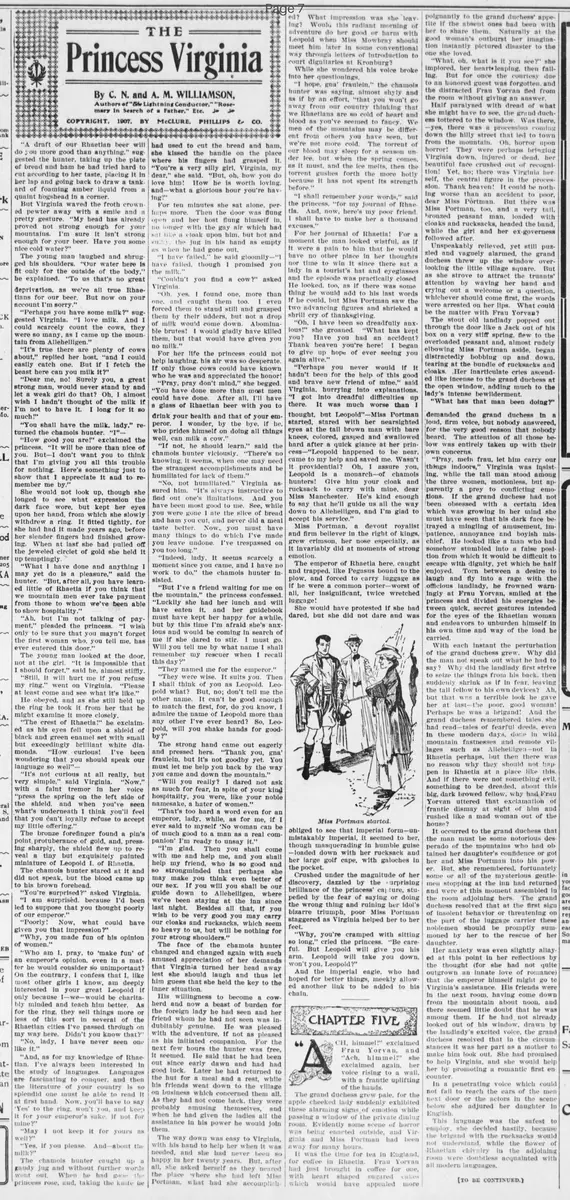
"A draft of our Rhaetian beer will do you more good than anything," suggested the hunter, taking up the plate of bread and ham he had tried hard to cut according to her taste, placing it in her lap and going back to draw a tankard of foaming amber liquid from a quaint hogshead in a corner.
But Virginia waved the froth-crowned pewter away with a smile and a pretty gesture. "My head has already proved not strong enough for your mountains. I'm sure it isn't strong enough for your beer. Have you some nice cold water?"
The young man laughed and shrugged his shoulders. "Our water here is fit only for the outside of the body," he explained. "To us that's no great deprivation, as we're all true Rhaetians for our beer. But now on your account I'm sorry."
"Perhaps you have some milk?" suggested Virginia. "I love milk. And I could scarcely count the cows, they were so many, as I came up the mountain from Alleheiligen."
"It's true there are plenty of cows about," replied her host, "and I could easily catch one. But if I fetch the beast here can you milk it?"
"Dear me, no! Surely you, a great strong man, would never stand by and let a weak girl do that? Oh, I almost wish I hadn't thought of the milk if I'm not to have it. I long for it so much!"
"You shall have the milk, lady," returned the chamois hunter. "I"—
"How good you are!" exclaimed the princess. "It will be more than nice of you. But—I don't want you to think that I'm giving you all this trouble for nothing. Here's something just to show that I appreciate it and to remember me by."
She would not look up, though she longed to see what expression the dark face wore, but kept her eyes upon her hand, from which she slowly withdrew a ring. It fitted tightly, for she had had it made years ago, before her slender fingers had finished growing. When at last she had pulled off the jeweled circlet of gold she held it up temptingly.
"What I have done and anything I may yet do is a pleasure," said the hunter. "But, after all, you have learned little of Rhaetia if you think that we mountain men ever take payment from those to whom we've been able to show hospitality."
"Ah, but I'm not talking of payment," pleaded the princess. "I wish only to be sure that you mayn't forget the first woman who, you tell me, has ever entered this door."
The young man looked at the door, not at the girl. "It is impossible that I should forget," said he, almost stiffly. Still, it will hurt me if you refuse my ring," went on Virginia. "Please at least come and see what it's like."
He obeyed, and as she still held up the ring he took it from her that he might examine it more closely.
"The crest of Rhaetia!" he exclaimed as his eyes fell upon a shield of black and green enamel set with small but exceedingly brilliant white diamonds.
"How curious! I've been wondering that you should speak our language so well"
"It's not curious at all really, but very simple," said Virginia. "Now," with a faint tremor in her voice "press the spring on the left side of the shield, and when you've seen what's underneath I think you'll feel that you can't loyally refuse to accept my little offering."
The bronze forefinger found a pin's point protuberance of gold, and, pressing sharply, the shield flew up to reveal a tiny but exquisitely painted miniature of Leopold I. of Rhaetia.
The chamois hunter stared at it and did not speak, but the blood came up to his brown forehead
"You're surprised?" asked Virginia.
"I am surprised, because I'd been led to suppose that you thought poorly of our emperor."
"Poorly! Now, what could have given you that impression?"
"Why, you made fun of his opinion of women."
"Who am I, pray, to 'make fun' of an emperor's opinion, even in a matter he would consider so unimportant? On the contrary, I confess that I, like most other girls I know, am deeply interested in your great Leopold if only because I—we—would be charitably minded and teach him better. As for the ring, they sell things more or less of this sort in several of the Rhaetian cities I've passed through on my way here. Didn't you know that?"
"No, lady, I have never seen one like it."
"And, as for my knowledge of Rhaetia, I've always been interested in the study of languages. Languages are fascinating to conquer, and then the literature of your country is so splendid one must be able to read it at first hand. Now, you'll have to say 'Yes' to the ring, won't you, and keep it for your emperor's sake, if not for mine?"
"May I not keep it for yours as well?"
"Yes, if you please. And—about the milk?"
The chamois hunter caught up a gaudy jug and without further words went out. When he had gone the princess rose, and, taking the knife he had used to cut the bread and ham, she kissed the handle on the place where his fingers had grasped it.
"You're a very silly girl, Virginia, my dear," she said. "But, oh, how you do love him! How he is worth loving and—what a glorious hour you're having!"
For ten minutes she sat alone, perhaps more. Then the door was flung open and her host flung himself in, no longer with the gay air which had sat like a cloak upon him, but hot and sullen, the jug in his hand as empty as when he had gone out
"I have failed," he said gloomily. "I have failed, though I promised you the milk."
"Couldn't you find a cow?" asked Virginia.
"Oh, yes, I found one, more than one, and caught them too. I even forced them to stand still and grasped them by their udders, but not a drop of milk would come down. Abominable brutes! I would gladly have killed them, but that would have given you no milk."
For her life the princess could not help laughing, his air was so desperate. If only those cows could have known who he was and appreciated the honor!
"Pray, pray don't mind," she begged. "You have done more than most men could have done. After all, I'll have a glass of Rhaetian beer with you to drink your health and that of your emperor. I wonder, by the bye, if he who prides himself on doing all things well, can milk a cow."
"If not, he should learn," said the chamois hunter viciously, "There's no knowing, it seems, when one may need the strangest accomplishments and be humiliated for lack of them."
"No, not humiliated," Virginia assured him. "It's always instructive to find out one's limitations. And you have been most good to me. See, while you were gone I ate the slice of bread and ham you cut, and never did a meal taste better. Now, you must have many things to do which I've made you leave undone. I've trespassed on you too long."
"Indeed, lady, it seems scarcely a moment since you came, and I have no work to do," the chamois hunter insisted.
"But I've a friend waiting for me on the mountain," the princess confessed "Luckily she had her lunch and will have eaten it, and her guidebook must have kept her happy for awhile, but by this time I'm afraid she's anxious and would be coming in search of me if she dared to stir. I must go. Will you tell me by what name I shall remember my rescuer when I recall this day?"
"They named me for the emperor."
"They were wise. It suits you. Then I shall think of you as Leopold. Leopold what? But, no; don't tell me the other name. It can't be good enough to match the first, for, do you know, I admire the name of Leopold more than any other I've ever heard? So, Leopold, will you shake hands for goodbye?"
The strong hand came out eagerly and pressed hers. "Thank you, gnäfraulein, but it's not goodbye yet. You must let me help you back by the way you came and down the mountain."
"Will you really? I dared not ask as much for fear, in spite of your kind hospitality, you were, like your noble namesake, a hater of women."
"That's too hard a word even for an emperor, lady, while, as for me, if I ever said to myself 'No woman can be of much good to a man as a real companion' I'm ready to unsay it."
"I'm glad. Then you shall come with me and help me, and you shall help my friend, who is so good and so strongminded that perhaps she may make you think even better of our sex. If you will you shall be our guide down to Alleheiligen, where we've been staying at the inn since last night. Besides all that, if you wish to be very good you may carry our cloaks and rucksacks, which seem so heavy to us, but will be nothing for your strong shoulders."
The face of the chamois hunter changed and changed again with such amused appreciation of her demands that Virginia turned her head away lest she should laugh and thus let him guess that she held the key to the inner situation.
His willingness to become a cowherd and now a beast of burden for the foreign lady he had seen and her friend whom he had not seen was indubitably genuine. He was pleased with the adventure, if not as pleased as his initiated companion. For the next few hours the hunter was free, It seemed. He said that he had been out since early dawn and had had good luck. Later he had returned to the hut for a meal and a rest, while his friends went down to the village on business which concerned them all. As they had not come back, they were probably amusing themselves, and when he had given the ladies all the assistance in his power he would join them.
The way down was easy to Virginia, with his hand to help her when it was needed, and she had never been so happy in her twenty years. But, after all, she asked herself as they neared the place where she had left Miss Portman, what had she accomplished? What impression was she leaving? Would this radiant morning of adventure do her good or harm with Leopold when Miss Mowbray should meet him later in some conventional way through letters of introduction to court dignitaries at Kronburg?
While she wondered his voice broke into her questionings
"I hope, gnäfraulein," the chamois hunter was saying, almost shyly and as if by an effort, "that you won't go away from our country thinking that we Rhaetians are so cold of heart and blood as you've seemed to fancy. We men of the mountains may be different from others you have seen, but we're not more cold. The torrent of our blood may sleep for a season under ice, but when the spring comes, as it must, and the ice melts, then the torrent gushes forth the more hotly because it has not spent its strength before."
"I shall remember your words," said the princess, "for my journal of Rhaetia. And, now, here's my poor friend. I shall have to make her a thousand excuses."
For her journal of Rhaetia! For a moment the man looked wistful, as if it were a pain to him that he would have no other place in her thoughts nor time to win it since there sat a lady in a tourist's hat and eyeglasses and the episode was practically closed He looked, too, as if there was something he would add to his last words if he could, but Miss Portman saw the two advancing figures and shrieked a shrill cry of thanksgiving.
"Oh, I have been so dreadfully anxious!" she groaned. "What has kept you? Have you had an accident? Thank heaven you're here! I began to give up hope of ever seeing you again alive."
"Perhaps you never would if it hadn't been for the help of this good and brave new friend of mine," said Virginia, hurrying into explanations. "I got into dreadful difficulties up there. It was much worse than I thought, but Leopold"—Miss Portman started, stared with her nearsighted eyes at the tall brown man with bare knees, colored, gasped and swallowed hard after a quick glance at her princess—"Leopold happened to be near, came to my help and saved me. Wasn't it providential? Oh, I assure you, Leopold is a monarch-of chamois hunters! Give him your cloak and rucksack to carry with mine, dear Miss Manchester. He's kind enough to say that he'll guide us all the way down to Alleheiligen, and I'm glad to accept his service."
Miss Portman, a devout royalist and firm believer in the right of kings, grew crimson, her nose especially, as it invariably did at moments of strong emotion.
The emperor of Rhaetia here, caught and trapped, like Pegasus bound to the plow, and forced to carry luggage as if he were a common porter—worst of all, her insignificant, twice wretched luggage!
She would have protested if she had dared, but she did not dare and was obliged to see that imperial form—unmistakably imperial, it seemed to her, though masquerading in humble guise —loaded down with her rucksack and her large golf cape, with galoshes in the pocket.
Crushed under the magnitude of her discovery, dazzled by the surprising brilliance of the princess' culture, stupefied by the fear of saying or doing the wrong thing and ruining her idol's bizarre triumph, poor Miss Portman staggered as Virginia helped her to her feet.
"Why, you're cramped with sitting so long," cried the princess. "Be careful. But Leopold will give you his arm. Leopold will take you down, won't you, Leopold?"
And the imperial eagle, who had hoped for better things, meekly allowed another link to be added to his chain.
CHAPTER FIVE
"Ach, himmel!" exclaimed Frau Yorvan, and "Ach, himmel!" she exclaimed again, her voice rising to a wail, with a frantic uplifting of the hands.
The grand duchess grew pale, for the apple-cheeked lady suddenly exhibited these alarming signs of emotion while passing a window of the private dining room. Evidently some scene of horror was being enacted outside, and Virginia and Miss Portman had been away for many hours.
It was the time for tea in England, for coffee in Rhaetia Frau Yorvan had just brought in coffee for one, with heart-shaped sugared cakes which would poignantly to the grand duchess' appetite if the absent ones had been with her to share them. Naturally at the good woman's outburst her imagination instantly pictured disaster to the one she loved.
"What, oh, what is it you see?" she implored, her heart leaping, then falling. But for once the courtesy due to an honored guest was forgotten, and the distracted Frau Yorvan fled from the room without giving an answer.
Half paralyzed with dread of what she might have to see, the grand duchess tottered to the window. Was there,—yes, there was a procession coming down the hilly street that led to town from the mountain. Oh, horror upon horror! They were perhaps bringing Virginia down, injured or dead, her beautiful face crushed out of recognition! Yet, no; there was Virginia herself, the central figure in the procession. Thank heaven! It could be nothing worse than an accident to poor, dear Miss Portman. But there was Miss Portman, too, and a very tall, bronzed peasant man, loaded with cloaks and rucksacks, headed the band, while the girl and her ex-governess followed after.
Unspeakably relieved, yet still puzzled and vaguely alarmed, the grand duchess threw up the window overlooking the little village square. But as she strove to attract the truants' attention by waving her hand and crying out a welcome or a question, whichever should come first, the words were arrested on her lips. What could be the matter with Frau Yorvan?
The stout old landlady popped out through the door like a Jack out of his box on a very stiff spring, flew to the overloaded peasant and, almost rudely elbowing Miss Portman aside, began distractedly bobbing up and down, tearing at the bundle of rucksacks and cloaks. Her inarticulate cries ascended like incense to the grand duchess at the open window, adding much to the lady's intense bewilderment
"What has that man been doing?" demanded the grand duchess, in a loud, firm voice, but nobody answered for the very good reason that nobody heard. The attention of all those below was entirely taken up with their own concerns.
"Pray, mein frau, let him carry our things indoors," Virginia was insisting, while the tall man stood among the three women, motionless, but apparently a prey to conflicting emotions. If the grand duchess had not been obsessed with a certain idea which was growing in her mind she must have seen that his dark face betrayed a mingling of amusement, impatience, annoyance and boyish mischief. He looked like a man who had somehow stumbled into a false position from which it would be difficult to escape with dignity, yet which he half enjoyed. Torn between a desire to laugh and fly into a rage with the officious landlady, he frowned warningly at Frau Yorvan, smiled at the princess and divided his energies between quick, secret gestures intended for the eyes of the Rhaetian woman and endeavors to unburden himself in his own time and way of the load he carried.
With each instant the perturbation of the grand duchess grew. Why did the man not speak out what he had to say? Why did the landlady first strive to seize the things from his back, then suddenly shrink as if in fear, leaving the tall fellow to his own devices? Ah, but that was a terrible look he gave her at last—the poor, good woman! Perhaps he was a brigand! And the grand duchess remembered tales, she had read—tales of fearful deeds, even in these modern days, done in wild mountain fastnesses and remote villages such as Alleheiligen—not in Rhaetia perhaps, but then there was no reason why they should not happen in Rhaetia at a place like this.
And if there were not something evil, something to be dreaded, about this big, dark-browed fellow, why had Frau Yorvan uttered that exclamation of frantic dismay at sight of him and rushed like a mad woman out of the house?
It occurred to the grand duchess that the man must be some notorious desperado of the mountains who had obtained her daughter's confidence or got her and Miss Portman into his power. But, she remembered, fortunately some or all of the mysterious gentlemen stopping at the inn had returned and were at this moment assembled in the room adjoining hers. The grand duchess resolved that at the first sign of insolent behavior or threatening on the part of the luggage carrier these noblemen should be promptly summoned by her to the rescue of her daughter.
Her anxiety was even slightly allayed at this point in her reflections by the thought (for she had not quite outgrown an innate love of romance) that the emperor himself might go to Virginia's assistance. His friends were in the next room, having come down from the mountain about noon, and there seemed little doubt that he was among them. If he had not already looked out of his window, drawn by the landlady's excited voice, the grand duchess resolved that in the circumstances it was her part as a mother to make him look out. She had promised to help Virginia, and she would help her by promoting a romantic first encounter.
In a penetrating voice which could not fail to reach the ears of the men next door or the actors in the scene below she adjured her daughter in English.
This language was the safest to employ, she decided hastily, because the brigand with the rucksacks would not understand, while the flower of Rhaetian chivalry in the adjoining room were doubtless acquainted with all modern languages.
[To be continued.]
Virginia
copyright.
1907.
"A draft of our Rhaetian beer will do you more good than anything," suggested the hunter, taking up the plate of bread and ham he had tried hard to cut according to her taste, placing it in her lap and going back to draw a tankard of foaming amber liquid from a quaint hogshead in a corner.
But Virginia waved the froth-crowned pewter away with a smile and a pretty gesture. "My head has already proved not strong enough for your mountains. I'm sure it isn't strong enough for your beer. Have you some nice cold water?"
The young man laughed and shrugged his shoulders. "Our water here is fit only for the outside of the body," he explained. "To us that's no great deprivation, as we're all true Rhaetians for our beer. But now on your account I'm sorry."
"Perhaps you have some milk?" suggested Virginia. "I love milk. And I could scarcely count the cows, they were so many, as I came up the mountain from Alleheiligen."
"It's true there are plenty of cows about," replied her host, "and I could easily catch one. But if I fetch the beast here can you milk it?"
"Dear me, no! Surely you, a great strong man, would never stand by and let a weak girl do that? Oh, I almost wish I hadn't thought of the milk if I'm not to have it. I long for it so much!"
"You shall have the milk, lady," returned the chamois hunter. "I"—
"How good you are!" exclaimed the princess. "It will be more than nice of you. But—I don't want you to think that I'm giving you all this trouble for nothing. Here's something just to show that I appreciate it and to remember me by."
She would not look up, though she longed to see what expression the dark face wore, but kept her eyes upon her hand, from which she slowly withdrew a ring. It fitted tightly, for she had had it made years ago, before her slender fingers had finished growing. When at last she had pulled off the jeweled circlet of gold she held it up temptingly.
"What I have done and anything I may yet do is a pleasure," said the hunter. "But, after all, you have learned little of Rhaetia if you think that we mountain men ever take payment from those to whom we've been able to show hospitality."
"Ah, but I'm not talking of payment," pleaded the princess. "I wish only to be sure that you mayn't forget the first woman who, you tell me, has ever entered this door."
The young man looked at the door, not at the girl. "It is impossible that I should forget," said he, almost stiffly. Still, it will hurt me if you refuse my ring," went on Virginia. "Please at least come and see what it's like."
He obeyed, and as she still held up the ring he took it from her that he might examine it more closely.
"The crest of Rhaetia!" he exclaimed as his eyes fell upon a shield of black and green enamel set with small but exceedingly brilliant white diamonds.
"How curious! I've been wondering that you should speak our language so well"
"It's not curious at all really, but very simple," said Virginia. "Now," with a faint tremor in her voice "press the spring on the left side of the shield, and when you've seen what's underneath I think you'll feel that you can't loyally refuse to accept my little offering."
The bronze forefinger found a pin's point protuberance of gold, and, pressing sharply, the shield flew up to reveal a tiny but exquisitely painted miniature of Leopold I. of Rhaetia.
The chamois hunter stared at it and did not speak, but the blood came up to his brown forehead
"You're surprised?" asked Virginia.
"I am surprised, because I'd been led to suppose that you thought poorly of our emperor."
"Poorly! Now, what could have given you that impression?"
"Why, you made fun of his opinion of women."
"Who am I, pray, to 'make fun' of an emperor's opinion, even in a matter he would consider so unimportant? On the contrary, I confess that I, like most other girls I know, am deeply interested in your great Leopold if only because I—we—would be charitably minded and teach him better. As for the ring, they sell things more or less of this sort in several of the Rhaetian cities I've passed through on my way here. Didn't you know that?"
"No, lady, I have never seen one like it."
"And, as for my knowledge of Rhaetia, I've always been interested in the study of languages. Languages are fascinating to conquer, and then the literature of your country is so splendid one must be able to read it at first hand. Now, you'll have to say 'Yes' to the ring, won't you, and keep it for your emperor's sake, if not for mine?"
"May I not keep it for yours as well?"
"Yes, if you please. And—about the milk?"
The chamois hunter caught up a gaudy jug and without further words went out. When he had gone the princess rose, and, taking the knife he had used to cut the bread and ham, she kissed the handle on the place where his fingers had grasped it.
"You're a very silly girl, Virginia, my dear," she said. "But, oh, how you do love him! How he is worth loving and—what a glorious hour you're having!"
For ten minutes she sat alone, perhaps more. Then the door was flung open and her host flung himself in, no longer with the gay air which had sat like a cloak upon him, but hot and sullen, the jug in his hand as empty as when he had gone out
"I have failed," he said gloomily. "I have failed, though I promised you the milk."
"Couldn't you find a cow?" asked Virginia.
"Oh, yes, I found one, more than one, and caught them too. I even forced them to stand still and grasped them by their udders, but not a drop of milk would come down. Abominable brutes! I would gladly have killed them, but that would have given you no milk."
For her life the princess could not help laughing, his air was so desperate. If only those cows could have known who he was and appreciated the honor!
"Pray, pray don't mind," she begged. "You have done more than most men could have done. After all, I'll have a glass of Rhaetian beer with you to drink your health and that of your emperor. I wonder, by the bye, if he who prides himself on doing all things well, can milk a cow."
"If not, he should learn," said the chamois hunter viciously, "There's no knowing, it seems, when one may need the strangest accomplishments and be humiliated for lack of them."
"No, not humiliated," Virginia assured him. "It's always instructive to find out one's limitations. And you have been most good to me. See, while you were gone I ate the slice of bread and ham you cut, and never did a meal taste better. Now, you must have many things to do which I've made you leave undone. I've trespassed on you too long."
"Indeed, lady, it seems scarcely a moment since you came, and I have no work to do," the chamois hunter insisted.
"But I've a friend waiting for me on the mountain," the princess confessed "Luckily she had her lunch and will have eaten it, and her guidebook must have kept her happy for awhile, but by this time I'm afraid she's anxious and would be coming in search of me if she dared to stir. I must go. Will you tell me by what name I shall remember my rescuer when I recall this day?"
"They named me for the emperor."
"They were wise. It suits you. Then I shall think of you as Leopold. Leopold what? But, no; don't tell me the other name. It can't be good enough to match the first, for, do you know, I admire the name of Leopold more than any other I've ever heard? So, Leopold, will you shake hands for goodbye?"
The strong hand came out eagerly and pressed hers. "Thank you, gnäfraulein, but it's not goodbye yet. You must let me help you back by the way you came and down the mountain."
"Will you really? I dared not ask as much for fear, in spite of your kind hospitality, you were, like your noble namesake, a hater of women."
"That's too hard a word even for an emperor, lady, while, as for me, if I ever said to myself 'No woman can be of much good to a man as a real companion' I'm ready to unsay it."
"I'm glad. Then you shall come with me and help me, and you shall help my friend, who is so good and so strongminded that perhaps she may make you think even better of our sex. If you will you shall be our guide down to Alleheiligen, where we've been staying at the inn since last night. Besides all that, if you wish to be very good you may carry our cloaks and rucksacks, which seem so heavy to us, but will be nothing for your strong shoulders."
The face of the chamois hunter changed and changed again with such amused appreciation of her demands that Virginia turned her head away lest she should laugh and thus let him guess that she held the key to the inner situation.
His willingness to become a cowherd and now a beast of burden for the foreign lady he had seen and her friend whom he had not seen was indubitably genuine. He was pleased with the adventure, if not as pleased as his initiated companion. For the next few hours the hunter was free, It seemed. He said that he had been out since early dawn and had had good luck. Later he had returned to the hut for a meal and a rest, while his friends went down to the village on business which concerned them all. As they had not come back, they were probably amusing themselves, and when he had given the ladies all the assistance in his power he would join them.
The way down was easy to Virginia, with his hand to help her when it was needed, and she had never been so happy in her twenty years. But, after all, she asked herself as they neared the place where she had left Miss Portman, what had she accomplished? What impression was she leaving? Would this radiant morning of adventure do her good or harm with Leopold when Miss Mowbray should meet him later in some conventional way through letters of introduction to court dignitaries at Kronburg?
While she wondered his voice broke into her questionings
"I hope, gnäfraulein," the chamois hunter was saying, almost shyly and as if by an effort, "that you won't go away from our country thinking that we Rhaetians are so cold of heart and blood as you've seemed to fancy. We men of the mountains may be different from others you have seen, but we're not more cold. The torrent of our blood may sleep for a season under ice, but when the spring comes, as it must, and the ice melts, then the torrent gushes forth the more hotly because it has not spent its strength before."
"I shall remember your words," said the princess, "for my journal of Rhaetia. And, now, here's my poor friend. I shall have to make her a thousand excuses."
For her journal of Rhaetia! For a moment the man looked wistful, as if it were a pain to him that he would have no other place in her thoughts nor time to win it since there sat a lady in a tourist's hat and eyeglasses and the episode was practically closed He looked, too, as if there was something he would add to his last words if he could, but Miss Portman saw the two advancing figures and shrieked a shrill cry of thanksgiving.
"Oh, I have been so dreadfully anxious!" she groaned. "What has kept you? Have you had an accident? Thank heaven you're here! I began to give up hope of ever seeing you again alive."
"Perhaps you never would if it hadn't been for the help of this good and brave new friend of mine," said Virginia, hurrying into explanations. "I got into dreadful difficulties up there. It was much worse than I thought, but Leopold"—Miss Portman started, stared with her nearsighted eyes at the tall brown man with bare knees, colored, gasped and swallowed hard after a quick glance at her princess—"Leopold happened to be near, came to my help and saved me. Wasn't it providential? Oh, I assure you, Leopold is a monarch-of chamois hunters! Give him your cloak and rucksack to carry with mine, dear Miss Manchester. He's kind enough to say that he'll guide us all the way down to Alleheiligen, and I'm glad to accept his service."
Miss Portman, a devout royalist and firm believer in the right of kings, grew crimson, her nose especially, as it invariably did at moments of strong emotion.
The emperor of Rhaetia here, caught and trapped, like Pegasus bound to the plow, and forced to carry luggage as if he were a common porter—worst of all, her insignificant, twice wretched luggage!
She would have protested if she had dared, but she did not dare and was obliged to see that imperial form—unmistakably imperial, it seemed to her, though masquerading in humble guise —loaded down with her rucksack and her large golf cape, with galoshes in the pocket.
Crushed under the magnitude of her discovery, dazzled by the surprising brilliance of the princess' culture, stupefied by the fear of saying or doing the wrong thing and ruining her idol's bizarre triumph, poor Miss Portman staggered as Virginia helped her to her feet.
"Why, you're cramped with sitting so long," cried the princess. "Be careful. But Leopold will give you his arm. Leopold will take you down, won't you, Leopold?"
And the imperial eagle, who had hoped for better things, meekly allowed another link to be added to his chain.
CHAPTER FIVE
"Ach, himmel!" exclaimed Frau Yorvan, and "Ach, himmel!" she exclaimed again, her voice rising to a wail, with a frantic uplifting of the hands.
The grand duchess grew pale, for the apple-cheeked lady suddenly exhibited these alarming signs of emotion while passing a window of the private dining room. Evidently some scene of horror was being enacted outside, and Virginia and Miss Portman had been away for many hours.
It was the time for tea in England, for coffee in Rhaetia Frau Yorvan had just brought in coffee for one, with heart-shaped sugared cakes which would poignantly to the grand duchess' appetite if the absent ones had been with her to share them. Naturally at the good woman's outburst her imagination instantly pictured disaster to the one she loved.
"What, oh, what is it you see?" she implored, her heart leaping, then falling. But for once the courtesy due to an honored guest was forgotten, and the distracted Frau Yorvan fled from the room without giving an answer.
Half paralyzed with dread of what she might have to see, the grand duchess tottered to the window. Was there,—yes, there was a procession coming down the hilly street that led to town from the mountain. Oh, horror upon horror! They were perhaps bringing Virginia down, injured or dead, her beautiful face crushed out of recognition! Yet, no; there was Virginia herself, the central figure in the procession. Thank heaven! It could be nothing worse than an accident to poor, dear Miss Portman. But there was Miss Portman, too, and a very tall, bronzed peasant man, loaded with cloaks and rucksacks, headed the band, while the girl and her ex-governess followed after.
Unspeakably relieved, yet still puzzled and vaguely alarmed, the grand duchess threw up the window overlooking the little village square. But as she strove to attract the truants' attention by waving her hand and crying out a welcome or a question, whichever should come first, the words were arrested on her lips. What could be the matter with Frau Yorvan?
The stout old landlady popped out through the door like a Jack out of his box on a very stiff spring, flew to the overloaded peasant and, almost rudely elbowing Miss Portman aside, began distractedly bobbing up and down, tearing at the bundle of rucksacks and cloaks. Her inarticulate cries ascended like incense to the grand duchess at the open window, adding much to the lady's intense bewilderment
"What has that man been doing?" demanded the grand duchess, in a loud, firm voice, but nobody answered for the very good reason that nobody heard. The attention of all those below was entirely taken up with their own concerns.
"Pray, mein frau, let him carry our things indoors," Virginia was insisting, while the tall man stood among the three women, motionless, but apparently a prey to conflicting emotions. If the grand duchess had not been obsessed with a certain idea which was growing in her mind she must have seen that his dark face betrayed a mingling of amusement, impatience, annoyance and boyish mischief. He looked like a man who had somehow stumbled into a false position from which it would be difficult to escape with dignity, yet which he half enjoyed. Torn between a desire to laugh and fly into a rage with the officious landlady, he frowned warningly at Frau Yorvan, smiled at the princess and divided his energies between quick, secret gestures intended for the eyes of the Rhaetian woman and endeavors to unburden himself in his own time and way of the load he carried.
With each instant the perturbation of the grand duchess grew. Why did the man not speak out what he had to say? Why did the landlady first strive to seize the things from his back, then suddenly shrink as if in fear, leaving the tall fellow to his own devices? Ah, but that was a terrible look he gave her at last—the poor, good woman! Perhaps he was a brigand! And the grand duchess remembered tales, she had read—tales of fearful deeds, even in these modern days, done in wild mountain fastnesses and remote villages such as Alleheiligen—not in Rhaetia perhaps, but then there was no reason why they should not happen in Rhaetia at a place like this.
And if there were not something evil, something to be dreaded, about this big, dark-browed fellow, why had Frau Yorvan uttered that exclamation of frantic dismay at sight of him and rushed like a mad woman out of the house?
It occurred to the grand duchess that the man must be some notorious desperado of the mountains who had obtained her daughter's confidence or got her and Miss Portman into his power. But, she remembered, fortunately some or all of the mysterious gentlemen stopping at the inn had returned and were at this moment assembled in the room adjoining hers. The grand duchess resolved that at the first sign of insolent behavior or threatening on the part of the luggage carrier these noblemen should be promptly summoned by her to the rescue of her daughter.
Her anxiety was even slightly allayed at this point in her reflections by the thought (for she had not quite outgrown an innate love of romance) that the emperor himself might go to Virginia's assistance. His friends were in the next room, having come down from the mountain about noon, and there seemed little doubt that he was among them. If he had not already looked out of his window, drawn by the landlady's excited voice, the grand duchess resolved that in the circumstances it was her part as a mother to make him look out. She had promised to help Virginia, and she would help her by promoting a romantic first encounter.
In a penetrating voice which could not fail to reach the ears of the men next door or the actors in the scene below she adjured her daughter in English.
This language was the safest to employ, she decided hastily, because the brigand with the rucksacks would not understand, while the flower of Rhaetian chivalry in the adjoining room were doubtless acquainted with all modern languages.
[To be continued.]
What sub-type of article is it?
Prose Fiction
What themes does it cover?
Love Romance
Political
Social Manners
What keywords are associated?
Princess Virginia
Emperor Leopold
Chamois Hunter
Rhaetia
Disguise
Romance
Milk Incident
Mountain Adventure
Literary Details
Title
Princess Virginia
Key Lines
"You're A Very Silly Girl, Virginia, My Dear," She Said. "But, Oh, How You Do Love Him! How He Is Worth Loving And—What A Glorious Hour You're Having!"
"I Hope, Gnäfraulein," The Chamois Hunter Was Saying, Almost Shyly And As If By An Effort, "That You Won't Go Away From Our Country Thinking That We Rhaetians Are So Cold Of Heart And Blood As You've Seemed To Fancy."
"The Emperor Of Rhaetia Here, Caught And Trapped, Like Pegasus Bound To The Plow, And Forced To Carry Luggage As If He Were A Common Porter—Worst Of All, Her Insignificant, Twice Wretched Luggage!"