Thank you for visiting SNEWPapers!
Sign up free
The Daily Worker
Chicago, Cook County, Illinois
What is this article about?
In Paterson, NJ, silk workers face irregular employment, with many mills closing seasonally. Government data shows low stability, often below 85%. The National Textile Workers' Union demands a 40-hour week, end to night and child labor, and fights capitalist exploitation.
Clipping
OCR Quality
Full Text
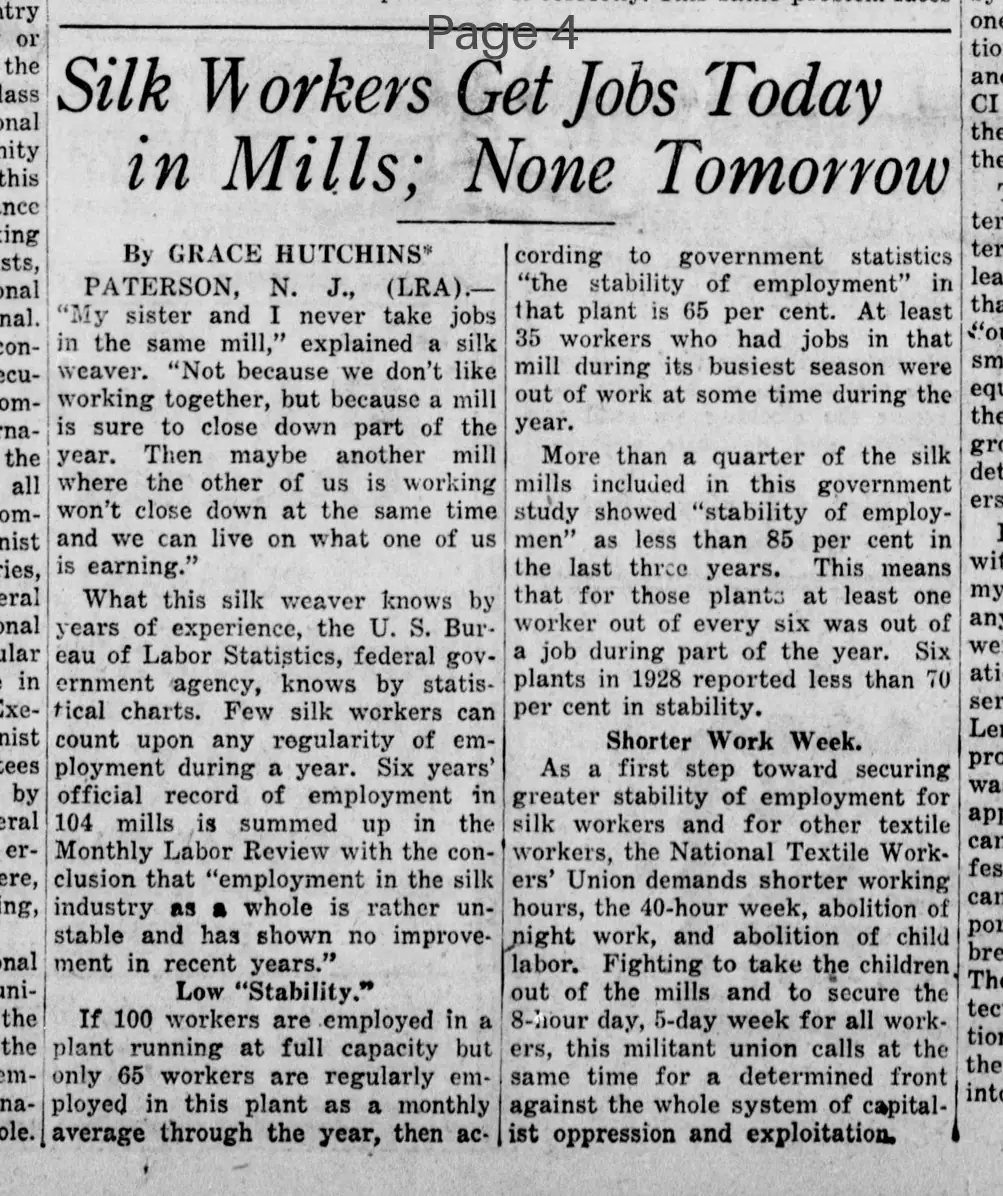
By GRACE HUTCHINS
PATERSON, N. J., (LRA).-
"My sister and I never take jobs in the same mill," explained a silk weaver. "Not because we don't like working together, but because a mill is sure to close down part of the year. Then maybe another mill where the other of us is working won't close down at the same time and we can live on what one of us is earning."
What this silk weaver knows by years of experience, the U. S. Bureau of Labor Statistics, federal government agency, knows by statistical charts. Few silk workers can count upon any regularity of employment during a year. Six years' official record of employment in 104 mills is summed up in the Monthly Labor Review with the conclusion that "employment in the silk industry as a whole is rather unstable and has shown no improvement in recent years."
Low "Stability."
If 100 workers are employed in a plant running at full capacity but only 65 workers are regularly employed in this plant as a monthly average through the year, then according to government statistics "the stability of employment" in that plant is 65 per cent. At least 35 workers who had jobs in that mill during its busiest season were out of work at some time during the year.
More than a quarter of the silk mills included in this government study showed "stability of employment" as less than 85 per cent in the last three years. This means that for those plants at least one worker out of every six was out of a job during part of the year. Six plants in 1928 reported less than 70 per cent in stability.
Shorter Work Week.
As a first step toward securing greater stability of employment for silk workers and for other textile workers, the National Textile Workers' Union demands shorter working hours, the 40-hour week, abolition of night work, and abolition of child labor. Fighting to take the children out of the mills and to secure the 8-hour day, 5-day week for all workers, this militant union calls at the same time for a determined front against the whole system of capitalist oppression and exploitation.
What sub-type of article is it?
What keywords are associated?
What entities or persons were involved?
Where did it happen?
Domestic News Details
Primary Location
Paterson, N. J.
Key Persons
Outcome
employment stability below 85% in over a quarter of silk mills; at least one in six workers unemployed part of the year; union demands 40-hour week, end to night and child labor.
Event Details
Silk workers in Paterson experience irregular employment due to seasonal mill closures. U.S. Bureau of Labor Statistics reports unstable employment in 104 mills over six years, with no improvement. National Textile Workers' Union seeks shorter hours and fights exploitation.