Thank you for visiting SNEWPapers!
Sign up free
Virginia Argus
Richmond, Virginia
What is this article about?
Commentary from Cobbett's Political Register on the fall of Napoleon, restoration of the Bourbons in France, and reflections on the French Revolution's gains, criticizing aristocratic triumph and Napoleon's betrayal of republican ideals.
Clipping
OCR Quality
Full Text
TRIUMPH OF THE ARISTOCRATS.
TREATMENT OF NAPOLEON.
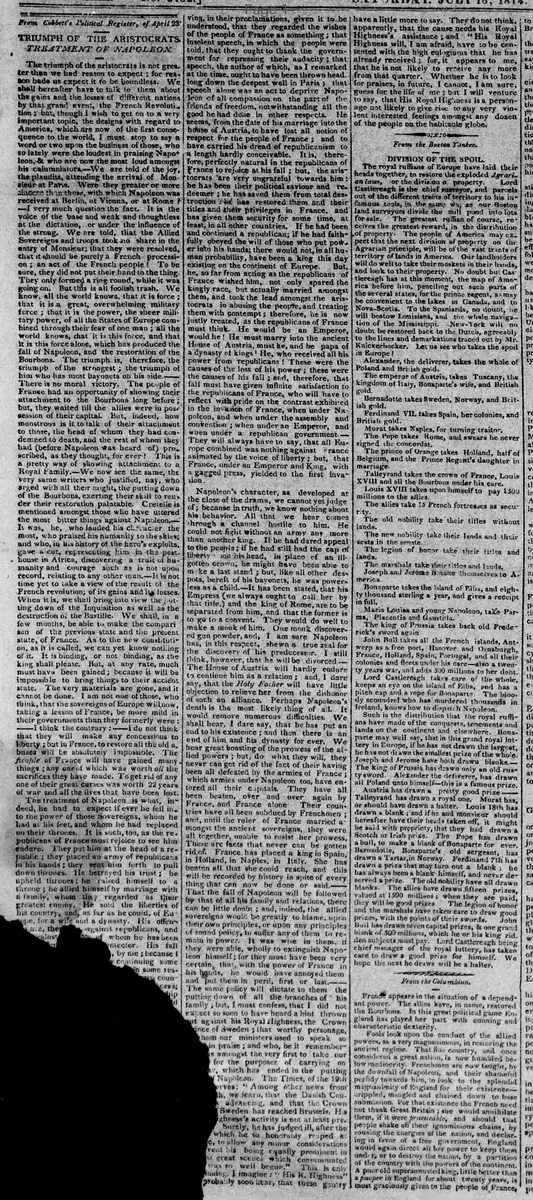
The triumph of the aristocrats is not greater than we had reason to expect; for reason bade us expect it to be boundless. We shall hereafter have to talk to them about the gains and the losses of different nations by that grand event, the French Revolution; but, though I wish to get on to a very important topic, the designs with regard to America, which are now of the first consequence to the world, I must stop to say a word or two upon the business of those, who so lately were the loudest in praising Napoleon, & who are now the most loud amongst his calumniators. We are told of the joy, the plaudits, attending the arrival of Monsieur at Paris. Were they greater or more sincere than those, with which Napoleon was received at Berlin, at Vienna, or at Rome? I very much question the fact. It is the voice of the base and weak and thoughtless at the dictation, or under the influence of the strong. We are told, that the Allied Sovereigns and troops took no share in the entry of Monsieur; that they were resolved, that it should be purely a French procession; an act of the French people! To be sure, they did not put their hand to the thing. They only formed a ring round, while it was going on. But this is all foolish trash. We know, all the world knows, that it is force; that it is a great, overwhelming military force; that it is the power, the sheer military power, of all the States of Europe combined through their fear of one man; all the world knows, that it is this force, and that it is this force alone, which has produced the fall of Napoleon, and the restoration of the Bourbons. The triumph is, therefore, the triumph of the strongest; the triumph of him who has most bayonets on his side. There is no moral victory. The people of France had an opportunity of showing their attachment to the Bourbons long before; but, they waited till the allies were in possession of their capital. But, indeed, how monstrous is it to talk of their attachment to those, the head of whom they had condemned to death, and the rest of whom they had (before Napoleon was heard of) proscribed, as they thought, for ever! This is a pretty way of showing attachment to a Royal Family. We now see the same, the very same writers who justified, nay, who urged with all their might, the putting down of the Bourbons, exerting their skill to render their restoration palatable. Cretelle is mentioned amongst those who have uttered the most bitter things against Napoleon. It was, he, who lauded his character the most, who praised his humanity to the skies; and who, in his history of the hero's exploits, gave a cut, representing him in the pest house in Africa, discovering a trait of humanity and courage such as is not upon record, relating to any other man. It is not time yet to take a view of the result of the French revolution; of its gains and its losses. When it is, we shall bring into view the putting down of the Inquisition as well as the destruction of the Bastille. We shall, in a few months, be able to make the comparison of the previous state and the present state, of France. As to the new constitution, as it is called, we can yet know nothing of it. It is binding, or not binding, as the king shall please. But, at any rate, much must have been gained; because it will be impossible to bring things to their ancient state. The very materials are gone, and it cannot be done. I am not one of those, who think, that the sovereigns of Europe will now, taking a lesson of France, be more mild in their governments than they formerly were: I think the contrary: I do not think that they will make any concessions to liberty; but in France, to restore all the old abuses will be absolutely impossible. The people of France will have gained many things; any one of which was worth all the sacrifices they have made. To get rid of any one of their great curses was worth 22 years of war and all the lives that have been lost. The treatment of Napoleon is what, indeed, he had to expect if ever he fell into the power of those Sovereigns, whom he had at his feet, and whom he had replaced on their thrones. It is such, too, as the republicans of France must rejoice to see him endure. They put him at the head of a republic; they placed an army of republicans in his hands; they sent him forth to pull down thrones. He betrayed his trust; he upheld thrones: he raised himself to a throne; he allied himself by marriage with a family, whom they regarded as their greatest enemy. He sold the liberties of his country, and, as far as he could, of Europe, for a wife and a dynasty. His offences against republicans, and whom he has been elector, his fall by five; because I continuing some in some jes- wa couu Cers; 1D
Having, in their proclamations, given it to be understood, that they regarded the wishes of the people of France as something; that insolent speech, in which the people were told, that they ought to thank the government for repressing their audacity: that speech, the author of which, as I remarked at the time, ought to have been thrown headlong down the deepest well in Paris; that speech alone was an act to deprive Napoleon of all compassion on the part of the friends of freedom, notwithstanding all the good he had done in other respects. He seems, from the date of his marriage into the house of Austria, to have lost all portion of respect for the people of France; and to have carried his dread of republicanism to a length hardly conceivable. It is, therefore, perfectly natural in the republicans of France to rejoice at his fall; but, the aristocrats are very ungrateful towards him: he has been their political saviour and redeemer; he has saved them from total destruction and has restored them and their titles and their privileges in France, and has given them security for some time, at least, in all other countries. If he had been and continued a republican; if he had faithfully obeyed the will of those who put power into his hands; there would not, in all human probability, have been a king this day existing on the continent of Europe. But, he, so far from acting as the republicans of France wished him, not only spared the kingly race, but actually married amongst them, and took the lead amongst the aristocrats in abusing the people, and treating them with contempt; therefore, he is now justly treated, as the republicans of France must think. He would be an Emperor would he! He must marry into the ancient House of Austria, must he, and be papa of a dynasty of kings! He, who received all his power from republicans! These were the causes of the loss of his power; these were the causes of his fall; and, therefore, that fall must have given infinite satisfaction to the republicans of France, who will have to reflect with pride on the contrast exhibited in the invasion of France, when under Napoleon, and when under the assembly and convention; when under an Emperor, and when under a republican government. They will always have to say, that all Europe combined was nothing against France animated by the voice of liberty; but, that France, under an Emperor and King, with a gagged press, yielded to the first invasion. Napoleon's character, as developed at the close of the drama, we cannot yet judge of; because in truth, we know nothing about his behavior. All that we hear comes through a channel hostile to him. He could not fight without an army any more than another king. If he had dared appeal to the people; if he had still had the cap of liberty on his head, in place of an ill-gotten crown, he might have been able to make a last stand; but, like all other despots, bereft of his bayonets, he was powerless as a child. It has been stated, that his Empress (we always ought to call her by that title,) and the king of Rome, are to be separated from him, and that the former is to go to a convent. They would do well to make a monk of him. One monk discovered gun powder, and, I am sure Napoleon has, in this respect, shewn a true zeal for the discovery of his predecessor. I still think, however, that he will be divorced. The House of Austria will hardly endure to continue him as a relation; and, I dare say, that the Holy Father will have little objection to relieve her from the dishonor of such an alliance. Perhaps Napoleon's death is the most likely thing of all. It would remove numerous difficulties. We shall hear. I dare say, that he has put an end to his existence; and then there is an end of him and his dynasty for ever. We hear great boasting of the prowess of the allied powers; but, do what they will, they never can get rid of the fact of their having been all defeated by the armies of France; which armies under Napoleon too, have entered all their Capitals. They have all been beaten, over and over again by France, and France alone Their countries have all been subdued by Frenchmen; and, until the ruler of France married amongst the ancient sovereigns, they were all together, unable to resist her prowess. These are facts that never can be gotten rid of. France has placed a king in Spain, in Holland, in Naples, in Italy. She has beaten all that she could reach, and this will be recorded by history in spite of every thing that can now be done or said. That the fall of Napoleon will be followed by that of all his family and relations, there can be little doubt; and, indeed, the allied sovereigns would be greatly to blame, upon their own principles, or upon any principles of sound policy, to suffer any of them to remain in power. It was wise in them, if they were able, wholly to extinguish Napoleon himself; for they must have been very certain, that, with the power of France in his hands, he would have annoyed them and put them in peril, first or last. The same policy will dictate to them the putting down of all the branches of his family; but, I must confess, that I did not expect so soon to have heard a hint thrown out against his Royal Highness, the Crown Prince of Sweden; that worthy personage, whom our ministers used to speak so in praise; and who, be it remembered, is amongst the very first to take our money for the purpose of carrying on war, which has ended in the putting down of Napoleon. The Times, of the 19th observes: "Among other news from the north, we learn, that the Danish Convention is advancing, and that the Crown Prince of Sweden has reached Brussels. His Highness's activity is not at least pre. Surely, he has judged ill, after the glory which he so honorably reaped a. C, to allow any minor considerations veat his being equally prominent in st great scenes which consummated was so well begun." This is only moaning. I imagine: "His K. Highness" probably soon learn, that these gantry have a little more to say.
What sub-type of article is it?
What keywords are associated?
What entities or persons were involved?
Where did it happen?
Foreign News Details
Primary Location
France
Key Persons
Outcome
fall of napoleon and restoration of the bourbons through overwhelming military force of european allies; speculation on napoleon's treatment including possible divorce, exile, or death; gains for french people in ending old abuses despite aristocratic triumph.
Event Details
Opinion piece critiquing the aristocratic triumph in Napoleon's fall and Bourbon restoration as result of military force rather than popular will; discusses hypocrisy of former Napoleon supporters; reflects on French Revolution's irreversible gains like destruction of Bastille and Inquisition; analyzes Napoleon's betrayal of republican ideals through marriage to Austrian royalty and upholding thrones; speculates on his future treatment and family downfall; notes allied powers' past defeats by France.