Thank you for visiting SNEWPapers!
Sign up free
Literary
July 13, 1797
Gazette Of The United States, & Philadelphia Daily Advertiser
Philadelphia, Philadelphia County, Pennsylvania
What is this article about?
An essay from the Farmer's Weekly Museum by the Lay Preacher critiques the profanation of the Sabbath in both city and country, advocating for its observance through rest, domestic devotion, nature contemplation, reading moral literature, and social piety rather than work or vice.
Clipping
OCR Quality
72%
Good
Full Text
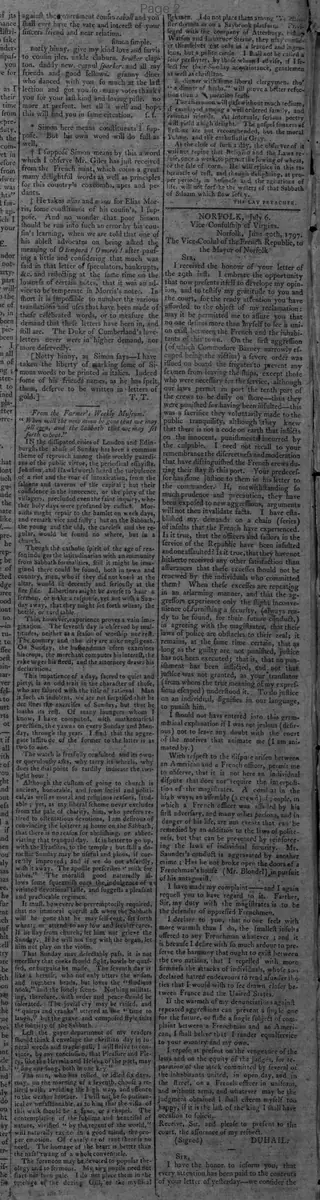
From the Farmer's Weekly Museum.
"When will the new moon be gone that we may sell corn, and the Sabbath that we may set forth wheat."
IN the dissipated cities of London and Edinburgh, the abuse of Sunday has been a common theme of reproach among those weekly guardians of the public virtue, the periodical essayists. Johnson and Hawkesworth heard the turbulence of a riot and the roar of intoxication, from the saloons and taverns of this capital; but their confidence in the innocence, or the piety of the villagers, precluded even the faint inquiry, whether holy days were profaned by rustics. Moralists might repair to the hamlet on week days, and remark vice and folly; but on the Sabbath, the young and the old, the careless and the regular, would be found no where, but in a church.
Though the catholic spirit of the age of reason indulges the latitudinarian with an immunity from Sabbath formalities, till it might be imagined there could be found, both in town and country, men, who if they did not kneel at the altar, would sit decently and seriously at the fire side. Libertines might be averse to hear a sermon, or make a response, yet not wish a Sunday away, that they might set forth wheat, the bottle, or card table.
This, however, experience proves a vain imagination. The seventh day is observed by multitudes, neither as a season of worship nor rest. The country and the city are alike negligent. On Sunday, the husbandman often examines his crops, the merchant computes his interest, the rake urges his steed, "and the attorney draws his declaration."
This impatience of a day sacred to quiet and piety, is an odd trait in the character of those, who are saluted with the title of rational Man is such an indolent, we are not surprised that he declines the exercises of Sunday, but. that he loaths its rest. Of many loungers whom I know, I have computed, with mathematical precision, the yawns on every Sunday and Monday, through the year. I find that the aggregate lasitude of the'former to the latter is as two to one.
The watch is fretfully consulted and its owner querulously asks, why tarry its wheels, why does the dial point so tardily indicate the twilight hour?
Although the custom of going to church is ancient, honorable, and from social and political, as well as moral and religious reasons, laudable; yet, as my liberal scheme never excludes from the pale of charity, him, who prefers retired to ostentatious devotions, I am desirous of convincing the loiterer at home on the Sabbath, that there is no reason for abolishing, or abbreviating that tranquil day. It is better to go up, with the Israelites, to the temple; but still a domestic Sunday may be useful and pious, if correctly improved; and if we do not absurdly, wish it away. The apostle prescribes "milk for babes." The moralist good naturedly allows some squeamish ones the indulgence of a vitiated devotional taste, and suggests a pleasant and practicable regimen.
It must, however, be peremptorily required, that no immoral querist ask when the Sabbath will be gone that he may sell corn, set forth wheat; or attend to any low and secular cares. If he stay from church, let him not grieve the Sunday. If he will not sing with the organ, let. him not play on the violin.
That Sunday may delectably pass, it is not necessary that cocks should fight, bowls be quaffed, or bargains be made. The seventh day is like a hermit, who not only utters the orison, and numbers beads, but loves the "studious nook," and the lonely scene. 'Nothing militating, therefore,.with order and peace should be tolerated. The jovial cry may be raised, and "quirps and cranks" uttered at he "time to laugh,?' but the grave and composed style-suits the sobriety of the Sabbath.
Lest the gayer department of my readers Should think I envelope the christian day in funeral weeds and tragie pall, I will strive to con vince. by my concluion, that Pleasure and Pie ty, like the Hermia and Helena of the poet, may "ing one ong, both in one key"
The man, who has toiled,, or idied ix days, may, on the morning of a seventh, choose a retired walk, avoiding the high wav, and offence to the weaker brother. I will not be o puritanical or unfashionable, as to hint that the vista of this walk should be a fane, or a chapel. The contemplation of the sublime and beautiful of nature, vivified "by the regent of the world," will naturally excite in a good mind, the pro per emotion. Of extay or of rant there is no need. The homage of the heart is better than the nafa! rwang of a whole conventicle.
The forenoon may be devoted to popular theology and to sermons. My airy pupils need not start nor turn pale. I do not place them in the tytelage of the dozing Gill, or the mytical Eckmen. I do not place them among 'Ve din fter divines dr on a Saybrook platform. Frivi leged with the company of Atterbury, bitho Waton and Laurevce Sterne, they may conid er themelves not only in a learned and ingen ious, but a polite circle. I Rhall not be cailed a our prebyter, by thoe whom I advie, if Ie tecl for their Sunday acauaintance, gentlemen as well as christiane.
A. dinner with fome liberal clergymen, the "a dinner of herbs, " u ill prove a beiter refec tioo than a poration feaft.
Theafternoon will pafswithout much tedium, if employed among a well ordered family, and rational iriends, At intervals, erious poetry will vield a high delight. The gopel onnets of Frkine are not recomimended, but the moral Yeung. and the enthuiaslie Gray.
At the cloe of uch a day, the oherver of it will not tepine that Weligion and the Laws re fuse, once a week, to pernit the owing of wheat, or the ale of corn. He will rejoice in this ta bernacle of ret, and rhough delighting, at pro ver periods, in busines and the agitations of life, will not forf ke the waters of that Sabbath of Sloam which flow oft y.
THE LAY PREACHER.
"When will the new moon be gone that we may sell corn, and the Sabbath that we may set forth wheat."
IN the dissipated cities of London and Edinburgh, the abuse of Sunday has been a common theme of reproach among those weekly guardians of the public virtue, the periodical essayists. Johnson and Hawkesworth heard the turbulence of a riot and the roar of intoxication, from the saloons and taverns of this capital; but their confidence in the innocence, or the piety of the villagers, precluded even the faint inquiry, whether holy days were profaned by rustics. Moralists might repair to the hamlet on week days, and remark vice and folly; but on the Sabbath, the young and the old, the careless and the regular, would be found no where, but in a church.
Though the catholic spirit of the age of reason indulges the latitudinarian with an immunity from Sabbath formalities, till it might be imagined there could be found, both in town and country, men, who if they did not kneel at the altar, would sit decently and seriously at the fire side. Libertines might be averse to hear a sermon, or make a response, yet not wish a Sunday away, that they might set forth wheat, the bottle, or card table.
This, however, experience proves a vain imagination. The seventh day is observed by multitudes, neither as a season of worship nor rest. The country and the city are alike negligent. On Sunday, the husbandman often examines his crops, the merchant computes his interest, the rake urges his steed, "and the attorney draws his declaration."
This impatience of a day sacred to quiet and piety, is an odd trait in the character of those, who are saluted with the title of rational Man is such an indolent, we are not surprised that he declines the exercises of Sunday, but. that he loaths its rest. Of many loungers whom I know, I have computed, with mathematical precision, the yawns on every Sunday and Monday, through the year. I find that the aggregate lasitude of the'former to the latter is as two to one.
The watch is fretfully consulted and its owner querulously asks, why tarry its wheels, why does the dial point so tardily indicate the twilight hour?
Although the custom of going to church is ancient, honorable, and from social and political, as well as moral and religious reasons, laudable; yet, as my liberal scheme never excludes from the pale of charity, him, who prefers retired to ostentatious devotions, I am desirous of convincing the loiterer at home on the Sabbath, that there is no reason for abolishing, or abbreviating that tranquil day. It is better to go up, with the Israelites, to the temple; but still a domestic Sunday may be useful and pious, if correctly improved; and if we do not absurdly, wish it away. The apostle prescribes "milk for babes." The moralist good naturedly allows some squeamish ones the indulgence of a vitiated devotional taste, and suggests a pleasant and practicable regimen.
It must, however, be peremptorily required, that no immoral querist ask when the Sabbath will be gone that he may sell corn, set forth wheat; or attend to any low and secular cares. If he stay from church, let him not grieve the Sunday. If he will not sing with the organ, let. him not play on the violin.
That Sunday may delectably pass, it is not necessary that cocks should fight, bowls be quaffed, or bargains be made. The seventh day is like a hermit, who not only utters the orison, and numbers beads, but loves the "studious nook," and the lonely scene. 'Nothing militating, therefore,.with order and peace should be tolerated. The jovial cry may be raised, and "quirps and cranks" uttered at he "time to laugh,?' but the grave and composed style-suits the sobriety of the Sabbath.
Lest the gayer department of my readers Should think I envelope the christian day in funeral weeds and tragie pall, I will strive to con vince. by my concluion, that Pleasure and Pie ty, like the Hermia and Helena of the poet, may "ing one ong, both in one key"
The man, who has toiled,, or idied ix days, may, on the morning of a seventh, choose a retired walk, avoiding the high wav, and offence to the weaker brother. I will not be o puritanical or unfashionable, as to hint that the vista of this walk should be a fane, or a chapel. The contemplation of the sublime and beautiful of nature, vivified "by the regent of the world," will naturally excite in a good mind, the pro per emotion. Of extay or of rant there is no need. The homage of the heart is better than the nafa! rwang of a whole conventicle.
The forenoon may be devoted to popular theology and to sermons. My airy pupils need not start nor turn pale. I do not place them in the tytelage of the dozing Gill, or the mytical Eckmen. I do not place them among 'Ve din fter divines dr on a Saybrook platform. Frivi leged with the company of Atterbury, bitho Waton and Laurevce Sterne, they may conid er themelves not only in a learned and ingen ious, but a polite circle. I Rhall not be cailed a our prebyter, by thoe whom I advie, if Ie tecl for their Sunday acauaintance, gentlemen as well as christiane.
A. dinner with fome liberal clergymen, the "a dinner of herbs, " u ill prove a beiter refec tioo than a poration feaft.
Theafternoon will pafswithout much tedium, if employed among a well ordered family, and rational iriends, At intervals, erious poetry will vield a high delight. The gopel onnets of Frkine are not recomimended, but the moral Yeung. and the enthuiaslie Gray.
At the cloe of uch a day, the oherver of it will not tepine that Weligion and the Laws re fuse, once a week, to pernit the owing of wheat, or the ale of corn. He will rejoice in this ta bernacle of ret, and rhough delighting, at pro ver periods, in busines and the agitations of life, will not forf ke the waters of that Sabbath of Sloam which flow oft y.
THE LAY PREACHER.
What sub-type of article is it?
Essay
What themes does it cover?
Religious
Moral Virtue
What keywords are associated?
Sabbath Observance
Moral Essay
Lay Preacher
Piety And Rest
Domestic Devotion
Religious Reflection
What entities or persons were involved?
The Lay Preacher
Literary Details
Title
The Lay Preacher.
Author
The Lay Preacher
Subject
On The Proper Observance Of The Sabbath
Form / Style
Moralistic Prose Essay
Key Lines
"When Will The New Moon Be Gone That We May Sell Corn, And The Sabbath That We May Set Forth Wheat."
The Seventh Day Is Observed By Multitudes, Neither As A Season Of Worship Nor Rest.
It Is Better To Go Up, With The Israelites, To The Temple; But Still A Domestic Sunday May Be Useful And Pious, If Correctly Improved;
Pleasure And Piety, Like The Hermia And Helena Of The Poet, May Sing One Song, Both In One Key