Thank you for visiting SNEWPapers!
Sign up free
Story
September 19, 1944
The Ypsilanti Daily Press
Ypsilanti, Washtenaw County, Michigan
What is this article about?
On September 19, President Roosevelt directs the budget bureau to plan demobilization of wartime government agencies, personnel reduction from 2.9 million to pre-war levels, and administrative simplification for peacetime, emphasizing careful transition post-victory.
Clipping
OCR Quality
98%
Excellent
Full Text
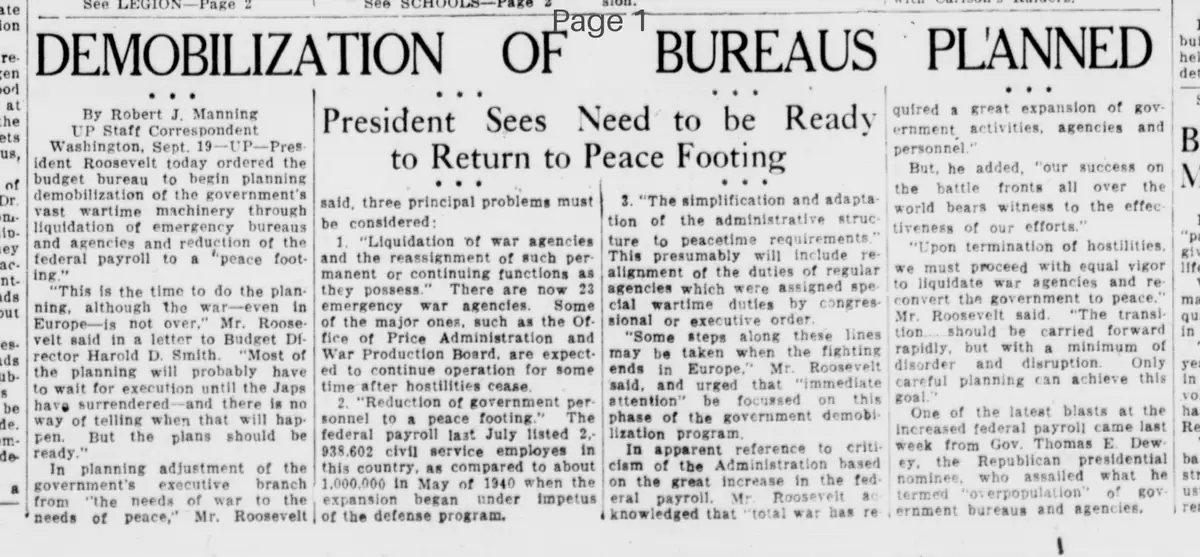
DEMOBILIZATION
By Robert J. Manning
Washington, Sept. 19—UP—President Roosevelt today ordered the budget bureau to begin planning demobilization of the government's vast wartime machinery through liquidation of emergency bureaus and agencies and reduction of the federal payroll to a "peace footing."
"This is the time to do the planning, although the war—even in Europe—is not over," Mr. Roosevelt said in a letter to Budget Director Harold D. Smith. "Most of the planning will probably have to wait for execution until the Japs have surrendered—and there is no way of telling when that will happen. But the plans should be ready."
In planning adjustment of the government's executive branch from the needs of war to the needs of peace, Mr. Roosevelt said, three principal problems must be considered:
1. "Liquidation of war agencies and the reassignment of such permanent or continuing functions as they possess."
There are now 23 emergency war agencies. Some of the major ones, such as the Office of Price Administration and War Production Board, are expected to continue operation for some time after hostilities cease.
2. "Reduction of government personnel to a peace footing."
The federal payroll last July listed 2,938,602 civil service employees in this country, as compared to about 1,000,000 in May of 1940 when the expansion began under impetus of the defense program.
3. "The simplification and adaptation of the administrative structure to peacetime requirements."
This presumably will include realignment of the duties of regular agencies which were assigned special wartime duties by congressional or executive order.
"Some steps along these lines may be taken when the fighting ends in Europe," Mr. Roosevelt said, and urged that "immediate attention" be focussed on this phase of the government demobilization program.
In apparent reference to criticism of the Administration based on the great increase in the federal payroll, Mr. Roosevelt acknowledged that total war has required a great expansion of government activities, agencies and personnel.
But, he added, "our success on the battle fronts all over the world bears witness to the effectiveness of our efforts."
"Upon termination of hostilities, we must proceed with equal vigor to liquidate war agencies and reconvert the government to peace." Mr. Roosevelt said. "The transition should be carried forward rapidly, but with a minimum of disorder and disruption. Only careful planning can achieve this goal."
One of the latest blasts at the increased federal payroll came last week from Gov. Thomas E. Dewey, the Republican presidential nominee, who assailed what he termed "overpopulation" of government bureaus and agencies.
By Robert J. Manning
Washington, Sept. 19—UP—President Roosevelt today ordered the budget bureau to begin planning demobilization of the government's vast wartime machinery through liquidation of emergency bureaus and agencies and reduction of the federal payroll to a "peace footing."
"This is the time to do the planning, although the war—even in Europe—is not over," Mr. Roosevelt said in a letter to Budget Director Harold D. Smith. "Most of the planning will probably have to wait for execution until the Japs have surrendered—and there is no way of telling when that will happen. But the plans should be ready."
In planning adjustment of the government's executive branch from the needs of war to the needs of peace, Mr. Roosevelt said, three principal problems must be considered:
1. "Liquidation of war agencies and the reassignment of such permanent or continuing functions as they possess."
There are now 23 emergency war agencies. Some of the major ones, such as the Office of Price Administration and War Production Board, are expected to continue operation for some time after hostilities cease.
2. "Reduction of government personnel to a peace footing."
The federal payroll last July listed 2,938,602 civil service employees in this country, as compared to about 1,000,000 in May of 1940 when the expansion began under impetus of the defense program.
3. "The simplification and adaptation of the administrative structure to peacetime requirements."
This presumably will include realignment of the duties of regular agencies which were assigned special wartime duties by congressional or executive order.
"Some steps along these lines may be taken when the fighting ends in Europe," Mr. Roosevelt said, and urged that "immediate attention" be focussed on this phase of the government demobilization program.
In apparent reference to criticism of the Administration based on the great increase in the federal payroll, Mr. Roosevelt acknowledged that total war has required a great expansion of government activities, agencies and personnel.
But, he added, "our success on the battle fronts all over the world bears witness to the effectiveness of our efforts."
"Upon termination of hostilities, we must proceed with equal vigor to liquidate war agencies and reconvert the government to peace." Mr. Roosevelt said. "The transition should be carried forward rapidly, but with a minimum of disorder and disruption. Only careful planning can achieve this goal."
One of the latest blasts at the increased federal payroll came last week from Gov. Thomas E. Dewey, the Republican presidential nominee, who assailed what he termed "overpopulation" of government bureaus and agencies.
What sub-type of article is it?
Historical Event
What themes does it cover?
Fortune Reversal
Triumph
What keywords are associated?
Demobilization
Wartime Agencies
Federal Payroll
Roosevelt Directive
Postwar Planning
What entities or persons were involved?
President Roosevelt
Harold D. Smith
Gov. Thomas E. Dewey
Where did it happen?
Washington
Story Details
Key Persons
President Roosevelt
Harold D. Smith
Gov. Thomas E. Dewey
Location
Washington
Event Date
Sept. 19
Story Details
President Roosevelt orders planning for government demobilization, including liquidation of 23 war agencies, reduction of federal payroll from 2,938,602 to about 1,000,000 employees, and administrative simplification for peacetime, in response to wartime expansion and amid criticism from Dewey.