Thank you for visiting SNEWPapers!
Sign up free
Pioneer And Democrat
Olympia, Thurston County, Washington
What is this article about?
Charles E. Weed, a quartermaster in Washington Territory's volunteer service, defends his supply management and accounting practices against criticisms in the Third Auditor's report by Mr. Atkinson. He explains bartering necessities due to lack of funds, surplus supplies for broader use, and humanitarian issuances during the Indian conflict.
Clipping
OCR Quality
Full Text
Editor Pioneer and Democrat:
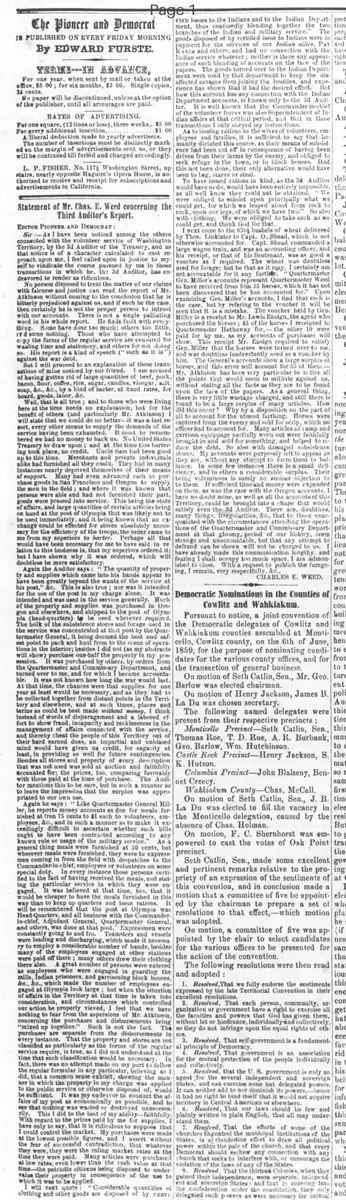
Sir:--As I have been noticed among the others connected with the volunteer service of Washington Territory, by the 3d Auditor of the Treasury, and as that notice is of a character calculated to cast reproach upon me, I feel called upon in justice to myself to vindicate the course pursued by me in those transactions in which he, the 3d Auditor, has endeavored to render as ridiculous.
No person disposed to treat the matter of our claims with fairness and justice can read the report of Mr. Atkinson without coming to the conclusion that he is bitterly prejudiced against us, and if such be the case, then certainly he is not the proper person to intrust with our accounts. There is not a single palliating word in his whole report. He finds fault with everything. Some have done too much; others too little, and some nothing. Those who have attempted to copy the forms of the regular service are censured for wasting time and stationery, and others for not doing so. His report is a kind of speech ("such as it is") against the war debt.
But I will proceed to an explanation of those transactions of mine noticed by our friend. I am accused of having gotten rid of large quantities of beef, pork, bacon, flour, coffee, rice, sugar, candles, vinegar, salt, soap, &c., &c., by a kind of barter, at fixed rates, for board, goods, labor, &c.
Well, that is all true; and to those who were living here at the time needs no explanation, but for the benefit of others (and particularly Mr. Atkinson) I will state that we could do no better--it was a last resort, every other means to supply the demands of the service having been exhausted. It must be remembered we had no money to back us. No United States Treasury to draw upon; and at the time this bartering took place, no credit. Uncle Sam had been good up to this time. Merchants and private individuals alike had furnished all they could. They had in many instances nearly deprived themselves of their means of support. Many had even advanced cash to purchase goods in San Francisco and Oregon to supply the men in the field; and where it was known that persons were able and had not furnished their part, goods were pressed into service. This being the state of affairs, and large quantities of certain articles being on hand at the post of Olympia that was likely not to be used immediately, and it being known that an exchange could be effected for stores absolutely necessary for the efficiency of the troops, the order came to me from my superiors to barter. Perhaps all that would have been necessary for me to have said in relation to this business is, that my superiors ordered it; but I have shown why it was ordered, which will doubtless be more satisfactory.
Again the Auditor says: "The quantity of property and supplies which came into his hands appear to have been greatly beyond the wants of the service at his post," &c. This is also true; nor was it intended for the use of the post in my charge alone. It was intended and was used in the service generally. Much of the property and supplies was purchased in Oregon and elsewhere, and shipped to the post of Olympia (head-quarters) to be used wherever required.
The bulk of the subsistence stores and forage used in the service was concentrated at that post by the Quartermaster General, it being deemed the best and safest point to pack and haul from to the scene of operations in the interior; besides I did not (as my abstracts will show) purchase one-half the property in my possession. It was purchased by others, by orders from the Quartermaster and Commissary Department, and turned over to me, and for which I became accountable. It was not known how long the war would last. At that time, the chances were that supplies for one year at least would be necessary, and as they had to be collected together from distant points in the Territory and elsewhere, and at such times, places and terms as could be best made without money. I think instead of words of disparagement and a labored effort to show fraud, incapacity and recklessness in the management of affairs connected with the service, and thereby cheat the people of this Territory out of their hard earned dues, an impartial and unbiased mind would have given us credit, for sagacity at least, in providing so well for future contingencies.
Besides all stores and property of every description that was not used was sold at auction and faithfully accounted for; the prices, too, comparing favorably with those paid at the time of purchase. The Auditor mentions this to be sure, but in such a manner as to leave the impression that the surplus was appropriated to our own use.
Again he says: "Like Quartermaster General Miller, he reports money accounts as due for meals furnished at from 75 cents to $1 each to volunteers, employees, &c., and in such a manner as to make it exceedingly difficult to ascertain whether such bills ought to have been contracted according to any known rule or usage of the military service." As a general thing meals were furnished at 50 cents, but wherever meals were furnished, they were to express-men coming in from the field with despatches to the Commander in-chief, employees or volunteers on some special duty. In every instance those persons certified to the fact of having received the meals, and stating the particular service in which they were engaged. It was believed at that time, too, that it would be cheaper to have the meals furnished in this way than to keep up quarters and issue rations. It will be remembered that the post at Olympia was Head-Quarters, and all business with the Commander-in-chief, Adjutant General, Quartermaster General, and others, was done at that post. Expressmen were constantly going to and fro. Teamsters and vessels were loading and discharging, which made it necessary to employ a considerable number of hands, besides many of the employees engaged at other stations were paid off there; many others drew their clothing there also.
A great number of persons were entered as employees who were engaged in guarding the mills, Indian prisoners, and garrisoning block houses, &c., &c., which made the number of employees engaged at Olympia look large; but when the situation of affairs in the Territory at that time is taken into consideration, and circumstances which controlled our action be properly viewed, I feel that we have nothing to fear from the aspersions of Mr. Atkinson, concerning the purchases and disbursements being "mixed up together."
Such is not the fact. The purchases are separate from the disbursements in every instance. That the property and stores, are not classified as particularly as the forms of the regular service require, is true, as I did not understand at the time that such classification would be necessary. In fact, there was no attempt made on my part to follow the regular formulæ in any particular, believing as I did, that a common sense exhibit, showing the manner in which the property in my charge was applied to the public service or otherwise disposed of, would be sufficient. It was my endeavor to conduct the affairs of my post as economically as possible, and to see that nothing was wasted or destroyed unnecessarily. This I did to the best of my ability--faithfully.
With regard to the prices paid by me for supplies, I have only to say, that it is ridiculous to suppose that I could control the market. My purchases were made at the lowest possible figures, and I assert without the fear of successful contradiction, that whatever they were, they were the ruling market rates at the time they were paid. Many articles were purchased at low rates, even lower than the cash value at that time--the patriotic citizens being disposed to undervalue their property in consequence of the use to which it was to be applied.
Fie! issues to the Indians and to the Indian Depart. ment, thus confusedly blending together the two branches of the Indian and military service." The goods disposed of by certified issue to Indians were in payment for the services of our Indian allies. Pa-Kan-M and others, and had no connection with the Indian service whatever; neither is there any appearance of such blending of accounts on the face of the papers. The goods turned over to the Indian Department were used by that department to keep the "dis-affected savages from joining the hostiles, and experience has shown that it had the desired effect. But how this account has any connection with the Indian Department accounts, is known only to the 3d Auditor. It is well known that the Commander in-chief of the volunteer forces was also Superintendent of Indian affairs at that critical period, and that in these transactions I only obeyed my instructions.
As to issuing rations to the wives of volunteers, employees and families, it is sufficient to say that humanity dictated this course, as their means of subsistence had been cut off in consequence of having been driven from their farms by the enemy, and obliged to seek refuge in the town, or in block houses. Had this not been done, their only alternative would have been to beg, starve or steal.
To have issued rations in kind, as the 3d Auditor would have us do, would have been entirely impossible, as all well know they could not be obtained. "We were obliged to subsist upon principally what we could get, for which we leaped about from rock to rock, upon our legs, of which we have two." So also with clothing. We were obliged to take such as we could get, and thank God for that.
I next come to the 635 bushels of wheat delivered by Thos. Linklater to Capt. O. Shead, which is not otherwise accounted for. Capt. Shead commanded a large wagon train, and was an accounting officer, and his receipt, or that of his lieutenant, was as good a voucher as I required. The wheat was doubtless used for forage; but be that as it may, I certainly am not accountable for it any further. "Quartermaster Gen. Miller's accounts represent Quartermaster Weed to have received from him 55 horses, which it has not been discovered that he has accounted for." Upon examining Gen. Miller's accounts, I find that such is the case, but by referring to the voucher it will be seen that it is a mistake. The voucher held by Gen. Miller is a receipt to Mr. Lewis Ensign, the agent who purchased the horses; 45 of the horses I receipted to Quartermaster Hathaway for,--the other 10 were paid for by me, as my accounts of purchases will show. This receipt Mr. Ensign required to satisfy Gen. Miller that the horses were turned over to me, and was doubtless inadvertently used as a voucher by him. The General's accounts show a large surplus of horses, and this error will account for 55 of them.--
Mr. Atkinson has been very particular to notice all the points that would seem to militate against us, without stating all the facts as they are to be found upon the face of the papers. As a general thing, there is very little wastage charged, and still there is found to be a large surplus of many articles. How did this occur? Why by a disposition on the part of all to account for the utmost farthing. Horses were captured from the enemy and sold for scrip, which no officer had to account for. Many articles of camp and garrison equipage partially worn out were faithfully brought in and sold for something, and helped to reduce the debt. So also with damaged subsistence stores. My accounts were purposely left to appear as they are, without any attempt to force them to balance. In some few instances there is a small deficiency, and in others a considerable surplus. Their being voluminous is surely no serious objection to them. If sufficient time and money were expended on them, as was the case with the Oregon accounts, I have no doubt mine, as well as all the accounts of this Territory, could be brought into a shape that would satisfy even the 3d Auditor. There are, doubtless, many things, irregularities, &c., that to those unacquainted with the circumstances attending the operations of the Quartermaster and Commissary Department at that gloomy period of our history, seem strange and unaccountable, but that any attempt to defraud can be shown will not be charged to us. I have already made this communication lengthy, and fearing I shall occupy too much space, I am admonished to close. With a request to publish the foregoing, I remain, very respectfully, &c.,
CHARLES E. WEED.
What sub-type of article is it?
What themes does it cover?
What keywords are associated?
What entities or persons were involved?
Letter to Editor Details
Author
Charles E. Weed
Recipient
Editor Pioneer And Democrat
Main Argument
charles e. weed defends his actions as quartermaster, arguing that the third auditor's criticisms are prejudiced and ignore the wartime necessities like bartering supplies without funds, surplus for broader use, and humanitarian aid, asserting all was done faithfully and economically.
Notable Details