Thank you for visiting SNEWPapers!
Sign up free
The Harlem News
Harlem, Blaine County, Montana
What is this article about?
Article by H. Irving King explores the superstition behind sailors' 'Crossing the Line' ceremony at the equator, tracing its roots from ancient sacrifices to Poseidon/Neptune for safe passage into unknown southern waters, revived in late Middle Ages despite Christian influence, persisting as a crew jollification masking atavistic beliefs.
Clipping
OCR Quality
Full Text
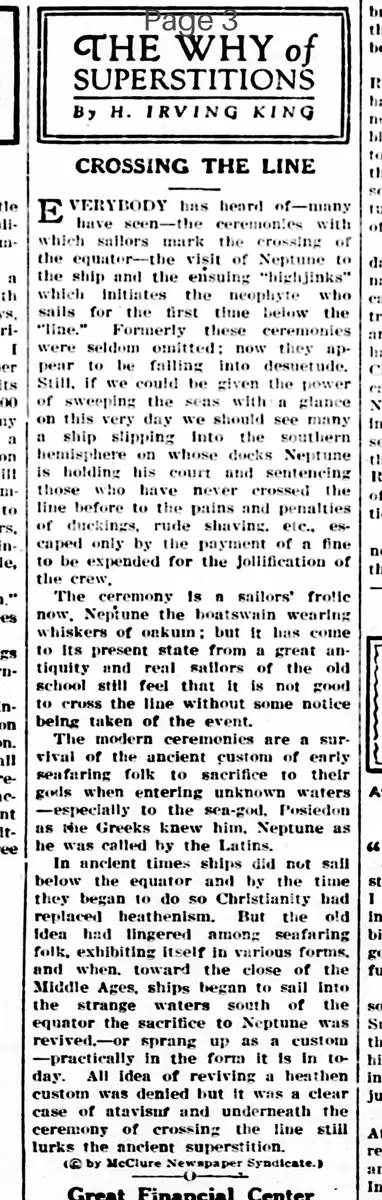
By H. Irving King
Crossing the Line
Everybody has heard of—many have seen—the ceremonies with which sailors mark the crossing of the equator—the visit of Neptune to the ship and the ensuing "highjinks" which initiates the neophyte who sails for the first time below the "line." Formerly these ceremonies were seldom omitted; now they appear to be falling into desuetude.
Still, if we could be given the power of sweeping the seas with a glance on this very day we should see many a ship slipping into the southern hemisphere on whose decks Neptune is holding his court and sentencing those who have never crossed the line before to the pains and penalties of duckings, rude shaving, etc., escaped only by the payment of a fine to be expended for the jollification of the crew.
The ceremony is a sailors' frolic now, Neptune the boatswain wearing whiskers of oakum; but it has come to its present state from a great antiquity and real sailors of the old school still feel that it is not good to cross the line without some notice being taken of the event.
The modern ceremonies are a survival of the ancient custom of early seafaring folk to sacrifice to their gods when entering unknown waters—especially to the sea-god, Poseidon as the Greeks knew him, Neptune as he was called by the Latins.
In ancient times ships did not sail below the equator and by the time they began to do so Christianity had replaced heathenism. But the old idea had lingered among seafaring folk, exhibiting itself in various forms, and when, toward the close of the Middle Ages, ships began to sail into the strange waters south of the equator the sacrifice to Neptune was revived—or sprang up as a custom—practically in the form it is in today. All idea of reviving a heathen custom was denied but it was a clear case of atavism and underneath the ceremony of crossing the line still lurks the ancient superstition.
(© by McClure Newspaper Syndicate.)
What sub-type of article is it?
What themes does it cover?
What keywords are associated?
What entities or persons were involved?
Where did it happen?
Story Details
Key Persons
Location
Equator, Southern Hemisphere
Event Date
Ancient Times To Present
Story Details
The article explains the origins of the sailors' ceremony for crossing the equator, a modern frolic surviving from ancient sacrifices to sea gods like Poseidon or Neptune when entering unknown waters, revived in the late Middle Ages as ships ventured south, masking pagan superstition as atavism.