Thank you for visiting SNEWPapers!
Sign up free
Alexandria Gazette & Daily Advertiser
Alexandria, Virginia
What is this article about?
Report from Pernambuco, Brazil, September 1821: Ongoing rebellion against Portuguese rule, led by João Martin and priest Francisco Paula Simon da Silva, with skirmishes at Olinda and Afogados, a reported massacre of 300-400 civilians, and demands for European expulsion. Commercial trade stalled amid unrest; British ships in port.
Merged-components note: These two components form a single correspondent's letter from Pernambuco, covering both political events and commercial intelligence; relabeled the commercial portion to foreign_news for coherence as foreign correspondence.
Clipping
OCR Quality
Full Text
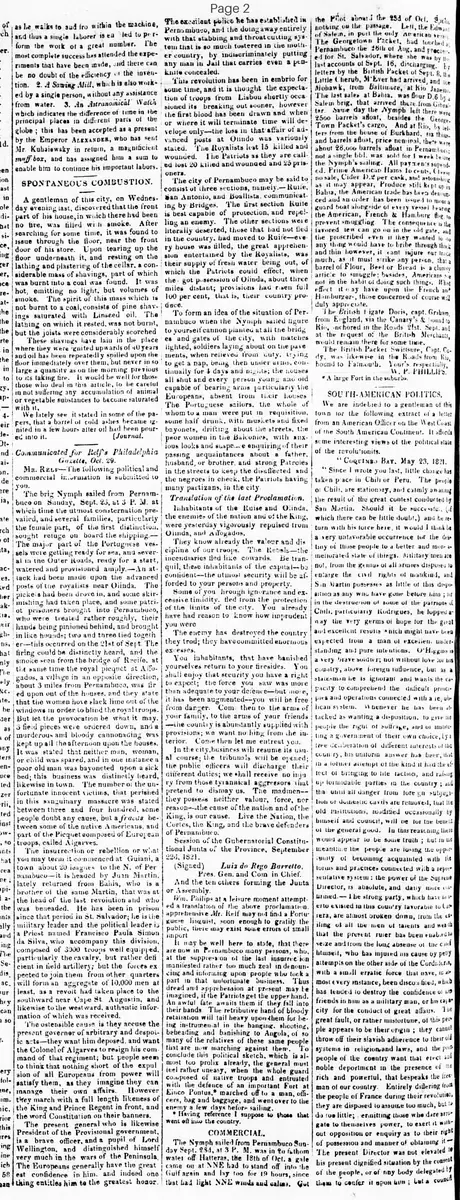
Mr. Relf—The following political and commercial information is submitted to you.
The brig Nymph sailed from Pernambuco on Sunday, Sept. 23, at 3 P. M. at which time the utmost consternation prevailed, and several families, particularly the female part, of the first distinction, sought refuge on board the shipping. The major part of the Portuguese vessels were getting ready for sea, and several in the Outer Roads, ready for a start, watered and provisioned amply.—An attack had been made upon the advanced posts of the royalists near Olinda. The pickets had been drove in, and some skirmishing had taken place, and some patriot prisoners brought into Pernambuco, who were treated rather roughly, their hands being pinioned behind, and brought in like hounds; two and three tied together—this occurred on the 21st of Sept. The firing could be distinctly heard, and the smoke seen from the bridge of Recife, at the same time the royal piquet at Afogados, a village in an opposite direction, about 3 miles from Pernambuco, was fired upon out of the houses, and they state that the women have black line out of the windows in order to blind the royal troops. But let the provocation be what it may, 3 field pieces were ordered down, and a murderous and bloody cannonading was kept up all the afternoon upon the houses. It was stated that neither man, woman, or child was spared, and in one instance a poor old man was bayoneted upon a sick bed: this business was distinctly heard, likewise in town. The number of the unfortunate innocent victims, that perished in this sanguinary massacre was stated between three and four hundred, some people doubt any cause, but a fracas between some of the native Americans, and part of the Piquet composed of European troops, called Algarves.
The insurrection or rebellion or what you may term it commenced at Goiana, a town about 20 leagues to the N. of Pernambuco—it is headed by Juao Martin, lately returned from Bahia, who is a brother of the same Martin, that was at the head of the last revolution and who was beheaded. He has been in prison since that period in St. Salvador; he is the military leader and the political leader is a Priest named Francisco Paula Simon da Silva, who accompany this division, composed of 3000 troops well equipped, particularly the cavalry, but rather deficient in field artillery; but the forces expected to join them from other quarters will form an aggregate of 10,000 men at least, as a revolt had taken place to the southward near Cape St. Augustin, and likewise to the westward, authentic information of which was received.
The ostensible cause is they accuse the present governor of arbitrary and despotic acts—they want him deposed, and want the Colonel of Algarves to resign his command of that regiment; but people seem to think that nothing short of the expulsion of all Europeans from power will satisfy them, as they imagine they can manage their own affairs. However they march with a full length likeness of the King and Prince Regent in front, and the word Constitution on their banners.
The present general who is likewise President of the Provisional government, is a brave officer, and a pupil of Lord Wellington, and distinguished himself very much in the wars of the Peninsula. The Europeans generally have the greatest confidence in him, and indeed one thing entitles him to the greatest honor.
The excellent police he has established in Pernambuco, and the doing away entirely with that stabbing and throat cutting system that is so much fostered in the mother country, by indiscriminately putting any man in jail that carries even a penknife concealed.
This revolution has been in embryo for some time, and it is thought the expectation of troops from Lisbon shortly occasioned its breaking out sooner, however the first blood has been drawn and when or where it will terminate time will develope only—the loss in that affair of advanced posts at Olinda was variously stated. The Royalists lost 15 killed and wounded. The Patriots as they are called lost 20 killed and wounded and 25 prisoners.
The city of Pernambuco may be said to consist of three sections, namely.—Recife, San Antonio, and Boavista, communicating by Bridges. The first section Recife is best capable of protection, and repelling an enemy. The other sections were literally deserted, those that had not fled in the country, had moved to Recife—every house was filled, the great apprehension entertained by the Royalists, was their supply of fresh water being cut off, of which the Patriots could effect, when they got possession of Olinda, about three miles distant; provisions had risen full 100 per cent, that is, their country produce.
To form an idea of the situation of Pernambuco when the Nymph sailed figure to yourself cannon planted at all the bridges and gates of the city, with matches lighted, soldiers laying about on the pavements, when relieved from duty, trying to get a nap, being then under arms, continually for 4 days and nights; the houses all shut and every person young and old capable of bearing arms particularly the Europeans, absent from their houses. The Portuguese sailors, the whole of whom to a man were put in requisition, some half drunk, with muskets and fixed bayonets, drifting about the streets, the poor women in the Balconies, with anxious looks and suspense enquiring of their passing acquaintances about a father, husband, or brother, and strong Patroles in the streets to keep the disaffected and the negroes in check, the Patriots having many partizans, in the city.
Translation of the last Proclamation.
Inhabitants of the Recife and Olinda, the enemies of the nation and of the King, were yesterday vigorously repulsed from Olinda, and Afogados. They know already the valour and discipline of our troops. The Rebels—the incendiaries fled like cowards. Be tranquil, these inhabitants of the capital—be confident—the utmost security will be afforded to your persons and property. Some of you through ignorance and excessive timidity, fled from the protection of the limits of the city. You already have had reason to know how imprudent you were. The enemy has destroyed the country they trod; they have committed enormous excesses. You inhabitants, that have banished yourselves return to your firesides. You shall enjoy that security you have a right to expect; the force you saw was more than adequate to your defence—but more, it has been augmented—you will be free from danger. Come then to the arms of your family, to the arms of your friends—the country is abundantly supplied with provisions; we want nothing from the interior. Come then let me entreat you. In the city, business will resume its usual course; the tribunals will be opened; the public officers will discharge their different duties; we shall receive no injury from those tyrannical aggressors that pretend to dismay us. The madmen—they possess neither valour, force, nor reason—the cause of the nation and of the King, is our cause. Live the Nation, the Cortes, the King, and the brave defenders of Pernambuco.
Session of the Gubernatorial Constitutional Junta of the Province, September 22d, 1821.
(Signed) Luiz do Rego Barreto, Pres. Gen. and Com in Chief. And the ten others forming the Junta or Assembly.
Wm. Philips at a leisure moment attempted a translation of the above proclamation, apprehensive Mr. Relf may not find a Portuguese linguist, soon enough to gratify the public, there may exist some errors of small import.
It may be well here to state, that there are now in Pernambuco many persons, who, at the suppression of the last insurrection manifested rather too much zeal in denouncing and informing upon people who took a part in that unfortunate business. Thus dread and apprehension at present may be imagined, if the Patriots get the upper hand. An awful fate awaits them if they fall into their hands. The retributive hand of bloody retaliation will fall heavy upon them for being instrumental in the hanging, shooting, beheading and banishing to Angola, of so many of the relatives of these same people that are now marching against them. To conclude this political sketch, which is almost too prolix already, the general must feel rather uneasy, when the whole guard composed of native troops and entrusted with the defence of an important Fort at Cinco Pontas,* marched off to a man, officers, bag and baggage, and went over to the enemy a few days before sailing.
* Having reference I suppose to those that went off in the country.
COMMERCIAL,
The Nymph sailed from Pernambuco Sunday Sept. 23d, at 3 P. M. was in 90 fathom water of Hatteras, the 18th of Oct. a gale came on at NNE had to stand off into the Gulf again and lay too for 19 hours, since that had light NNE winds and calms. Got the Pilot aboard the 22d of Oct. spoke nothing on the passage. Left, the Edward of Salem, in port the only american vessel. The Georgetown Packet, had touched Pernambuco the 6th of Aug, and proceeded for St. Salvador, where she was by the last accounts of Sept. 16, discharging. By letters by the British Packet of Sept. 8. its Little Cherub, M'Ever had arrived, and the Mohawk, from Baltimore, at Rio Janeiro. The last sales at Bahia. was flour $6 by a Salem brig, that arrived there from Gibraltar. Same day the Nymph left there were 2500 barrels afloat, besides the Georgetown Packet's cargo. And at Rio, by letters from the house of Burkhard, six thousand barrels afloat, price nominal, there were about 28,000 barrels afloat in Pernambuco; not a single bbl. was sold for 1 week before the Nymph's sailing. All pay men's suspended. Prime American Hams 10 cents, Cheese no sale, Cider $5 per cask, and astonishing as it may appear, Produce still kept up in Bahia, the American trade has been denounced and an order has been issued to moor a guard boat alongside of every vessel bearing the American, French & Hamburg flag to prevent smuggling. The consequence is the favored few can go on in the old gale, and the proscribed even if they wanted to do any thing would have to bribe through thick and thin however, it cant injure our trade much, as it must strike any person, that a barrel of Flour, Beef or Bread is a clumsy article to smuggle; besides, Americans are not in the habit of doing such things. What effect it may have upon the French and Hamburgers, those concerned of course will duly appreciate.
The British Frigate Doris, Capt. Graham from England, via the Canarys & bound to Rio. anchored in the Roads 21st. Sept. and at the request of the British Merchants, would remain there for some time.
The British Packet Swiftshire, Capt. Cody, was likewise in the Roads from Rio, bound to Falmouth.
Your's respectfully,
W.P. PHILLIPS.
*A large Fort in the suburbs.
What sub-type of article is it?
What keywords are associated?
What entities or persons were involved?
Where did it happen?
Foreign News Details
Primary Location
Pernambuco
Event Date
September 21 23, 1821
Key Persons
Outcome
royalists lost 15 killed and wounded at olinda; patriots lost 20 killed and wounded, 25 prisoners. reported massacre at afogados: 300-400 civilians killed. whole guard at cinco pontas fort defected to rebels. trade stalled, provisions up 100%, flour unsold.
Event Details
Insurrection began at Goiana, led by Juao Martin (military) and priest Francisco Paula Simon da Silva (political), with 3000 troops expecting to reach 10,000. Skirmishes at Olinda (Sept 21) and Afogados, where royalists bombarded houses killing 300-400. Rebels demand governor's deposition, European expulsion, but carry images of King and Prince Regent with 'Constitution' banners. City in panic, under arms; proclamation by Gen. Luiz do Rego Barreto urges return to normalcy. Commercial: Trade suspended, American goods unsold, guard boats on foreign vessels; British ships Doris and Swiftshire in port.