Thank you for visiting SNEWPapers!
Sign up free
Springfield Weekly Republican
Springfield, Hampden County, Massachusetts
What is this article about?
Editorial critiquing the inefficient and expensive military trials of Generals McDowell and Porter in Washington during the Civil War, noting unresolved conflicting testimonies, resource waste, and suggesting suspending trials until after the war to prioritize active service.
Clipping
OCR Quality
Full Text
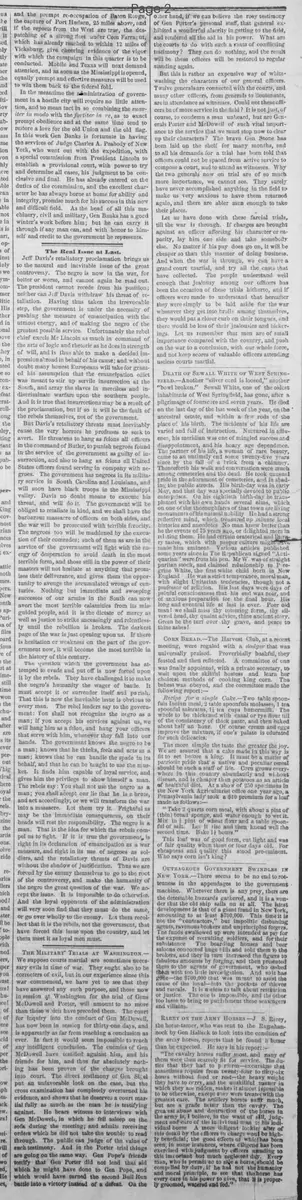
We suppose courts martial are sometimes necessary evils in time of war. They ought also to be correctors of evil, but in our experience since this war commenced, we have yet to see that they have answered any such purpose, and those now in session at Washington for the trial of Gens. McDowell and Porter, will amount to no more than those which have preceded them. The court for inquiry into the conduct of Gen. McDowell, has now been in session for thirty-one days, and is apparently as far from reaching a conclusion as ever. In fact it would seem impossible to reach any intelligent conclusion. The enemies of Gen. McDowell have testified against him, and his friends for him, and thus far absolutely nothing has been proven of the charges brought into court. The direct testimony of Gen. Sigel put an unfavorable look on the case, but the cross examination has completely overturned his evidence, and shows that he deserves a court martial fully as much as the man he is testifying against. He bears witness to interviews with Gen. McDowell, in which he fell asleep on the sofa during the meeting; and admits receiving orders which he did not take the trouble to read through. The public can judge of the value of such testimony. And in the Porter trial things are going on the same way. Gen. Pope's friends testify that Gen. Porter did not lend that aid which he might have done to Gen. Pope, and which would have turned the second Bull Run battle into a victory instead of a defeat. On the other hand, if we can believe the rosy testimony of Gen. Porter's personal staff, that general exhibited a wonderful alacrity in getting to the field, and rendered all the aid in his power. What are the courts to do with such a case of conflicting testimony? They can do nothing, and the result will be these officers will be restored to regular standing again.
But this is rather an expensive way of white-washing the characters of our general officers. Twelve generals are connected with the courts, and many other officers, from generals to lieutenants, are in attendance as witnesses. Could not these officers be of more service in the field? It is not just, of course, to condemn a man unheard, but are Generals Porter and McDowell of such vital importance to the service that we must stop now to clear up their characters? The brave Gen. Stone has been laid on the shelf for many months, and to all his demands for a trial has been told that officers could not be spared from active service to compose a court, and to attend as witnesses. Why the two generals now on trial are of so much more importance, we cannot see. They surely have never accomplished anything in the field to make us very anxious to have them returned again, and there are abler men enough to take their places.
Let us have done with these farcical trials, till the war is through. If charges are brought against an officer affecting his character or capacity, lay him one side and take somebody else. No matter if his pay does go on, it will be cheaper so than this manner of doing business. And when the war is through, we can have a grand court martial, and try all the cases that have collected. The people understand well enough that jealousy among our officers has been the occasion of these trials hitherto, and if officers were made to understand that hereafter they were simply to be laid aside for the war whenever they get into broils among themselves, they would put a closer curb on their tongues, and there would be less of their jealousies and bickerings. Let us remember that men are of small importance compared with the country, and push on the war to a conclusion, with our whole force, and not keep scores of valuable officers attending useless courts martial.
What sub-type of article is it?
What themes does it cover?
What keywords are associated?
What entities or persons were involved?
Where did it happen?
Story Details
Key Persons
Location
Washington
Story Details
The article criticizes ongoing military trials of Generals McDowell and Porter at Washington, highlighting conflicting testimonies that prevent clear conclusions, the expense and delay in using officers for courts instead of the field, and contrasts with General Stone's untreated case, advocating to suspend such trials until war's end to focus on victory.