Thank you for visiting SNEWPapers!
Sign up free
The Saint Paul Globe
Saint Paul, Ramsey County, Minnesota
What is this article about?
The Globe newspaper corrects lumber magnate Mr. Weyerhaeuser's claims justifying high tariffs on Canadian lumber, revealing through investigation and an anonymous expert that US wages in the industry are lower (97 cents/day average) than Canadian ($1.25-$1.50/day), and logging costs higher in Canada, undermining his arguments from 1893 data.
Clipping
OCR Quality
Full Text
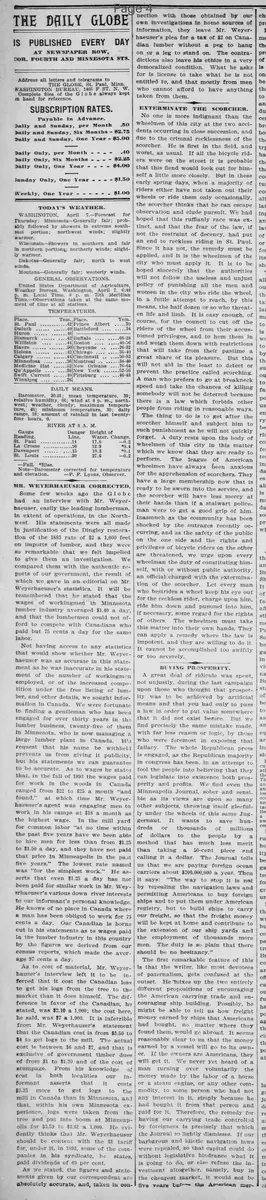
Some few weeks ago the Globe had an interview with Mr. Weyerhaeuser, easily the leading lumberman, in extent of operations, in the Northwest. His statements were all made in justification of the Dingley restoration of the 1883 rate of $2 a 1,000 feet on imports of lumber, and they were so remarkable that we felt impelled to give them an investigation. We compared them with the authentic reports of our government, the result of which we gave in an editorial on Mr. Weyerhaeuser's statistics. It will be remembered that he stated that the wages of workingmen in Minnesota lumber industry averaged $1.40 a day. and that the lumbermen could not afford to compete with Canadians who paid but 75 cents a day for the same labor.
Not having access to any statistics that would show whether Mr. Weyerhaeuser was as accurate in this statement as he was inaccurate in his statement of the number of workingmen employed, or of the increased competition under the free listing of lumber, and other details, we sought information in Canada. We were fortunate in finding a gentleman who has been engaged for over thirty years in the lumber business. twenty-five of them in Minnesota, who is now managing a large lumber plant in Canada. His request that his name be withheld prevents us from giving it publicity, but his statements we can guarantee to be accurate. As to wages he states that. in the fall of 1893 the wages paid for work in the woods in Canada ranged from $22 to $25 a month "and found," at which time Mr. Weyerhaeuser's agent was engaging men to work in his camps at $15 a month as the highest wage. In the mill yard for common labor "at no time within the past five years have we been able to hire men for less than from $1.25 to $1.50 a day. and they have not paid that price in Minneapolis in the past five years."
The lowest rate named was "for the simplest work." He asserts that even $1.25 a day has not been paid for similar work in Mr. Weyerhaeuser's various down river interests to our informant's personal knowledge. He knows of no place in Canada where a man has been obliged to work for 75 cents a day. Our Canadian is borne out in his statements as to wages paid in the lumber industry in this country by the figures we derived from our census reports. which made the average 97 cents a day.
As to cost of material, Mr. Weyerhaeuser's interview left it to be inferred that it cost the Canadian less to get his logs from the tree to the market than it does himself. The difference in favor of the Canadian, he stated, was $2.10 a 1,000; the cost here, he said. was $7 a 1,000. It is inferrible from Mr. Weyerhaeuser's statement that the Canadian cost is from $3.50 to $4 to get logs to the mill. The actual cost is between $6 and $7, and that is exclusive of government timber dues of from $1 to $1.30 and of the cost of stumpage.
From his knowledge of cost in both localities our informant asserts that it costs $2.35 more to get logs to the mill in Canada than in Minnesota, and that. within his own experience, logs were taken from the tree and put into boom at Minneapolis for $3.59 to $3.61 a 1,000. He evidently thinks that Mr. Weyerhaeuser should be content with the $1 tariff for, under it, in 1893, some of the companies in his syndicate, he states, paid dividends of 40 per cent.
As we stated, the figures and statements given by our correspondent are absolutely accurate, and, taken in connection with those obtained by our own investigations in home sources of information, they leave Mr. Weyerhaeuser's plea for a tax of $2 on Canadian lumber without a peg to hang on or a leg to stand on. The contradictions also leave his ethics in a very demoralized condition. What he asks for is license to take what he is not entitled to, and that mostly from men who cannot afford to have anything taken from them.
What sub-type of article is it?
What themes does it cover?
What keywords are associated?
What entities or persons were involved?
Where did it happen?
Story Details
Key Persons
Location
Minnesota, Canada, Minneapolis
Event Date
Fall Of 1893
Story Details
The Globe investigates and corrects Mr. Weyerhaeuser's inaccurate claims on low Canadian lumber wages (actually higher at $1.25-$1.50/day vs. US 97 cents/day) and lower costs (actually higher in Canada), using expert testimony and census data to refute his push for $2 tariffs, noting his firms profited 40% under $1 tariff.