Thank you for visiting SNEWPapers!
Sign up free
The New Bloomfield, Pa. Times
New Bloomfield, Perry County, Pennsylvania
What is this article about?
Account of the July 2, 1881, assassination attempt on President James A. Garfield by Charles Guiteau at the Washington depot, including shooting details, medical updates, public outrage, Guiteau's letters and statements claiming political motives, family reactions, a near-accident on Mrs. Garfield's train, and discussion of presidential succession.
Merged-components note: Merged related components on President Garfield's assassination: bulletin updates and political commentary, detailed account, and presidential succession law; changed label from domestic_news for the bulletin to story as dominant narrative content
Clipping
OCR Quality
Full Text
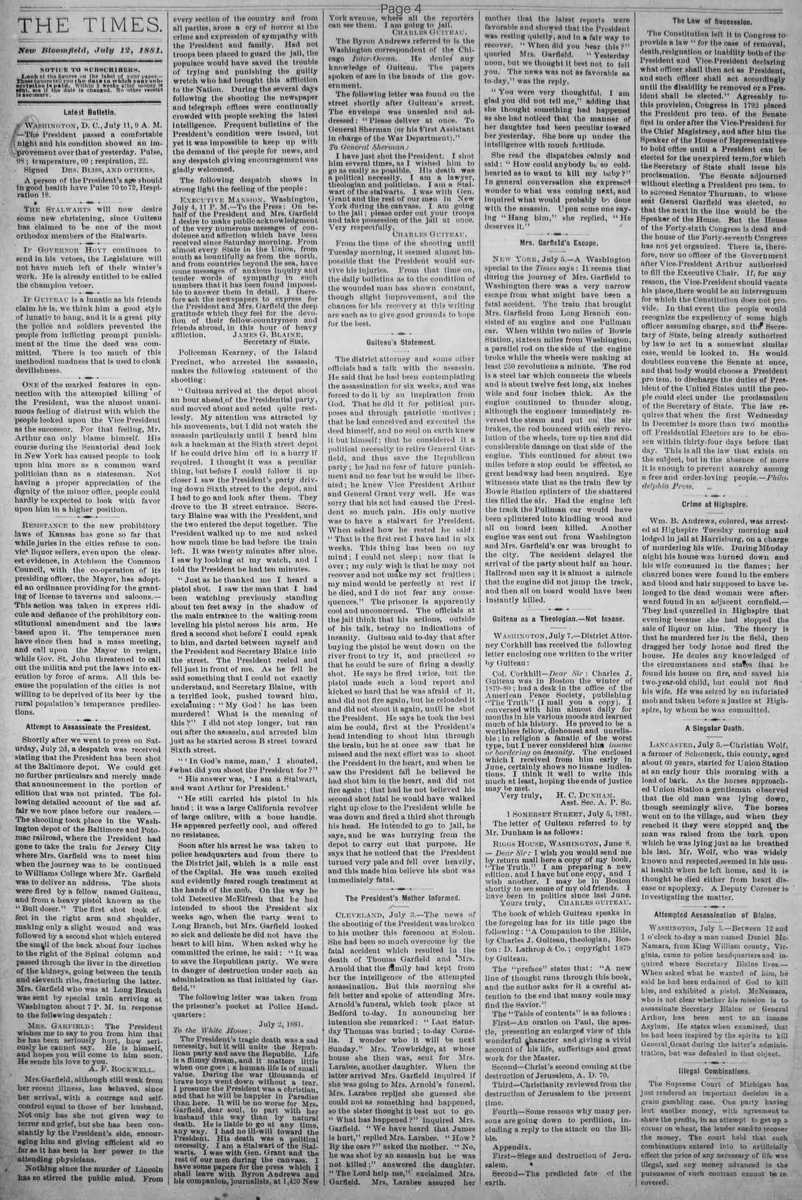
WASHINGTON, D. C., July 11, 9 A. M.
The President passed a comfortable night and his condition showed an improvement over that of yesterday.
Pulse, 98; temperature, 99; respiration, 22.
Signed DRS. BLISS, AND OTHERS.
A person of the President's age should in good health have Pulse 70 to 72, Respiration 18.
THE STALWARTS will now desire some new christening, since Guiteau has claimed to be one of the most orthodox members of the Stalwarts.
IF GOVERNOR HOYT continues to send in his vetoes, the Legislature will not have much left of their winter's work.
He is already entitled to be called the champion vetoer.
If Guiteau is a lunatic as his friends claim he is, we think him a good style of lunatic to hang, and it is a great pity the police and soldiers prevented the people from inflicting prompt punishment at the time the deed was committed.
There is too much of this methodical madness that is used to cloak devilishness.
One of the marked features in connection with the attempted killing of the President, was the almost unanimous feeling of distrust with which the people looked upon the Vice President as the successor.
For that feeling, Mr. Arthur can only blame himself.
His course during the Senatorial dead lock in New York has caused people to look upon him more as a common ward politician than as a statesman.
Not having a proper appreciation of the dignity of the minor office, people could hardly be expected to look with favor upon him in a higher position.
Attempt to Assassinate the President.
Shortly after we went to press on Saturday, July 2d, a despatch was received stating that the President has been shot at the Baltimore depot.
We could get no further particulars and merely made that announcement in the portion of edition that was not printed.
The following detailed account of the sad affair we now place before our readers.
The shooting took place in the Washington depot of the Baltimore and Potomac railroad, where the President had gone to take the train for Jersey City where Mrs. Garfield was to meet him when the journey was to be continued to Williams College where Mr. Garfield was to deliver an address.
The shots were fired by a fellow named Guiteau, and from a heavy pistol known as the 'Bull dog.'
The first shot took effect in the right arm and shoulder, making only a slight wound and was followed by a second shot which entered the small of the back about four inches to the right of the Spinal column and passed through the liver in the direction of the kidneys, going between the tenth and eleventh ribs, fracturing the latter.
Mrs. Garfield who was at Long Branch was sent by special train arriving at Washington about 7 P. M. in response to the following despatch:
MRS. GARFIELD: The President wishes me to say to you from him that he has been seriously hurt, how seriously he cannot say.
He is himself, and hopes you will come to him soon.
He sends his love to you.
A. F. ROCKWELL.
Mrs. Garfield, although still weak from her recent illness, has behaved, since her arrival, with a courage and self-control equal to those of her husband.
Not only has she not given way to terror and grief, but she has been constantly by the President's side, encouraging him and giving efficient aid so far as it has been in her power to the attending physicians.
Nothing since the murder of Lincoln has so stirred the public mind.
From every section of the country and from all parties, arose a cry of horror at the crime and expression of sympathy with the President and family.
Had not troops been placed to guard the jail, the populace would have saved the trouble of trying and punishing the guilty wretch who had brought this affliction to the Nation.
During the several days following the shooting the newspaper and telegraph offices were continually crowded with people seeking the latest intelligence.
Frequent bulletins of the President's condition were issued, but yet it was impossible to keep up with the demand of the people for news, and any despatch giving encouragement was gladly welcomed.
The following despatch shows in strong light the feeling of the people:
Executive Mansion. Washington, July 4. 11 P. M.-To the Press: On behalf of the President and Mrs. Garfield I desire to make public acknowledgment of the very numerous messages of condolence and affection which have been received since Saturday morning.
From almost every State in the Union, from south as bountifully as from the north, and from countries beyond the sea, have come messages of anxious inquiry and tender words of sympathy in such numbers that it has been found impossible to answer them in detail.
I therefore ask the newspapers to express for the President and Mrs. Garfield the deep gratitude which they feel for the devotion of their fellow-countrymen and friends abroad, in this hour of heavy affliction.
JAMES G. BLAINE,
Secretary of State.
Policeman Kearney, of the Island Precinct, who arrested the assassin, makes the following statement of the shooting:
'Guiteau arrived at the depot about an hour ahead of the Presidential party, and moved about and acted quite restlessly.
My attention was attracted by his movements, but I did not watch the assassin particularly until I heard him ask a hackman at the Sixth street depot if he could drive him off in a hurry if required.
I thought it was a peculiar thing, but before I could follow it up closer I saw the President's party driving down Sixth street to the depot, and I had to go and look after them.
They drove to the B street entrance.
Secretary Blaine was with the President, and the two entered the depot together.
The President walked up to me and asked how much time he had before the train left.
It was twenty minutes after nine. I saw by looking at my watch, and I told the President he had ten minutes.
Just as he thanked me I heard a pistol shot, I saw the man that I had been watching previously standing about ten feet away in the shadow of the main entrance to the waiting-room leveling his pistol across his arm.
He fired a second shot before I could speak to him, and darted between myself and the President and Secretary Blaine into the street.
The President reeled and fell just in front of me.
As he fell he said something that I could not exactly understand, and Secretary Blaine, with a terrified look, pushed toward him, exclaiming: 'My God! he has been murdered! What is the meaning of this?' I did not stop longer, but ran out after the assassin, and arrested him just as he started across B street toward Sixth street.
'In God's name, man,' I shouted, 'what did you shoot the President for?' His answer was, 'I am a Stalwart, and want Arthur for President.'
He still carried his pistol in his hand; it was a large California revolver of large calibre, with a bone handle.
He appeared perfectly cool, and offered no resistance.
Soon after his arrest he was taken to police headquarters and from there to the District jail, which is a mile east of the Capital.
He was much excited and evidently feared rough treatment at the hands of the mob.
On the way he told Detective McElfresh that he had intended to shoot the President six weeks ago, when the party went to Long Branch, but Mrs. Garfield looked so sick and delicate he did not have the heart to kill him.
When asked why he committed the crime, he said: 'It was to save the Republican party.
We were in danger of destruction under such an administration as that initiated by Garfield.'
The following letter was taken from the prisoner's pocket at Police Headquarters:
July 2, 1881.
To the White House:
The President's tragic death was a sad necessity, but it will unite the Republican party and save the Republic.
Life is a flimsy dream, and it matters little when one goes; a human life is of small value.
During the war thousands of brave boys went down without a tear.
I presume the President was a Christian, and that he will be happier in Paradise than here.
It will be no worse for Mrs. Garfield, dear soul, to part with her husband this way than by natural death.
He is liable to go at any time, any way.
I had no ill-will toward the President.
His death was a political necessity.
I am a Stalwart of the Stalwarts.
I was with Gen. Grant and the rest of our men during the canvass.
I have some papers for the press which I shall leave with Byron Andrews and his companion, journalists, at 1,420 New York avenue, where all the reporters can see them.
I am going to jail.
CHARLES GUITEAU.
The Byron Andrews referred to is the Washington correspondent of the Chicago Inter-Ocean.
He denies any knowledge of Guiteau.
The papers spoken of are in the hands of the government.
The following letter was found on the street shortly after Guiteau's arrest.
The envelope was unsealed and addressed: 'Please deliver at once. To General Sherman (or his First Assistant in charge of the War Department).'
To General Sherman:
I have just shot the President.
I shot him several times, as I wished him to go as easily as possible.
His death was a political necessity.
I am a lawyer, theologian and politician.
I am a Stalwart of the Stalwarts.
I was with Gen. Grant and the rest of our men in New York during the canvass.
I am going to the jail; please order out your troops and take possession of the jail at once.
Very respectfully,
CHARLES GUITEAU.
From the time of the shooting until Tuesday morning, it seemed almost impossible that the President would survive his injuries.
From that time on, the daily bulletins as to the condition of the wounded man has shown constant, though slight improvement, and the chances for his recovery at this writing are such as to give good grounds to hope for the best.
Guiteau's Statement.
The district attorney and some other officials had a talk with the assassin.
He said that he had been contemplating the assassination for six weeks, and was forced to do it by an inspiration from God.
That he did it for political purposes and through patriotic motives; that he had conceived and executed the deed himself, and no soul on earth knew it but himself: that he considered it a political necessity to retire General Garfield, and thus save the Republican party; he had no fear of future punishment and no fear but he would be liberated; he knew Vice President Arthur and General Grant very well.
He was sorry that his act had caused the President so much pain.
His only motive was to have a Stalwart for President.
When asked how he rested he said: 'That is the first rest I have had in six weeks.
This thing has been on my mind: I could not sleep; now that is over; my only wish is that he may not recover and not make my act fruitless; my mind would be perfectly at rest if he died, and I do not fear any consequences.'
The prisoner is apparently cool and unconcerned.
The officials at the jail think that his actions, outside of his talk, betray no indications of insanity.
Guiteau said to-day that after buying the pistol he went down on the river front to try it, and practiced so that he could be sure of firing a deadly shot.
He says he fired twice, but the pistol made such a loud report and kicked so hard that he was afraid of it, and did not fire again, but he reloaded it and did not shoot it again, until he shot the President.
He says he took the best aim he could, first at the President's head intending to shoot him through the brain, but he at once saw that he missed and the next effort was to shoot the President in the heart, and when he saw the President fall he believed he had shot him in the heart, and did not fire again; that had he not believed his second shot fatal he would have walked right up close to the President while he was down and fired a third shot through his head.
He intended to go to jail, he says, and he was hurrying from the depot to carry out that purpose.
He says that he noticed that the President turned very pale and fell over heavily, and this made him believe his shot was immediately fatal.
The President's Mother Informed.
CLEVELAND, July 3.-The news of the shooting of the President was broken to his mother this forenoon at Solon.
She had been so much overcome by the fatal accident which resulted in the death of Thomas Garfield and Mrs. Arnold that the family had kept from her the intelligence of the attempted assassination.
But this morning she felt better and spoke of attending Mrs. Arnold's funeral, which took place at Bedford to-day.
In announcing her intention she remarked: 'Last Saturday Thomas was buried; to-day Cornelia.
I wonder who it will be next Sunday.'
Mrs. Trowbridge, at whose house she then was, sent for Mrs. Larabee, another daughter.
When the latter arrived Mrs. Garfield inquired if she was going to Mrs. Arnold's funeral.
Mrs. Larabee replied she guessed she could not as something had happened, so the sister thought it best not to go.
'What has happened?' inquired Mrs. Garfield.
'We have heard that James is hurt,' replied Mrs. Larabee.
'How? By the cars?' asked the mother.
'No, he was shot by an assassin but he was not killed;' answered the daughter.
'The Lord help me,' exclaimed Mrs. Garfield.
Mrs. Larabee assured her mother that the latest reports were favorable and showed that the President was resting quietly, and in a fair way to recover.
'When did you hear this?' queried Mrs. Garfield.
'Yesterday noon, but we thought it best not to tell you.'
The news was not as favorable as to-day, was the reply.
'You were very thoughtful.
I am glad you did not tell me,' adding that she thought something had happened as she had noticed that the manner of her daughter had been peculiar toward her yesterday.
She bore up under the intelligence with much fortitude.
She read the dispatches calmly and said: 'How could anybody be so cold-hearted as to want to kill my baby?'
In general conversation she expressed wonder to what was coming next, and inquired what would probably be done with the assassin.
Upon some one saying 'Hang him,' she replied, 'He deserves it.'
Mrs. Garfield's Escape.
New YORK, July 5.-A Washington special to the Times says: It seems that during the journey of Mrs. Garfield to Washington there was a very narrow escape from what might have been a fatal accident.
The train that brought Mrs. Garfield from Long Branch consisted of an engine and one Pullman car.
When within two miles of Bowie Station, sixteen miles from Washington, a parallel rod on the side of the engine broke while the wheels were making at least 250 revolutions a minute.
The rod is a steel bar which connects the wheels and is about twelve feet long, six inches wide and four inches thick.
As the engine continued to thunder along, although the engineer immediately reversed the steam and put on the air brakes, the rod bounced with each revolution of the wheels, tore up ties and did considerable damage on that side of the engine.
This continued for about two miles before a stop could be effected, so great headway had been acquired.
Eye witnesses state that as the train flew by Bowie Station splinters of the shattered ties filled the air.
Had the engine left the track the Pullman car would have been splintered into kindling wood and all on board been killed.
Another engine was sent out from Washington and Mrs. Garfield's car was brought to the city.
The accident delayed the arrival of the party about half an hour.
Railroad men say it is almost a miracle that the engine did not jump the track, and then all on board would have been instantly killed.
Guiteau as a Theologian.—Not Insane.
WASHINGTON, July 7.-District Attorney Corkhill has received the following letter enclosing one written to the writer by Guiteau:
Col. Corkhill-Dear Sir: Charles. J. Guiteau was in Boston the winter of 1879-80: had a desk in the office of the American Peace Society, publishing 'The Truth' (I mail you a copy).
I conversed with him almost daily for months in his various moods and learned much of his history.
He proved to be a worthless fellow, dishonest and unreliable: in religion a fanatic of the worst type, but I never considered him insane or bordering on insanity.
The enclosed which I received from him early in June, certainly shows no insane indications.
I think it well to write this much at least, hoping the ends of justice may be met.
Very truly,
H. C. DUNHAM.
Asst. Sec. A. P. So.
1 SOMERSET STREET, July 5. 1881,
The letter of Guiteau referred to by Mr. Dunham is as follows:
RIGGS HOUSE, WASHINGTON, June 8. - Dear Sir: I wish you would send me by return mail here a copy of my book, 'The Truth.'
I am preparing a new edition, and I have but one copy, and I wish another.
I may be in Boston shortly to see some of my old friends.
I have been in politics since last June.
Yours truly, CHARLES GUITEAU.
The book of which Guiteau speaks in the foregoing has for its title page the following: 'A Companion to the Bible, by Charles J. Guiteau, theologian, Boston: D. Lathrop & Co.; copyright 1879 by Guiteau.'
The 'preface' states that: 'A new line of thought runs through this book, and the author asks for it a careful attention to the end that many souls may find the Savior.'
The 'Table of contents' is as follows:
First-An oration on Paul, the apostle, presenting an enlarged view of this wonderful character and giving a vivid account of his life, sufferings and great work for the Master.
Second-Christ's second coming at the destruction of Jerusalem, A. D. 70.
Third-Christianity reviewed from the destruction of Jerusalem to the present time.
Fourth-Some reasons why many persons are going down to perdition, including a reply to the attack on the Bible.
Appendix.
First-Siege and destruction of Jerusalem.
Second-The predicted fate of the earth.
The Law of Succession.
The Constitution left it to Congress to provide a law 'for the case of removal, death, resignation or inability both of the President and Vice-President declaring what officer shall then act as President, and such officer shall act accordingly until the disability be removed or a President shall be elected.'
Agreeably to this provision, Congress in 1792 placed the President pro tem. of the Senate first in order after the Vice-President for the Chief Magistracy, and after him the Speaker of the House of Representatives to hold office until a President can be elected for the unexpired term, for which the Secretary of State shall issue his proclamation.
The Senate adjourned without electing a President pro tem. to succeed Senator Thurman, to whose seat General Garfield was elected, so that the next in the line would be the Speaker of the House.
But the House of the Forty-sixth Congress is dead and the house of the Forty-seventh Congress has not yet organized.
There is, therefore, now no officer of the Government after Vice-President Arthur authorized to fill the Executive Chair.
If, for any reason, the Vice-President should vacate his place, there would be an interregnum for which the Constitution does not provide.
In that event the people would recognize the expediency of some high officer assuming charge, and the Secretary of State, being already authorized by law to act in a somewhat similar case, would be looked to.
He would doubtless convene the Senate at once, and that body would choose a President pro tem. to discharge the duties of President of the United States until the people could elect under the proclamation of the Secretary of State.
The law requires that when the first Wednesday in December is more than two months off Presidential Electors are to be chosen within thirty-four days before that day.
This is all the law that exists on the subject, but in the absence of more it is enough to prevent anarchy among a free and order-loving people.-Philadelphia Press.
What sub-type of article is it?
What themes does it cover?
What keywords are associated?
What entities or persons were involved?
Where did it happen?
Story Details
Key Persons
Location
Washington D.C., Baltimore And Potomac Railroad Depot
Event Date
July 2, 1881
Story Details
Charles Guiteau shoots President Garfield at a train depot, claiming political necessity to install Arthur; wound details, arrest, letters justifying act, public sympathy, medical bulletins showing improvement, family reactions, near train accident for Mrs. Garfield, Guiteau's background, and presidential succession concerns.