Thank you for visiting SNEWPapers!
Sign up free
The Daily Dispatch
Richmond, Virginia
What is this article about?
General Garfield receives visitors in New York on August 6, 1880, delivers a speech at Republican headquarters emphasizing Union, Civil War sacrifices, and equality for black citizens. On August 7, his train stops at multiple towns where he gives brief speeches to enthusiastic crowds.
Clipping
OCR Quality
Full Text
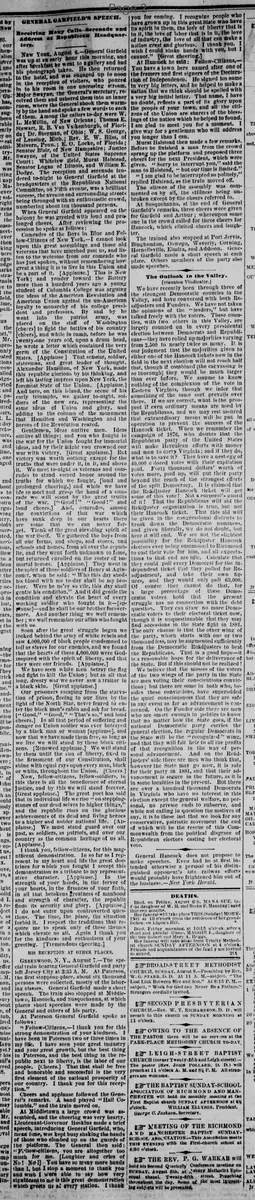
Receiving Many Calls—Serenade and Address as Republican Headquarters.
NEW YORK, August 6.—General Garfield was up at an early hour this morning, and after breakfast he went to a gallery and had his photograph taken. He then returned to the hotel, and was engaged up to noon in the reception of visitors, who poured in to his room in one unceasing stream. Major Swayne, the General's secretary, received them and ushered them into an inner room, where the General shook them warmly by the hand and spoke a few words to each of them. Among the callers to-day were W. L. McMillin, of New Orleans; Thomas E. Stewart, R. B. Van Valkenburgh, of Florida; W. S. George, of Lansing, Mich.; Rev. E. W. Bliss, of Malvern, Penn.; E. O. Locke, of Florida; Senator Blair, of New Hampshire; Justice Swayne, of the United States Supreme Court; Whitelaw Reid, Murat Halstead, Senator Logan of Illinois, and William E. Dodge. The reception and serenade tendered to-night to General Garfield at the headquarters of the Republican National Committee, on Fifth avenue, was a brilliant success, the avenue and surrounding streets being thronged with an enthusiastic crowd, numbering about ten thousand persons.
When General Garfield appeared on the balcony he was greeted with loud and prolonged cheers. After reviewing the procession he spoke as follows:
Comrades of the Boys in Blue and Fellow-Citizens of New York,—I cannot look upon this great assemblage and those old veterans that have marched past us, and listen to the welcome from our comrade who has just spoken, without remembering how great a thing it is to live in this Union and be a part of it. [Applause.] This is New York; and yonder toward the Battery more than a hundred years ago a young student of Columbia College was arguing the ideas of the American Revolution and American Union against the un-American loyalty to monarchy of his college president and professors. By and by he went into the patriot army, was placed on the staff of Washington [cheers] to fight the battles of his country [cheers], and while in camp, before he was twenty-one years old, upon a drum head, he wrote a letter which contained the very germ of the Constitution of the United States. [Applause] That scholar, soldier, statesman, and great leader of thought, Alexander Hamilton, of New York, made this republic glorious by his thinking, and left his lasting impress upon New York, the foremost State of the Union. [Applause.]
And here, on this island, the scene of his early triumphs, we gather to-night, soldiers of the new era, representing the same ideas of Union and glory, and adding to the column of the monument that Hamilton and Washington and the heroes of the Revolution reared.
Gentlemen, ideas outlive men. Ideas outlive all things; and you who fought in the war for the Union fought for immortal ideas, and by their light you crowned our war with victory. [Great applause.] But victory was worth nothing except for the truths that were under it, in it, and above it. We meet to-night as veterans and comrades to stand sacred honor around the truths for which we fought, [loud and prolonged cheering,] and while we have life to meet and grasp the hand of a comrade we will stand by the great truths of the war. ["Good!" "Good!" and loud cheers.] And, comrades, among the convictions of that war which have sunk deep in our hearts there are some that we can never forget. Think of the great elevating spirit of the war itself. We gathered the boys from all our farms, and shops, and stores, and schools and homes, from all over the republic, and they went forth unknown to fame, but returned enrolled on the roster of immortal heroes. [Applause.] They went in the spirit of those soldiers of Henry at Agincourt, when he said: "Who this day sheds his blood with me to-day shall be my brother. Were he ne'er so vile, this day shall gentle his condition." And it did gentle the condition and elevate the heart of every working soldier who fought in it—[applause]—and he shall be our brother forevermore. "And another thing we well remember; we well remember our allies who fought with us. Soon after the great struggle began we looked behind the army of white rebels and saw 4,000,000 of black people condemned to toil as slaves for our enemies, and we found that the hearts of these 4,000,000 were God-inspired with the spirit of liberty, and that they were our friends. [Applause.] We have seen white men betray the flag and fight to kill the Union; but in all that long, dreary war we never saw a traitor in a black skin. [Great applause.] Our prisoners escaping from the starvation of prison, fleeing to our lines by the light of the North Star, never feared to enter the black man's cabin and ask for bread. ["Good," "Good," "That's so," and loud cheers.] In all that period of suffering and danger no Union soldier was ever betrayed by a black man or woman [applause], and now that we have made them free, so long as we live we will stand by these black citizens. [Renewed applause.] We will stand by them until the sun of liberty, fixed in the firmament of our Constitution, shall shine with equal rays upon every man, black or white, throughout the Union. [Cheers.]
Now, fellow-citizens, fellow-soldiers, in this there is all the beneficence of eternal justice, and by this we will stand forever. [Great applause.] The great poet has said that in individual life we rise "on stepping stones of our dead selves to higher things," and the republic rises on the glorious achievements of its dead and living heroes to a higher and nobler national life. [Applause.] We must stand guard over our past, as soldiers, as patriots, and over our country as the common heritage of us all. [Applause.]
I thank you, fellow-citizens, for this magnificent demonstration. In so far as I represent in my heart and life the great doctrines for which you fought I accept this demonstration as a tribute to my representative character. [Applause.] In the strength of your hands, in the fervor of your hearts, in the firmness of your faith, in all that betokens greatness of manhood and strength of character, the republic finds its security and glory. [Applause.] I do not enter upon controverted questions. The time, the place, the situation forbid it. I respect the traditions that require me to speak only of these themes which elevate us all. Again I thank you for the kindness and enthusiasm of your greeting. [Tremendous cheering.]
HIS RECEPTION AT OTHER PLACES.
Greenwood, N. Y., August 7.—The special train bearing General Garfield and party left Jersey City at 3:35 A. M. At Paterson, the first stopping-place, about six thousand persons were collected, mostly of the laboring classes. General Garfield made a short speech. The train also stopped at Middletown, Hancock, and Susquehanna, at which places short speeches were made by the General and others of his party.
At Paterson General Garfield spoke as follows:
"Fellow-Citizens,—I thank you for this strong demonstration of your kindness. I have been in Paterson two or three times in my life. I have seen your great industry and your great growth, but the best thing in Paterson, and the best thing in the republic next to liberty, is the labor of our people. [Cheers.] That that shall be free and honorable and successful is the very first element of the national prosperity of our country.
I thank you for this reception."
Cheers and applause followed the General's remarks. A band played "Hail Columbia," and the train moved on.
At Middletown a large crowd was assembled, and the cheering was very hearty. Lieutenant-Governor Hocksins made a brief speech, introducing General Garfield, who, meantime, was kept busy shaking the hands of those who climbed up on the guards of the platform. The General then said:
"Fellow-citizens, you are altogether too much for me. [Laughter and cries of "No! No!"] You have so many more hands than I, but I stop a moment to thank you and wish I were able to say how very significant to me is this great demonstration which greets us at every station. I thank you for coming. I recognize people who have grown up in this great State who have its spirit in them, the love of liberty that is in it, the love of labor that is in it, the love of industry, the love of all that can make a nation great and glorious. I thank you. I wish I could shake hands with you, but I cannot." (Great cheering.)
At Hancock he said: Fellow-Citizens,—
You have a town here named after one of the framers and first signers of the Declaration of Independence. He signed his name in very big letters, and he helped to make a nation that we think should be spelled with a very big initial letter. That name, I have no doubt, reflects a part of its glory upon the people of your town, and all the citizens of the Union are sharers of the blessings of the nation which he helped to found.
I am glad to meet you for a moment. I give way for a gentleman who will address you longer than I can.
Murat Halstead then made a few remarks. Before he finished a man from the crowd sprang up the platform and proposed three cheers for the next President, which were given. "Sorry to interrupt you," said the man to Halstead, "but our time is limited."
"I am glad to be interrupted so politely," replied Halstead, as the train moved off.
The silence of the assembly was commented on by all, the stillness being unbroken except by the cheers referred to.
At Susquehanna, at the end of General Garfield's remarks, three cheers were given for Garfield and Arthur; whereupon some one in the crowd called for three cheers for Hancock, which elicited cheers and laughter.
The train also stopped at Port Jervis, Binghamton, Oswego, Waverly, Corning, Hornellsville, Elmira, and Addison. General Garfield made a short speech at each place. Other members of the party also made speeches.
What sub-type of article is it?
What themes does it cover?
What keywords are associated?
What entities or persons were involved?
Where did it happen?
Story Details
Key Persons
Location
New York; Train Route From Jersey City Through Paterson, Middletown, Hancock, Susquehanna, Port Jervis, Binghamton, Oswego, Waverly, Corning, Hornellsville, Elmira, Addison
Event Date
August 6, 1880; August 7, 1880
Story Details
General Garfield receives visitors and delivers a major speech in New York on Union, Civil War ideals, and support for freed black citizens; travels by train on August 7, stopping at multiple towns to give short speeches to crowds, emphasizing liberty, labor, and national heritage.