Thank you for visiting SNEWPapers!
Sign up free
Story
July 6, 1932
The Daily Worker
Chicago, Cook County, Illinois
What is this article about?
In Schenectady, the Great Depression has shattered workers' beliefs in hard work and industry paternalism, leading to massive layoffs at General Electric and American Locomotive Works, declining health, inadequate compensation, and harsh welfare practices, forcing skilled workers into poverty and relief dependency.
Clipping
OCR Quality
98%
Excellent
Full Text
By S. Van Veen
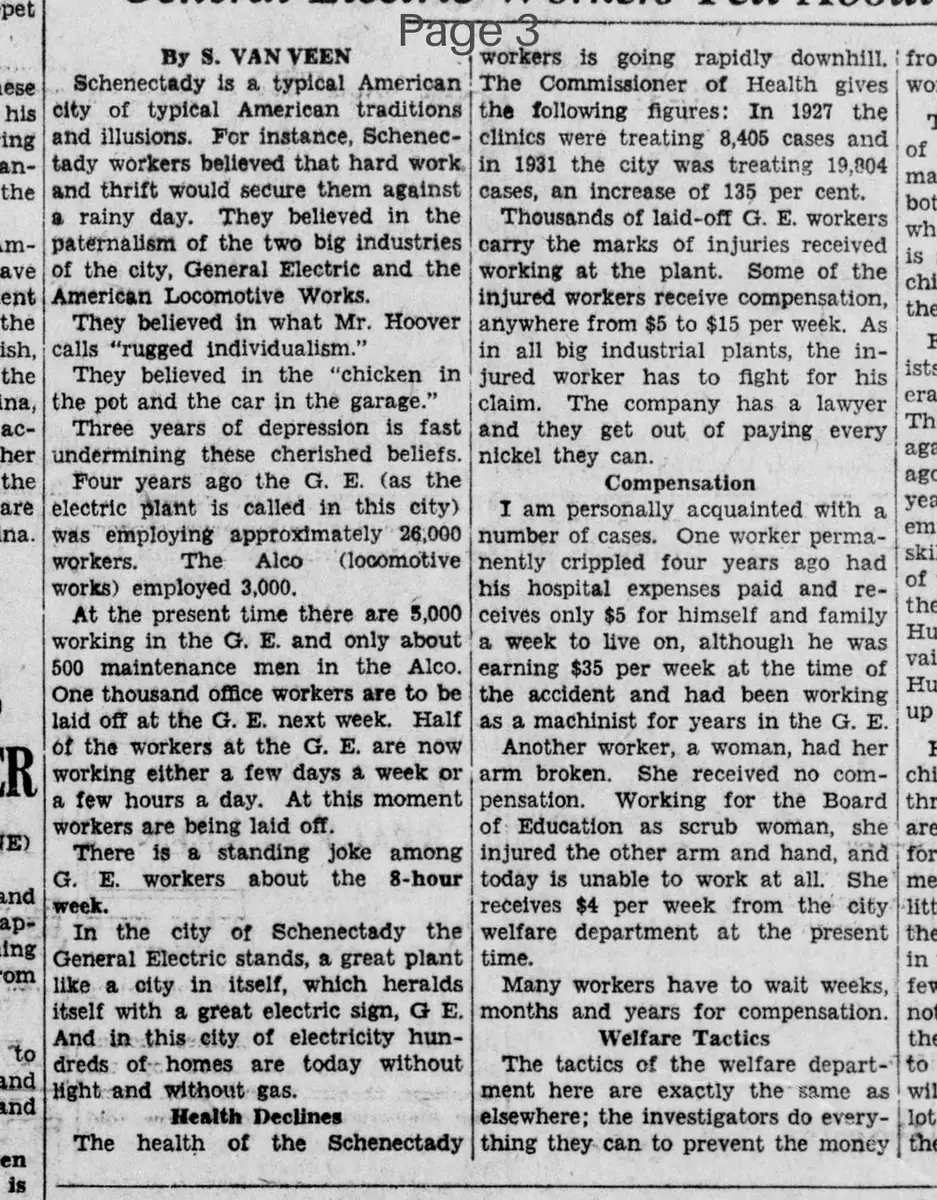
Schenectady is a typical American city of typical American traditions and illusions. For instance, Schenectady workers believed that hard work and thrift would secure them against a rainy day. They believed in the paternalism of the two big industries of the city, General Electric and the American Locomotive Works.
They believed in what Mr. Hoover calls rugged individualism."
They believed in the "chicken in the pot and the car in the garage."
Three years of depression is fast undermining these cherished beliefs.
Four years ago the G. E. (as the electric plant is called in this city) was employing approximately 26,000 workers.
The Alco (locomotive works) employed 3,000.
At the present time there are 5,000 working in the G. E. and only about 500 maintenance men in the Alco.
One thousand office workers are to be laid off at the G. E. next week. Half of the workers at the G. E. are now working either a few days a week or a few hours a day. At this moment workers are being laid off.
There is a standing joke among G. E. workers about the 8-hour week.
In the city of Schenectady the General Electric stands, a great plant like a city in itself, which heralds itself with a great electric sign, G E.
And in this city of electricity hundreds of homes are today without light and without gas.
Health Declines
The health of the Schenectady workers is going rapidly downhill.
The Commissioner of Health gives the following figures: In 1927 the clinics were treating 8,405 cases and in 1931 the city was treating 19,804 cases, an increase of 135 per cent.
Thousands of laid-off G. E. workers carry the marks of injuries received working at the plant. Some of the injured workers receive compensation, anywhere from $5 to $15 per week. As in all big industrial plants, the injured worker has to fight for his claim. The company has a lawyer and they get out of paying every nickel they can.
Compensation
I am personally acquainted with a number of cases. One worker permanently crippled four years ago had his hospital expenses paid and receives only $5 for himself and family a week to live on, although he was earning $35 per week at the time of the accident and had been working as a machinist for years in the G. E.
Another worker, a woman, had her arm broken. She received no compensation. Working for the Board of Education as scrub woman, she injured the other arm and hand, and today is unable to work at all. She receives $4 per week from the city welfare department at the present time.
Many workers have to wait weeks, months and years for compensation.
Welfare Tactics
The tactics of the welfare department here are exactly the same as elsewhere; the investigators do everything they can to prevent the money from getting to the unemployed workers.
They tell the mothers that one can of milk mixed with three of water makes good milk, as good as fresh bottled milk. They tell the mothers who complain that gas and electricity is shut off that they should put the children to bed at 7 o'clock and thus they will not need any lights.
For many years engineers, machinists and skilled workers in the General Electric Works worked and saved. They built little homes and saved against that "rainy day." Four years ago the G. E. began to lay off. Two years ago only half the workers were employed, and today thousands of skilled workers are living on the last of their savings with no idea of what they will do when everything is gone.
Hundreds have moved away in the vain hope of finding jobs elsewhere.
Hundreds of families have doubled up to save rent and light.
Hundreds of American skilled machinists are losing their little homes through foreclosures; their savings are gone; they are turning to the city for relief. The city welfare department is wise enough to give them a little relief to keep them from joining the unskilled workers and laborers in the struggle to keep alive. But the few dollars some of them receive is not enough, and the result is that these American workers, who are told to keep away from the foreign born, will more and more throw in their lot with the unemployed masses in the city.
Schenectady is a typical American city of typical American traditions and illusions. For instance, Schenectady workers believed that hard work and thrift would secure them against a rainy day. They believed in the paternalism of the two big industries of the city, General Electric and the American Locomotive Works.
They believed in what Mr. Hoover calls rugged individualism."
They believed in the "chicken in the pot and the car in the garage."
Three years of depression is fast undermining these cherished beliefs.
Four years ago the G. E. (as the electric plant is called in this city) was employing approximately 26,000 workers.
The Alco (locomotive works) employed 3,000.
At the present time there are 5,000 working in the G. E. and only about 500 maintenance men in the Alco.
One thousand office workers are to be laid off at the G. E. next week. Half of the workers at the G. E. are now working either a few days a week or a few hours a day. At this moment workers are being laid off.
There is a standing joke among G. E. workers about the 8-hour week.
In the city of Schenectady the General Electric stands, a great plant like a city in itself, which heralds itself with a great electric sign, G E.
And in this city of electricity hundreds of homes are today without light and without gas.
Health Declines
The health of the Schenectady workers is going rapidly downhill.
The Commissioner of Health gives the following figures: In 1927 the clinics were treating 8,405 cases and in 1931 the city was treating 19,804 cases, an increase of 135 per cent.
Thousands of laid-off G. E. workers carry the marks of injuries received working at the plant. Some of the injured workers receive compensation, anywhere from $5 to $15 per week. As in all big industrial plants, the injured worker has to fight for his claim. The company has a lawyer and they get out of paying every nickel they can.
Compensation
I am personally acquainted with a number of cases. One worker permanently crippled four years ago had his hospital expenses paid and receives only $5 for himself and family a week to live on, although he was earning $35 per week at the time of the accident and had been working as a machinist for years in the G. E.
Another worker, a woman, had her arm broken. She received no compensation. Working for the Board of Education as scrub woman, she injured the other arm and hand, and today is unable to work at all. She receives $4 per week from the city welfare department at the present time.
Many workers have to wait weeks, months and years for compensation.
Welfare Tactics
The tactics of the welfare department here are exactly the same as elsewhere; the investigators do everything they can to prevent the money from getting to the unemployed workers.
They tell the mothers that one can of milk mixed with three of water makes good milk, as good as fresh bottled milk. They tell the mothers who complain that gas and electricity is shut off that they should put the children to bed at 7 o'clock and thus they will not need any lights.
For many years engineers, machinists and skilled workers in the General Electric Works worked and saved. They built little homes and saved against that "rainy day." Four years ago the G. E. began to lay off. Two years ago only half the workers were employed, and today thousands of skilled workers are living on the last of their savings with no idea of what they will do when everything is gone.
Hundreds have moved away in the vain hope of finding jobs elsewhere.
Hundreds of families have doubled up to save rent and light.
Hundreds of American skilled machinists are losing their little homes through foreclosures; their savings are gone; they are turning to the city for relief. The city welfare department is wise enough to give them a little relief to keep them from joining the unskilled workers and laborers in the struggle to keep alive. But the few dollars some of them receive is not enough, and the result is that these American workers, who are told to keep away from the foreign born, will more and more throw in their lot with the unemployed masses in the city.
What sub-type of article is it?
Historical Event
Tragedy
What themes does it cover?
Misfortune
Catastrophe
Survival
What keywords are associated?
Great Depression
Unemployment
Schenectady
General Electric
Worker Hardship
Welfare Tactics
Job Layoffs
Health Decline
What entities or persons were involved?
S. Van Veen
Where did it happen?
Schenectady
Story Details
Key Persons
S. Van Veen
Location
Schenectady
Event Date
Three Years Of Depression (Circa 1932)
Story Details
The Great Depression undermines Schenectady workers' faith in hard work and industry, causing massive layoffs at GE and Alco, health decline, inadequate injury compensation, and stingy welfare, leading skilled workers to poverty and foreclosure.