Thank you for visiting SNEWPapers!
Sign up free
The Sauk Centre Herald
Sauk Centre, Stearns County, Minnesota
What is this article about?
Article highlights the unrecognized adventures of U.S. Department of Agriculture's plant explorers who travel to distant lands, especially tropics, to discover and introduce new crops like citrus fruits, durum wheat, and alfalfa, boosting American agriculture by over $100 million annually through scientific efforts.
Clipping
OCR Quality
Full Text
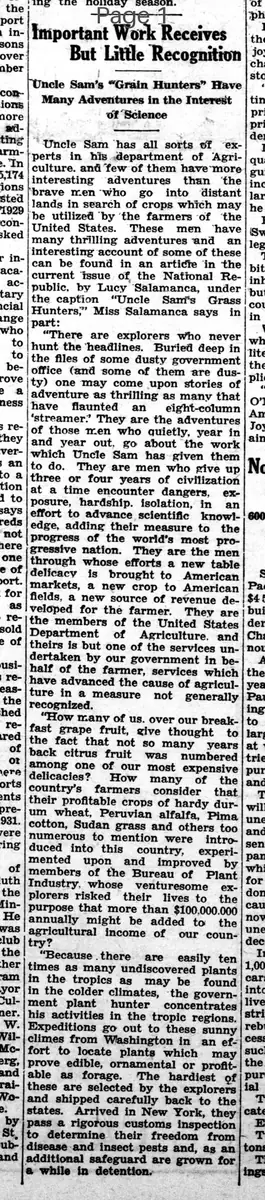
Uncle Sam's "Grain Hunters" Have Many Adventures in the Interest of Science
Uncle Sam has all sorts of experts in his department of Agriculture, and few of them have more interesting adventures than the brave men who go into distant lands in search of crops which may be utilized by the farmers of the United States. These men have many thrilling adventures and an interesting account of some of these can be found in an article in the current issue of the National Republic, by Lucy Salamanca, under the caption "Uncle Sam's Grass Hunters," Miss Salamanca says in part:
"There are explorers who never hunt the headlines. Buried deep in the files of some dusty government office (and some of them are dusty) one may come upon stories of adventure as thrilling as many that have flaunted an eight-column 'streamer.' They are the adventures of those men who quietly, year in and year out, go about "the work which Uncle Sam has given them to do. They are men who give up three or four years of civilization at a time encounter dangers, exposure, hardship, isolation, in an effort to advance scientific knowledge, adding their measure to the progress of the world's most progressive nation. They are the men through whose efforts a new table delicacy is brought to American markets, a new crop to American fields, a new source of revenue developed for the farmer. They are the members of the United States Department of Agriculture, and theirs is but one of the services undertaken by our government in behalf of the farmer, services which have advanced the cause of agriculture in a measure not generally recognized.
"How many of us, over our breakfast grape fruit, give thought to the fact that not so many years back citrus fruit was numbered among one of our most expensive delicacies? How many of the country's farmers consider that their profitable crops of hardy durum wheat, Peruvian alfalfa, Pima cotton, Sudan grass and others too numerous to mention were introduced into this country, experimented upon and improved by members of the Bureau of Plant Industry, whose venturesome explorers risked their lives to the purpose that more than $100,000,000 annually might be added to the agricultural income of our country?
"Because there are easily ten times as many undiscovered plants in the tropics as may be found in the colder climates, the government plant hunter concentrates his activities in the tropic regions. Expeditions go out to these sunny climes from Washington in an effort to locate plants which may prove edible, ornamental or profitable as forage. The hardiest of these are selected by the explorers and shipped carefully back to the states. Arrived in New York, they pass a rigorous customs inspection to determine their freedom from disease and insect pests and, as an additional safeguard are grown for a while in detention."
What sub-type of article is it?
What themes does it cover?
What keywords are associated?
What entities or persons were involved?
Where did it happen?
Story Details
Key Persons
Location
Tropic Regions
Story Details
U.S. Department of Agriculture explorers venture into distant tropical lands, facing dangers and hardships to discover new plants and crops like citrus fruits, durum wheat, Peruvian alfalfa, Pima cotton, and Sudan grass, which are introduced, tested, and improved to add over $100 million annually to American agricultural income.