Thank you for visiting SNEWPapers!
Sign up free
The Liberator
Boston, Suffolk County, Massachusetts
What is this article about?
A Colored Baltimorean praises the Liberator newspaper as a vital advocate for African American rights, urges greater support from the community despite opposition, criticizes their underappreciation of the press's power, and condemns religious editors for ignoring slavery while addressing other issues. Dated February 12, 1831, Baltimore.
Clipping
OCR Quality
Full Text
To the Editor of the Liberator.
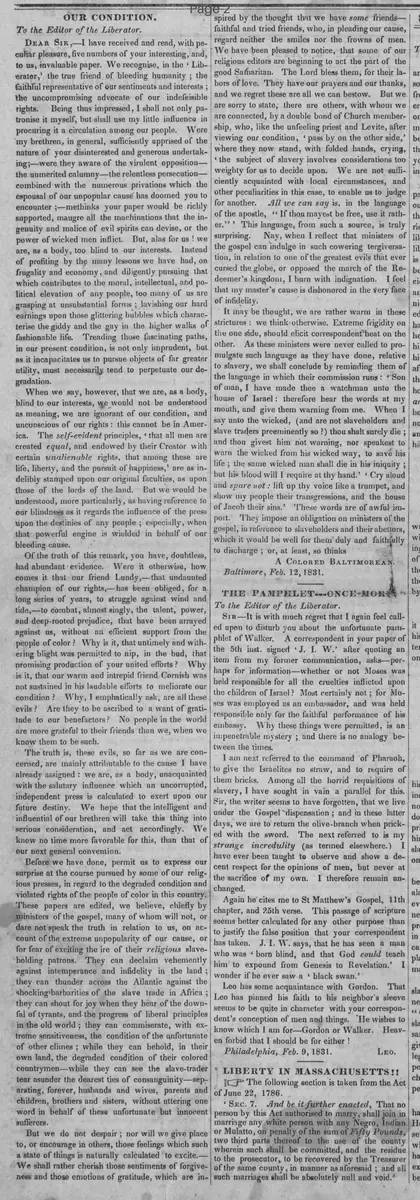
DEAR SIR, I have received and read, with peculiar pleasure, five numbers of your interesting, and to us, invaluable paper. We recognise, in the 'Liberator,' the true friend of bleeding humanity; the faithful representative of our sentiments and interests: the uncompromising advocate of our indefeasible rights. Being thus impressed, I shall not only patronise it myself, but shall use my little influence in procuring it a circulation among our people. Were my brethren, in general, sufficiently apprised of the nature of your disinterested and generous undertaking;—were they aware of the virulent opposition—the unmerited calumny—the relentless persecution—combined with the numerous privations which the espousal of our unpopular cause has doomed you to encounter;—methinks your paper would be richly supported, maugre all the machinations that the ingenuity and malice of evil spirits can devise, or the power of wicked men inflict. But, alas for us! we are, as a body, too blind to our interests. Instead of profiting by the many lessons we have had, on frugality and economy, and diligently pursuing that which contributes to the moral, intellectual, and political elevation of any people, too many of us are grasping at unsubstantial forms; lavishing our hard earnings upon those glittering bubbles which characterise the giddy and the gay in the higher walks of fashionable life. Treading those fascinating paths, in our present condition, is not only imprudent, but as it incapacitates us to pursue objects of far greater utility, must necessarily tend to perpetuate our degradation.
When we say, however, that we are, as a body, blind to our interests, we would not be understood as meaning, we are ignorant of our condition, and unconscious of our rights: this cannot be in America. The self-evident principles, 'that all men are created equal, and endowed by their Creator with certain unalienable rights, that among these are life, liberty, and the pursuit of happiness,' are as indelibly stamped upon our original faculties, as upon those of the lords of the land. But we would be understood, more particularly, as having reference to our blindness as it regards the influence of the press upon the destinies of any people; especially, when that powerful engine is wielded in behalf of our bleeding cause.
Of the truth of this remark, you have, doubtless, had abundant evidence. Were it otherwise, how comes it that our friend Lundy,—that undaunted champion of our rights,—has been obliged, for a long series of years, to struggle against wind and tide,—to combat, almost singly, the talent, power, and deep-rooted prejudice, that have been arrayed against us, without an efficient support from the people of color? Why is it, that untimely and withering blight was permitted to nip, in the bud, that promising production of your united efforts? Why is it, that our warm and intrepid friend Cornish was not sustained in his laudable efforts to meliorate our condition? Why, I emphatically ask, are all these evils? Are they to be ascribed to a want of gratitude to our benefactors? No people in the world are more grateful to their friends than we, when we know them to be such.
The truth is, these evils, so far as we are concerned, are mainly attributable to the cause I have already assigned: we are, as a body, unacquainted with the salutary influence which an uncorrupted, independent press is calculated to exert upon our future destiny. We hope that the intelligent and influential of our brethren will take this thing into serious consideration, and act accordingly. We know no time more favorable for this, than that of our next general convention.
Before we have done, permit us to express our surprise at the course pursued by some of our religious presses, in regard to the degraded condition and violated rights of the people of color in this country. These papers are edited, we believe, chiefly by ministers of the gospel, many of whom will not, or dare not speak the truth in relation to us, on account of the extreme unpopularity of our cause, or for fear of exciting the ire of their religious slaveholding patrons. They can declaim vehemently against intemperance and infidelity in the land; they can thunder across the Atlantic against the shocking barbarities of the slave trade in Africa: they can shout for joy when they hear of the downfall of tyrants, and the progress of liberal principles in the old world; they can commiserate, with extreme sensitiveness, the condition of the unfortunate of other climes; while they can behold, in their own land, the degraded condition of their colored countrymen—while they can see the slave-trader tear asunder the dearest ties of consanguinity—separating, forever, husbands and wives, parents and children, brothers and sisters, without uttering one word in behalf of these unfortunate but innocent sufferers.
But we do not despair; nor will we give place to, or encourage in others, those feelings which such a state of things is naturally calculated to excite.—We shall rather cherish those sentiments of forgiveness and those emotions of gratitude, which are inspired by the thought that we have some friends—faithful and tried friends, who, in pleading our cause, regard neither the smiles nor the frowns of men. We have been pleased to notice, that some of our religious editors are beginning to act the part of the good Samaritan. The Lord bless them, for their labors of love. They have our prayers and our thanks, and we regret these are all we can bestow. But we are sorry to state, there are others, with whom we are connected, by a double bond of Church membership, who, like the unfeeling priest and Levite, after viewing our condition, pass by on the other side, where they now stand, with folded hands, crying, 'the subject of slavery involves considerations too weighty for us to decide upon. We are not sufficiently acquainted with local circumstances, and other peculiarities in this case, to enable us to judge for another. All we can say is, in the language of the apostle, "If thou mayest be free, use it rather."' ; This language, from such a source, is truly surprising. Nay, when I reflect that ministers of the gospel can indulge in such cowering tergiversation, in relation to one of the greatest evils that ever cursed the globe, or opposed the march of the Redeemer's kingdom, I burn with indignation. I feel that my master's cause is dishonored in the very face of infidelity.
It may be thought, we are rather warm in these strictures: we think otherwise. Extreme frigidity on the one side, should elicit correspondent heat on the other. As these ministers were never called to promulgate such language as they have done, relative to slavery, we shall conclude by reminding them of the language in which their commission runs: Son of man, I have made thee a watchman unto the house of Israel: therefore hear the words at my mouth, and give them warning from me. When I say unto the wicked, (and are not slaveholders and slave traders preeminently so?) thou shalt surely die; and thou givest him not warning, nor speakest to warn the wicked from his wicked way, to save his life; the same wicked man shall die in his iniquity; but his blood will I require at thy hand.' Cry aloud and spare not: lift up thy voice like a trumpet, and show my people their transgressions, and the house of Jacob their sins.' These words are of awful import. They impose an obligation on ministers of the gospel, in reference to slaveholders and their abettors, which it would be well for them duly and faithfully to discharge; or, at least, so thinks
A COLORED BALTIMOREAN.
Baltimore, Feb. 12, 1831.
What sub-type of article is it?
What themes does it cover?
What keywords are associated?
What entities or persons were involved?
Letter to Editor Details
Author
A Colored Baltimorean.
Recipient
Editor Of The Liberator
Main Argument
the writer urges african americans to support the liberator newspaper more robustly, recognizing its vital role in advocating for their rights against slavery, and criticizes religious presses and ministers for their silence on the issue despite their moral obligations.
Notable Details