Thank you for visiting SNEWPapers!
Sign up free
Literary
August 14, 1867
The Fairfield Herald
Winnsboro, Fairfield County, South Carolina
What is this article about?
General Wade Hampton recounts exploits of Confederate cavalry scouts during the Civil War, including a disguised scout's infiltration of Union lines and Sergeant Shadbourne's daring captures and escapes, highlighting their bravery and skill in gathering intelligence.
Clipping
OCR Quality
98%
Excellent
Full Text
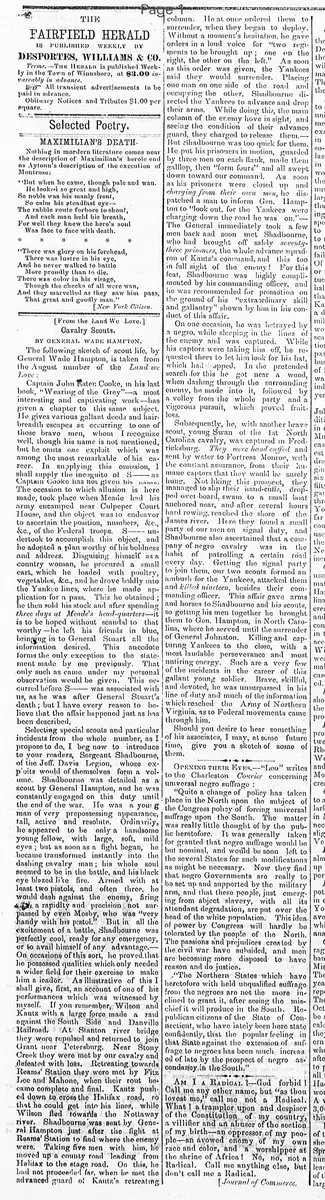
[From the Land We Love.]
Cavalry Scouts.
BY GENERAL WADE HAMPTON.
The following sketch of scout life, by General Wade Hampton, is taken from the August number of the Land We Love:
Captain John Esten Cooke, in his last book, "Wearing of the Gray," a most interesting and captivating work, has given a chapter to this same subject. He gives various gallant deeds and hair-breadth escapes as occurring to one of those brave men, whom I recognize well, though his name is not mentioned, but he omits one exploit which was among the most remarkable of his career. In supplying this omission, I shall supply the incognito of S— as Captain Cooke has not given his name.
The occasion to which allusion is here made, took place when Meade had his army encamped near Culpeper Court House, and the object was to endeavor to ascertain the position, numbers, &c., &c., of the Federal troops. S— undertook to accomplish this object, and he adopted a plan worthy of his boldness and address. Disguising himself as a country woman, he procured a small cart, which he loaded with poultry, vegetables, &c., and he drove boldly into the Yankee lines, where he made application for a pass. This he obtained; he then sold his stock and after spending three days at Meade's headquarters—it is to be hoped without scandal to that worthy—he left his friends in blue, bringing in to General Stuart all the information desired. This anecdote forms the only exception to the statement made by me previously. That only such as came under my personal observation would be given. This occurred before S— was associated with us, as he was after General Stuart's death; but I have every reason to believe that the affair happened just as has been described.
Selecting special scouts and particular incidents from the whole number, as I propose to do, I beg now to introduce to your readers, Sergeant Shadbourne, of the Jeff. Davis Legion, whose exploits would of themselves form a volume. Shadbourne was detailed as a scout by General Hampton, and he was constantly engaged on this duty until the end of the war. He was a young man of very prepossessing appearance, tall, active and resolute. Ordinarily, he appeared to be only a handsome young fellow, with large, soft, mild eyes; but as soon as a fight began, he became transformed instantly into the dashing cavalry man; his whole soul seemed to be in the battle, and his black eye blazed like fire. Armed with at least two pistols, and often three, he would dash against the enemy, firing with a rapidity and precision not surpassed by even Mosby, who was "very handy with his pistol." But in all the excitement of a battle, Shadbourne was perfectly cool, ready for any emergency, or to avail himself of any advantage.— On occasions of this sort, he proved that he possessed qualities which only needed a wider field for their exercise to make him a leader. As illustrative of this I shall give, first, an account of one of his performances which was witnessed by myself. If you remember, Wilson and Kautz with a large force made a raid against the South Side and Danville Railroad. At Staunton River Bridge they were repulsed and returned to join Grant near Petersburg. Near Stony Creek they were met by our cavalry and defeated with loss. Retreating towards Reams' Station they were met by Fitz Lee and Mahone, when their rout became complete and final. Kautz pushed down to cross the Halifax road, so that he could get into his lines, while Wilson fled towards the Nottoway River. Shadbourne was sent by General Hampton just after the fight at Reams' Station to find where the enemy were. Taking five men with him, he moved up a county road leading from Halifax to the stage road. On this, he had not proceeded far, when he met the advanced guard of Kautz's retreating column. He at once ordered them to surrender, when they began to deploy. Without a moment's hesitation, he gave orders in a loud voice for "two regiments to be brought up; one on the right, the other on the left." As soon as this order was given, the Yankees said they would surrender. Placing one man on one side of the road and occupying the other, Shadbourne directed the Yankees to advance and drop their arms. While doing this, the main column of the enemy hove in sight, and seeing the condition of their advance guard, they charged to release them.— But Shadbourne was too quick for them. He put his prisoners in motion, guarded by three men on each flank, made them gallop, then "form fours" and all swept down toward our command. As soon as his prisoners were closed up and charging from their own men, he dispatched a man to inform Gen. Hampton to "look out, for the Yankees were charging down the road he was on."— The General immediately took a few men back and soon met Shadbourne, who had brought off safely seventy-three prisoners, the whole advance squadron of Kautz's command, and this too in full sight of the enemy! For this feat, Shadbourne was highly complimented by his commanding officer, and he was recommended for promotion on the ground of his "extraordinary skill and gallantry" shown by him in his conduct of this affair.
On one occasion, he was betrayed by a negro, while sleeping in the lines of the enemy and was captured. While his captors were taking him off, he requested them to let him look for his hat, which had dropped. In the pretended search for this he got near a wood, when dashing through the surrounding enemy, he made into it, followed by a volley from the whole party and a vigorous pursuit, which proved fruitless.
Subsequently, he, with another brave scout, young Swan of the 1st North Carolina cavalry, was captured in Fredericksburg. They were hand-cuffed and sent by water to Fortress Monroe, with the constant assurance, from their humane captors that they would be surely hung. Not liking this prospect, they managed to slip their hand-cuffs, dropped over-board, swam to a small boat anchored near, and after several hours hard rowing, reached the shore of the James River. Here they found a small party of our men on signal duty, and Shadbourne also ascertained that a company of negro cavalry was in the habit of patrolling a certain road every day. Getting the signal party to join them, our two scouts formed an ambush for the Yankees, attacked them and killed nineteen, besides their commanding officer. This affair gave arms and horses to Shadbourne and his scouts, so getting his men together he brought them to Gen. Hampton, in North Carolina, where he served until the surrender of General Johnston. Killing and capturing Yankees to the close, with a most laudable perseverance and most untiring energy. Such are a very few of the incidents in the career of this gallant young soldier. Brave, skillful, and devoted, he was unsurpassed in his line of duty and much of the information which reached the Army of Northern Virginia, as to Federal movements came through him.
Should you desire to hear something of his associates, I may, at some future time, give you a sketch of some of them.
Cavalry Scouts.
BY GENERAL WADE HAMPTON.
The following sketch of scout life, by General Wade Hampton, is taken from the August number of the Land We Love:
Captain John Esten Cooke, in his last book, "Wearing of the Gray," a most interesting and captivating work, has given a chapter to this same subject. He gives various gallant deeds and hair-breadth escapes as occurring to one of those brave men, whom I recognize well, though his name is not mentioned, but he omits one exploit which was among the most remarkable of his career. In supplying this omission, I shall supply the incognito of S— as Captain Cooke has not given his name.
The occasion to which allusion is here made, took place when Meade had his army encamped near Culpeper Court House, and the object was to endeavor to ascertain the position, numbers, &c., &c., of the Federal troops. S— undertook to accomplish this object, and he adopted a plan worthy of his boldness and address. Disguising himself as a country woman, he procured a small cart, which he loaded with poultry, vegetables, &c., and he drove boldly into the Yankee lines, where he made application for a pass. This he obtained; he then sold his stock and after spending three days at Meade's headquarters—it is to be hoped without scandal to that worthy—he left his friends in blue, bringing in to General Stuart all the information desired. This anecdote forms the only exception to the statement made by me previously. That only such as came under my personal observation would be given. This occurred before S— was associated with us, as he was after General Stuart's death; but I have every reason to believe that the affair happened just as has been described.
Selecting special scouts and particular incidents from the whole number, as I propose to do, I beg now to introduce to your readers, Sergeant Shadbourne, of the Jeff. Davis Legion, whose exploits would of themselves form a volume. Shadbourne was detailed as a scout by General Hampton, and he was constantly engaged on this duty until the end of the war. He was a young man of very prepossessing appearance, tall, active and resolute. Ordinarily, he appeared to be only a handsome young fellow, with large, soft, mild eyes; but as soon as a fight began, he became transformed instantly into the dashing cavalry man; his whole soul seemed to be in the battle, and his black eye blazed like fire. Armed with at least two pistols, and often three, he would dash against the enemy, firing with a rapidity and precision not surpassed by even Mosby, who was "very handy with his pistol." But in all the excitement of a battle, Shadbourne was perfectly cool, ready for any emergency, or to avail himself of any advantage.— On occasions of this sort, he proved that he possessed qualities which only needed a wider field for their exercise to make him a leader. As illustrative of this I shall give, first, an account of one of his performances which was witnessed by myself. If you remember, Wilson and Kautz with a large force made a raid against the South Side and Danville Railroad. At Staunton River Bridge they were repulsed and returned to join Grant near Petersburg. Near Stony Creek they were met by our cavalry and defeated with loss. Retreating towards Reams' Station they were met by Fitz Lee and Mahone, when their rout became complete and final. Kautz pushed down to cross the Halifax road, so that he could get into his lines, while Wilson fled towards the Nottoway River. Shadbourne was sent by General Hampton just after the fight at Reams' Station to find where the enemy were. Taking five men with him, he moved up a county road leading from Halifax to the stage road. On this, he had not proceeded far, when he met the advanced guard of Kautz's retreating column. He at once ordered them to surrender, when they began to deploy. Without a moment's hesitation, he gave orders in a loud voice for "two regiments to be brought up; one on the right, the other on the left." As soon as this order was given, the Yankees said they would surrender. Placing one man on one side of the road and occupying the other, Shadbourne directed the Yankees to advance and drop their arms. While doing this, the main column of the enemy hove in sight, and seeing the condition of their advance guard, they charged to release them.— But Shadbourne was too quick for them. He put his prisoners in motion, guarded by three men on each flank, made them gallop, then "form fours" and all swept down toward our command. As soon as his prisoners were closed up and charging from their own men, he dispatched a man to inform Gen. Hampton to "look out, for the Yankees were charging down the road he was on."— The General immediately took a few men back and soon met Shadbourne, who had brought off safely seventy-three prisoners, the whole advance squadron of Kautz's command, and this too in full sight of the enemy! For this feat, Shadbourne was highly complimented by his commanding officer, and he was recommended for promotion on the ground of his "extraordinary skill and gallantry" shown by him in his conduct of this affair.
On one occasion, he was betrayed by a negro, while sleeping in the lines of the enemy and was captured. While his captors were taking him off, he requested them to let him look for his hat, which had dropped. In the pretended search for this he got near a wood, when dashing through the surrounding enemy, he made into it, followed by a volley from the whole party and a vigorous pursuit, which proved fruitless.
Subsequently, he, with another brave scout, young Swan of the 1st North Carolina cavalry, was captured in Fredericksburg. They were hand-cuffed and sent by water to Fortress Monroe, with the constant assurance, from their humane captors that they would be surely hung. Not liking this prospect, they managed to slip their hand-cuffs, dropped over-board, swam to a small boat anchored near, and after several hours hard rowing, reached the shore of the James River. Here they found a small party of our men on signal duty, and Shadbourne also ascertained that a company of negro cavalry was in the habit of patrolling a certain road every day. Getting the signal party to join them, our two scouts formed an ambush for the Yankees, attacked them and killed nineteen, besides their commanding officer. This affair gave arms and horses to Shadbourne and his scouts, so getting his men together he brought them to Gen. Hampton, in North Carolina, where he served until the surrender of General Johnston. Killing and capturing Yankees to the close, with a most laudable perseverance and most untiring energy. Such are a very few of the incidents in the career of this gallant young soldier. Brave, skillful, and devoted, he was unsurpassed in his line of duty and much of the information which reached the Army of Northern Virginia, as to Federal movements came through him.
Should you desire to hear something of his associates, I may, at some future time, give you a sketch of some of them.
What sub-type of article is it?
Essay
What themes does it cover?
War Peace
Patriotism
What keywords are associated?
Cavalry Scouts
Confederate Exploits
Civil War Anecdotes
Sergeant Shadbourne
General Hampton
Intelligence Gathering
Prisoner Capture
What entities or persons were involved?
By General Wade Hampton
Literary Details
Title
Cavalry Scouts
Author
By General Wade Hampton
Subject
Sketch Of Scout Life
Form / Style
Anecdotal Memoir In Prose
Key Lines
Disguising Himself As A Country Woman, He Procured A Small Cart, Which He Loaded With Poultry, Vegetables, &C., And He Drove Boldly Into The Yankee Lines, Where He Made Application For A Pass.
He At Once Ordered Them To Surrender, When They Began To Deploy. Without A Moment's Hesitation, He Gave Orders In A Loud Voice For "Two Regiments To Be Brought Up; One On The Right, The Other On The Left."
Brave, Skillful, And Devoted, He Was Unsurpassed In His Line Of Duty And Much Of The Information Which Reached The Army Of Northern Virginia, As To Federal Movements Came Through Him.