Thank you for visiting SNEWPapers!
Sign up free
Story
December 16, 1823
Alexandria Gazette & Advertiser
Alexandria, Virginia
What is this article about?
Harrison G. Dyar, formerly of Middlebury College, VT, invents a novel clock in New York with a cycloidal pendulum for equal vibrations, simple striking mechanism, and wheels enabling long operation periods up to a century. Two prototypes operate at Swain and Dyar's manufactory.
Clipping
OCR Quality
98%
Excellent
Full Text
From a New York Paper.
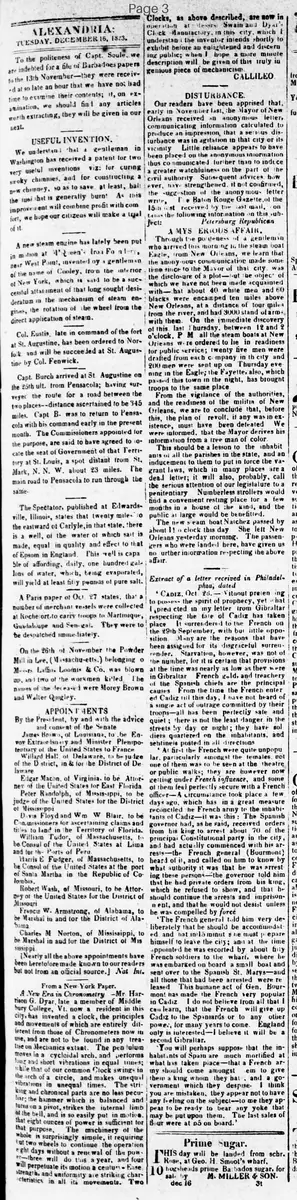
A New Era in Chronometry—Mr. Harrison G. Dyar, late a member of Middlebury College, Vt. now a resident in this city, has invented a clock, the principles and movements of which are entirely different from those of Chronometers now in use, and are not to be found in any treatise on Mechanics extant. The pendulum moves in a cycloidal arch, and performs long and short vibrations in equal times; while that of our common clock swings in the arch of a circle, and makes unequal vibrations in unequal times. The striking and chiming parts are no less peculiar; the hammer which is balanced and turns on a pivot, strikes the internal limb of the bell, and is so easily put in motion that eight ounces of power is sufficient for that purpose. The whole is surprisingly simple, it requiring but two wheels to continue the operation eight days without a renewal of the power—three will do thus a year, and four will perpetuate its motion a century. Ease, strength, and uniformity are striking characteristics in all its movements. Two Clocks, as above described, are now in operation at Messrs. Swain and Dyar's Clock Manufactory, in this city, which I understand the inventor intends shortly to exhibit before an enlightened and discerning public; when I hope a more minute description will be given of this truly ingenious piece of mechanism.
A New Era in Chronometry—Mr. Harrison G. Dyar, late a member of Middlebury College, Vt. now a resident in this city, has invented a clock, the principles and movements of which are entirely different from those of Chronometers now in use, and are not to be found in any treatise on Mechanics extant. The pendulum moves in a cycloidal arch, and performs long and short vibrations in equal times; while that of our common clock swings in the arch of a circle, and makes unequal vibrations in unequal times. The striking and chiming parts are no less peculiar; the hammer which is balanced and turns on a pivot, strikes the internal limb of the bell, and is so easily put in motion that eight ounces of power is sufficient for that purpose. The whole is surprisingly simple, it requiring but two wheels to continue the operation eight days without a renewal of the power—three will do thus a year, and four will perpetuate its motion a century. Ease, strength, and uniformity are striking characteristics in all its movements. Two Clocks, as above described, are now in operation at Messrs. Swain and Dyar's Clock Manufactory, in this city, which I understand the inventor intends shortly to exhibit before an enlightened and discerning public; when I hope a more minute description will be given of this truly ingenious piece of mechanism.
What sub-type of article is it?
Curiosity
Personal Triumph
What themes does it cover?
Triumph
What keywords are associated?
Clock Invention
Cycloidal Pendulum
Chronometry
Harrison Dyar
New York Manufactory
What entities or persons were involved?
Harrison G. Dyar
Where did it happen?
New York
Story Details
Key Persons
Harrison G. Dyar
Location
New York
Story Details
Mr. Harrison G. Dyar invents a clock with cycloidal pendulum for equal vibrations, simple balanced hammer striking, and minimal wheels for extended operation up to a century; two are operating at Swain and Dyar's manufactory for public exhibition.