Thank you for visiting SNEWPapers!
Sign up free
The Watchman
Hartford, Hartford County, Connecticut
What is this article about?
In this installment of Charles Evans's autobiographical narrative, he describes his recovery from nervous illness through medical treatment, exercise, and diversion. He reflects on common errors in treating such conditions, emphasizing physical causes and appropriate remedies. He then recounts a later episode of religious melancholy, triggered by self-examination and fears of hypocrisy, leading to intense guilt without evidence.
Clipping
OCR Quality
Full Text
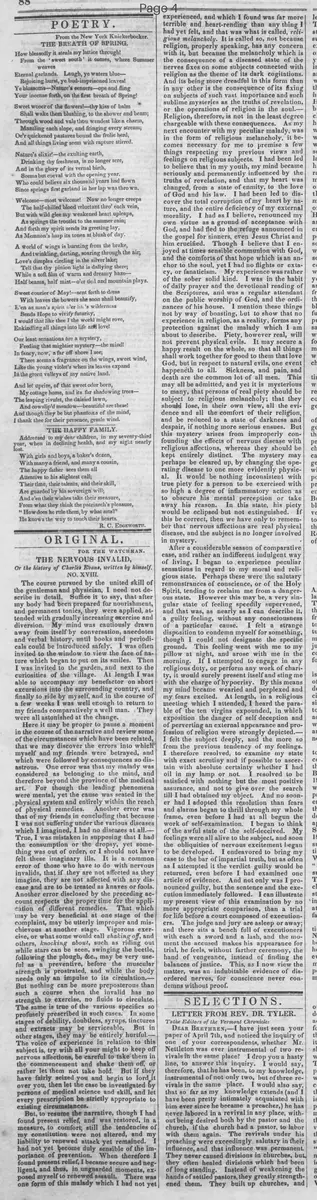
FOR THE WATCHMAN.
THE NERVOUS INVALID,
Or the history of Charles Evans, written by himself
NO. XVIII.
The course pursued by the united skill of the gentleman and physician, I need not describe in detail. Suffice it to say, that after my body had been prepared for nourishment, and permanent tonics, they were applied, attended with gradually increasing exercise and diversion. My mind was cautiously drawn away from itself by conversation, anecdotes and verbal history, until books and periodicals could be introduced safely. I was often invited to the window to view the face of nature which began to put on its smiles. Then I was invited to the garden, and next to the curiosities of the village. At length I was able to accompany my benefactor on short excursions into the surrounding country, and finally to ride by myself, and in the course of a few weeks I was well enough to return to my friends comparatively a well man. They were all astonished at the change.
Here it may be proper to pause a moment in the course of the narrative and review some of the circumstances which have been related, that we may discover the errors into which myself and my friends were betrayed, and which were followed by consequences so disastrous. One error was that my malady was considered as belonging to the mind, and therefore beyond the province of the medical art. For though the leading phenomena were mental, yet the cause was seated in the physical system and entirely within the reach of physical remedies. Another error was that of my friends in concluding that because I was not suffering under the various diseases which I imagined, I had no diseases at all. True. I was mistaken in supposing that I had the consumption or the dropsy, yet something was out of order, or I should not have felt these imaginary ills. It is a common error of those who have to do with nervous invalids, that if they are not affected as they imagine, they are not affected with any disease and are to be treated as knaves or fools. Another error disclosed by the preceding account respects the proper time for the application of different remedies. That which may be very beneficial at one stage of the complaint, may be utterly improper and mischievous at another stage. Vigorous exercise, or what some would call shaking off, and others, knocking about, such as riding out while stars can be seen, swinging the beetle, following the plough, &c., may be very useful as a preventive, before the muscular strength is prostrated, and while the body needs only an impulse to its circulation.— But nothing can be more preposterous than such a course when the invalid has no strength to exercise, no fluids to circulate. The same is true of the various specifics so profusely prescribed in such cases. In some stages of debility, doubtless, syrups, tinctures and extracts may be serviceable. But in other stages, they may be entirely hurtful.— The voice of experience in relation to this subject is, try with all your might to keep off nervous affections, be careful to take them in the commencement and shake them off, or rather let them not take hold. But if they have fairly seized you and begin to lord it over you, then let the case be investigated by persons of medical science and skill, and let every prescription be strictly appropriate to existing circumstances.
But, to resume the narrative, though I had found present relief, and was restored, in a measure, to comfort; still the tendencies of my constitution were not altered, and my liability to renewed attack yet remained. I had not yet become duly sensible of the importance of prevention. When therefore I found present relief, I became secure and negligent, and thus, in unguarded moments, exposed myself to renewed assault. There was one form of this malady which I had not yet experienced, and which I found was far more terrible and heart-rending than any thing I had yet felt. and that was what is called, religious melancholy. It is called so, not because religion, properly speaking, has any concern with it, but because the melancholy which is the consequence of a diseased state of the nerves fixes on some subjects connected with religion as the theme of its dark cogitations. And its being more dreadful in this form than in any other is the consequence of its fixing on subjects of such vast importance and such sublime mysteries as the truths of revelation, or the operations of religion in the soul.— Religion, therefore, is not in the least degree chargeable with these consequences. As my next encounter with my peculiar malady, was in the form of religious melancholy, it becomes necessary for me to premise a few things respecting my previous views and feelings on religious subjects. I had been led to believe that in my youth, my mind became seriously and permanently influenced by the truths of revelation, and that my heart was changed, from a state of enmity, to the love of God and his law. I had been led to discover the total corruption of my heart by nature, and the entire deficiency of my external morality. I had as I believe, renounced my own virtue as a ground of acceptance with God, and had fled to the refuge announced in the gospel for sinners, even Jesus Christ and him crucified. Though I believe that I enjoyed at times sensible communion with God, and the comforts of that hope which is an anchor to the soul, yet I had no flights or ecstasy, or fanaticism. My experience was rather of the sober solid kind. I was in the habit of daily prayer and the devotional reading of the Scriptures, and was a regular attendant on the public worship of God, and the ordinances of his house. I mention these things not by way of boasting, but to show that no experience in religion, as a reality, forms any protection against the malady which I am about to describe. Piety. however real. will not prevent physical evils. It may secure a happy result on the whole, so that all things shall work together for good to them that love God, but in respect to natural evils, one event happeneth to all. Sickness, and pain, and death are the common lot of all men. This may all be admitted, and yet it is mysterious to many, that persons of real piety should be subject to religious melancholy; that they should lose, in their own view, all the evidence and all the comfort of their religion. and be reduced to a state of darkness and despair, if nothing more serious ensues. But this mystery arises from improperly confounding the effects of nervous disease with religious affections, whereas they should be kept entirely distinct. The mystery may perhaps be cleared up, by changing the operating disease to one more evidently physical. It would be nothing inconsistent with true piety for a person to be exercised with so high a degree of inflammatory action as to obscure his mental perception or take away his reason. In this state, his piety would be eclipsed but not extinguished. If this be correct, then we have only to remember that nervous affections are real physical disease, and the subject is no longer involved in mystery.
After a considerable season of comparative ease, and rather an indifferent indulgent way of living, I began to experience peculiar sensations in regard to my moral and religious state. Perhaps these were the salutary remonstrances of conscience, or of the Holy Spirit, tending to reclaim me from a dangerous state. However this may be, a very singular state of feeling speedily supervened, and that was, as nearly as I can describe it, a guilty feeling, without any consciousness of a particular cause. I felt a strange disposition to condemn myself for something, though I could not designate the specific ground. This feeling went with me to my pillow at night, and arose with me in the morning. If I attempted to engage in any religious duty, or perform any work of charity, it would surely present itself and sting me with the charge of hypocrisy. By this means my mind became wearied and perplexed and my fears excited. At length, in a religious meeting which I attended, I heard the parable of the ten virgins expounded, in which exposition the danger of self deception and of perverting an external appearance and profession of religion were strongly depicted.— I felt the subject deeply, and the more so from the previous tendency of my feelings. I therefore resolved, to examine my state with exact scrutiny and if possible to ascertain with absolute certainty whether I had oil in my lamp or not. I resolved to be satisfied with nothing but the most positive assurance, and not to give over the search till I had obtained my object. And no sooner had I adopted this resolution than fears and alarms began to thrill through my whole frame, even before I had at all begun the work of self-examination. I began to think of the awful state of the self-deceived. My feelings were all alive to the subject, and soon the obliquities of nervous excitement began to be developed. I endeavored to bring my case to the bar of impartial truth, but as often as I attempted it the verdict—guilty would be returned, even before I had examined one article of evidence. And not only was I pronounced guilty, but the sentence and the execution immediately followed. I can illustrate my present view of this examination by no more appropriate comparison, than a trial for life before a court composed of executioners. The judge and jury are asleep or away; and there sits a bench full of executioners with each a sword and a lash, and the moment the accused makes his appearance for trial, he feels, without farther ceremony, the hand of vengeance, instead of finding the balances of justice. This, as I now view the matter, was an indubitable evidence of disordered nerves, for conscience never condemns without proof.
What sub-type of article is it?
What themes does it cover?
What keywords are associated?
What entities or persons were involved?
Literary Details
Title
The Nervous Invalid, Or The History Of Charles Evans, Written By Himself No. Xviii.
Author
Charles Evans
Subject
Recovery From Nervous Illness And Onset Of Religious Melancholy
Form / Style
Autobiographical Narrative In Prose
Key Lines