Thank you for visiting SNEWPapers!
Sign up free
Barre Evening Telegram
Barre, Washington County, Vermont
What is this article about?
In 1890, a whale in Bering Sea was found with a harpoon from the American whaler Montezuma, which ceased whaling by 1854, indicating the whale carried it for at least 36 years. William H. Dall recounts discussions with Captain E. P. Herendeen on whales possibly migrating from Greenland to Bering Strait, identified by harpoons, though uncertainties exist due to reused tools.
Clipping
OCR Quality
Full Text
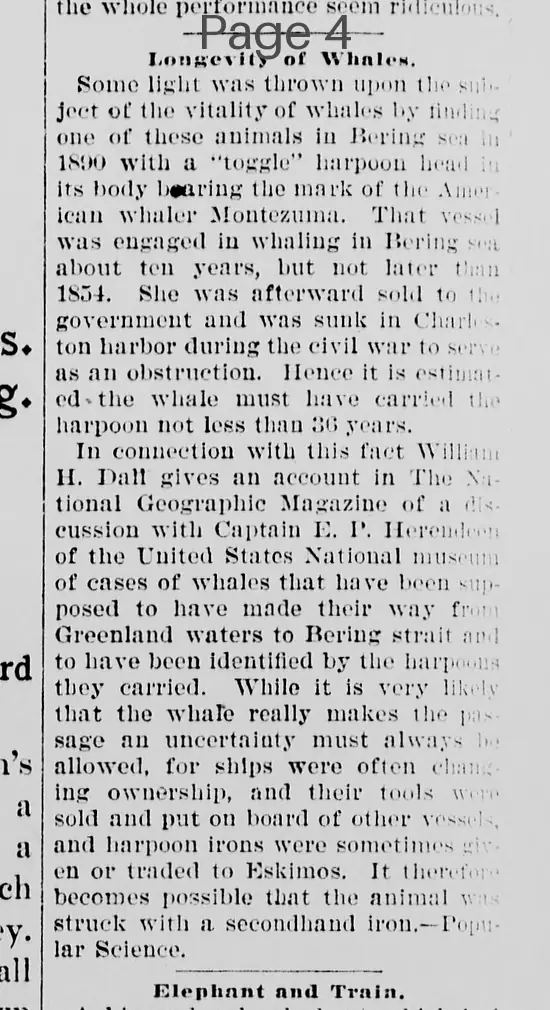
Some light was thrown upon the subject of the vitality of whales by finding one of these animals in Bering sea in 1890 with a "toggle" harpoon head its body bearing the mark of the American whaler Montezuma. That vessel was engaged in whaling in Bering sea about ten years, but not later than 1854. She was afterward sold to the government and was sunk in Charleston harbor during the civil war to serve as an obstruction. Hence it is estimated the whale must have carried the harpoon not less than 36 years.
In connection with this fact William H. Dall gives an account in The National Geographic Magazine of a discussion with Captain E. P. Herendeen. of the United States National museum of cases of whales that have been supposed to have made their way from Greenland waters to Bering strait and to have been identified by the harpoons they carried. While it is very likely that the whale really makes the passage an uncertainty must always be allowed, for ships were often changing ownership, and their tools were sold and put on board of other vessels and harpoon irons were sometimes given or traded to Eskimos. It therefore becomes possible that the animal was struck with a secondhand iron.--Popular Science.
What sub-type of article is it?
What themes does it cover?
What keywords are associated?
What entities or persons were involved?
Where did it happen?
Story Details
Key Persons
Location
Bering Sea
Event Date
1890
Story Details
A whale found in Bering Sea in 1890 carried a harpoon from the Montezuma, which whaled until 1854, suggesting 36 years of survival. Discussion notes possible migration from Greenland to Bering Strait via harpoon identification, but with doubts due to tool reuse.