Thank you for visiting SNEWPapers!
Sign up free
Editorial
March 1, 1864
Daily State Sentinel
Indianapolis, Marion County, Indiana
What is this article about?
Editorial defends the Democratic Party's loyalty to the Constitution against Republican accusations of disloyalty, criticizes the partisan policies of the Lincoln Administration including abolitionism and national banking, and includes resolutions from the Connecticut Democratic State Convention reaffirming states' rights and opposing revolutionary changes.
Clipping
OCR Quality
96%
Excellent
Full Text
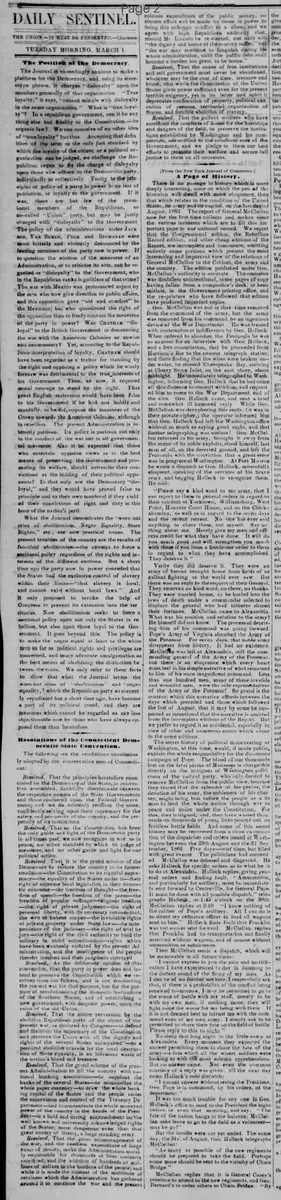
The Position of the Democracy.
The Journal is exceedingly anxious to make a platform for the Democracy, and, using its stereotype phrase, it charges "disloyalty" upon the members generally of that organization. "True loyalty," it says, "cannot mingle with disloyalty in the same organization." What is "true loyalty"? In a republican government, can it be anything else but fidelity to the Constitution—its organic law? We can conceive of no other idea of true loyalty but that. Accepting that definition of the term as the only just standard by which the loyalty of the citizen or a political organization can be judged, we challenge the Republican organ to fix the charge of disloyalty upon those who adhere to the Democratic party, individually or collectively. Fealty to the principles or policy of a party in power is no test of patriotism, or loyalty to the government. If it was, there are but few of the prominent members of the Republican, or so-called "Union" party, but may be justly charged with "disloyalty" to the Government. The policy of the administrations under Jackson, Van Buren, Polk and Buchanan were most bitterly and violently denounced by the leading members of the party now in power. If to question the wisdom of the measures of an Administration, or to criticise its acts, can be regarded as "disloyalty" to the Government, who in the Republican ranks is guiltless of that crime? The war with Mexico was pronounced unjust by the men who now give direction to public affairs, and this opposition gave "aid and comfort" to the Mexicans; but who questioned the right of the opposition then to freely canvass the measures of the party in power? Was Chatham "disloyal" to the British Government in denouncing the war with the American Colonies as unwise and unnecessary? Yet, according to the Republican interpretation of loyalty, Chatham should have been regarded as a traitor for standing by the right and opposing a policy which he wisely foresaw was detrimental to the true interests of his Government. Then, as now, it required moral courage to stand by the right. That great English statesman would have been false to his Government if he had not boldly and manfully, as he did, oppose the measures of the Crown towards the American Colonies, although in rebellion. The present Administration is intensely partisan. Its policy is partisan not only in the conduct of the war but in all governmental measures. Can it be expected that those who entertain opposite views as to the best means of preserving the Government and promoting its welfare, should surrender their convictions at the bidding of their political opponents? In that only are the Democracy "disloyal," and they would have proved false to principle and to their own manhood if they yielded their convictions of right and duty in this hour of the nation's peril.
What the Journal denominates the "worn out cries of abolitionism, Negro Equality, State Rights," etc., are now practical issues. The present troubles of the country are the results of fanatical abolitionism—the attempt to force a sectional policy regardless of the rights and interests of the different sections. But a short time ago the party now in power conceded that the States had the exclusive control of slavery within their limits—“that slavery is local, and cannot exist without local laws.” And it only proposed to invoke the help of Congress to prevent its extension into the territories. Now abolitionism seeks to force a sectional policy upon not only the States in rebellion, but also upon those loyal to the Government. It goes beyond this. The policy is to make the negro equal at least to the white man so far as political rights and privileges are concerned, and many advocate amalgamation as the best means of abolishing the distinction between the races. We only refer to these facts to show that what the Journal terms the worn out cries of "abolitionism" and "negro equality," which the Republican party so earnestly repudiated but a short time ago, have become a part of its political creed, and they are measures which cannot be regarded as any less objectionable now by those who have always opposed them than heretofore.
Resolutions of the Connecticut Democratic State Convention.
The following are the resolutions unanimously adopted by the conservative men of Connecticut:
Resolved, That the principles heretofore enunciated by the Democracy of this State, in convention assembled, faithfully discriminate between the respective powers of the State Governments and those conferred upon the Federal Government; and we do solemnly reaffirm the same, confidently relying upon their supremacy for the safety and prosperity of the country, and the perpetuity of its institutions.
Resolved, That as the Constitution has been the only guide and light of the Democratic party in all times past, we now recognize in war, as in peace, no other standard by which to judge of measures, and no other guide and light for our political action.
Resolved, That it is the grand mission of the Democracy to restore the country to its former condition—the Constitution to its rightful supremacy—the equality of the States under it—their right of supreme local legislation in their domestic concerns—the freedom of thought—the freedom of speech—the freedom of the press—the freedom of popular suffrage—religious freedom—the right of private judgment—the right of personal liberty, with its necessary concomitant, the writ of habeas corpus—the inviolable rights of private property under State laws—the independence of the judiciary—the right of trial by jury—the right of the civil authority to hold the military in strict subordination—rights which have been wantonly violated by the present Administration, and the intelligence of the people thereby insulted and their judgment outraged.
Resolved, As the deliberate opinion of this convention, that the party in power does not intend to preserve the Constitution which we received from our fathers, and is not conducting the present war for that purpose, but for the purpose of revolutionizing the domestic institutions of the Southern States, and of establishing a new government, with despotic power, upon the ruins of the old Union.
Resolved, That the entire perversion by the abolition Republican party of the object of the present war, as declared by Congress to defend and maintain the supremacy of the Constitution and preserve the Union with all the dignity and rights of the several States unimpaired”—to a pestilent abolition crusade for the total destruction of State equality, is an infamous waste of the nation's blood and treasure.
Resolved, That the grand scheme of the present Administration to fill the country with national banking associations—to supplant the banks of the several States—to monopolize the whole paper currency—to draw the whole banking capital of the States and the people under the supervision and control of the Treasury Department—and to concentrate the whole monied power of the country in the hands of the President—is a bold and daring encroachment on the well known and universally acknowledged rights of the States; more dangerous even than that great enemy of liberty, a large standing army.
Resolved, That the gross mismanagement of the war, and the needless expenditure of large sums of money, make the Administration morally responsible for thousands of lives uselessly sacrificed, and the addition of hundreds of millions of dollars to the burdens of the people; and while it is made the interest of the multitude of retainers which the Administration has gathered around it to continue the war and the present ruinous expenditure of the public money, no sincere effort will be made by those in power to bring this unhappy conflict to a close; and we agree with high Republican authority that, should Mr. Lincoln be re-elected, not only will "the dignity and honor of the country suffer," but "the war may continue to languish during his whole administration, until the public debt shall become a burden too great to be borne."
Resolved, That the cause of free institutions and self government must never be abandoned, whatever may be the cost of time, treasure and blood; that while the Constitution of the United States gives power sufficient even for the present terrible exigency, yet in its letter and spirit it deprecates confiscation of property, political execution of persons, territorial organization of States, and forcible abolition of slavery.
Resolved, That the gallant soldiers who have sacrificed the comforts of home for the hardships and dangers of the field, to preserve the institutions established by Washington and his compatriots, are entitled to the solicitous care of the Government; and we pledge to them our best efforts to promote their welfare and secure full justice to them on all occasions.
The Journal is exceedingly anxious to make a platform for the Democracy, and, using its stereotype phrase, it charges "disloyalty" upon the members generally of that organization. "True loyalty," it says, "cannot mingle with disloyalty in the same organization." What is "true loyalty"? In a republican government, can it be anything else but fidelity to the Constitution—its organic law? We can conceive of no other idea of true loyalty but that. Accepting that definition of the term as the only just standard by which the loyalty of the citizen or a political organization can be judged, we challenge the Republican organ to fix the charge of disloyalty upon those who adhere to the Democratic party, individually or collectively. Fealty to the principles or policy of a party in power is no test of patriotism, or loyalty to the government. If it was, there are but few of the prominent members of the Republican, or so-called "Union" party, but may be justly charged with "disloyalty" to the Government. The policy of the administrations under Jackson, Van Buren, Polk and Buchanan were most bitterly and violently denounced by the leading members of the party now in power. If to question the wisdom of the measures of an Administration, or to criticise its acts, can be regarded as "disloyalty" to the Government, who in the Republican ranks is guiltless of that crime? The war with Mexico was pronounced unjust by the men who now give direction to public affairs, and this opposition gave "aid and comfort" to the Mexicans; but who questioned the right of the opposition then to freely canvass the measures of the party in power? Was Chatham "disloyal" to the British Government in denouncing the war with the American Colonies as unwise and unnecessary? Yet, according to the Republican interpretation of loyalty, Chatham should have been regarded as a traitor for standing by the right and opposing a policy which he wisely foresaw was detrimental to the true interests of his Government. Then, as now, it required moral courage to stand by the right. That great English statesman would have been false to his Government if he had not boldly and manfully, as he did, oppose the measures of the Crown towards the American Colonies, although in rebellion. The present Administration is intensely partisan. Its policy is partisan not only in the conduct of the war but in all governmental measures. Can it be expected that those who entertain opposite views as to the best means of preserving the Government and promoting its welfare, should surrender their convictions at the bidding of their political opponents? In that only are the Democracy "disloyal," and they would have proved false to principle and to their own manhood if they yielded their convictions of right and duty in this hour of the nation's peril.
What the Journal denominates the "worn out cries of abolitionism, Negro Equality, State Rights," etc., are now practical issues. The present troubles of the country are the results of fanatical abolitionism—the attempt to force a sectional policy regardless of the rights and interests of the different sections. But a short time ago the party now in power conceded that the States had the exclusive control of slavery within their limits—“that slavery is local, and cannot exist without local laws.” And it only proposed to invoke the help of Congress to prevent its extension into the territories. Now abolitionism seeks to force a sectional policy upon not only the States in rebellion, but also upon those loyal to the Government. It goes beyond this. The policy is to make the negro equal at least to the white man so far as political rights and privileges are concerned, and many advocate amalgamation as the best means of abolishing the distinction between the races. We only refer to these facts to show that what the Journal terms the worn out cries of "abolitionism" and "negro equality," which the Republican party so earnestly repudiated but a short time ago, have become a part of its political creed, and they are measures which cannot be regarded as any less objectionable now by those who have always opposed them than heretofore.
Resolutions of the Connecticut Democratic State Convention.
The following are the resolutions unanimously adopted by the conservative men of Connecticut:
Resolved, That the principles heretofore enunciated by the Democracy of this State, in convention assembled, faithfully discriminate between the respective powers of the State Governments and those conferred upon the Federal Government; and we do solemnly reaffirm the same, confidently relying upon their supremacy for the safety and prosperity of the country, and the perpetuity of its institutions.
Resolved, That as the Constitution has been the only guide and light of the Democratic party in all times past, we now recognize in war, as in peace, no other standard by which to judge of measures, and no other guide and light for our political action.
Resolved, That it is the grand mission of the Democracy to restore the country to its former condition—the Constitution to its rightful supremacy—the equality of the States under it—their right of supreme local legislation in their domestic concerns—the freedom of thought—the freedom of speech—the freedom of the press—the freedom of popular suffrage—religious freedom—the right of private judgment—the right of personal liberty, with its necessary concomitant, the writ of habeas corpus—the inviolable rights of private property under State laws—the independence of the judiciary—the right of trial by jury—the right of the civil authority to hold the military in strict subordination—rights which have been wantonly violated by the present Administration, and the intelligence of the people thereby insulted and their judgment outraged.
Resolved, As the deliberate opinion of this convention, that the party in power does not intend to preserve the Constitution which we received from our fathers, and is not conducting the present war for that purpose, but for the purpose of revolutionizing the domestic institutions of the Southern States, and of establishing a new government, with despotic power, upon the ruins of the old Union.
Resolved, That the entire perversion by the abolition Republican party of the object of the present war, as declared by Congress to defend and maintain the supremacy of the Constitution and preserve the Union with all the dignity and rights of the several States unimpaired”—to a pestilent abolition crusade for the total destruction of State equality, is an infamous waste of the nation's blood and treasure.
Resolved, That the grand scheme of the present Administration to fill the country with national banking associations—to supplant the banks of the several States—to monopolize the whole paper currency—to draw the whole banking capital of the States and the people under the supervision and control of the Treasury Department—and to concentrate the whole monied power of the country in the hands of the President—is a bold and daring encroachment on the well known and universally acknowledged rights of the States; more dangerous even than that great enemy of liberty, a large standing army.
Resolved, That the gross mismanagement of the war, and the needless expenditure of large sums of money, make the Administration morally responsible for thousands of lives uselessly sacrificed, and the addition of hundreds of millions of dollars to the burdens of the people; and while it is made the interest of the multitude of retainers which the Administration has gathered around it to continue the war and the present ruinous expenditure of the public money, no sincere effort will be made by those in power to bring this unhappy conflict to a close; and we agree with high Republican authority that, should Mr. Lincoln be re-elected, not only will "the dignity and honor of the country suffer," but "the war may continue to languish during his whole administration, until the public debt shall become a burden too great to be borne."
Resolved, That the cause of free institutions and self government must never be abandoned, whatever may be the cost of time, treasure and blood; that while the Constitution of the United States gives power sufficient even for the present terrible exigency, yet in its letter and spirit it deprecates confiscation of property, political execution of persons, territorial organization of States, and forcible abolition of slavery.
Resolved, That the gallant soldiers who have sacrificed the comforts of home for the hardships and dangers of the field, to preserve the institutions established by Washington and his compatriots, are entitled to the solicitous care of the Government; and we pledge to them our best efforts to promote their welfare and secure full justice to them on all occasions.
What sub-type of article is it?
Partisan Politics
Constitutional
Slavery Abolition
What keywords are associated?
Democratic Loyalty
Republican Accusations
Constitutional Fidelity
Abolitionism Criticism
States Rights
Civil War Policy
National Banking
Habeas Corpus
Negro Equality
Partisan Administration
What entities or persons were involved?
Democratic Party
Republican Party
Journal
Connecticut Democratic State Convention
Lincoln Administration
Jackson
Van Buren
Polk
Buchanan
Chatham
Editorial Details
Primary Topic
Defense Of Democratic Loyalty Against Republican Charges
Stance / Tone
Strongly Pro Democratic, Critical Of Republican Administration And Abolitionism
Key Figures
Democratic Party
Republican Party
Journal
Connecticut Democratic State Convention
Lincoln Administration
Jackson
Van Buren
Polk
Buchanan
Chatham
Key Arguments
True Loyalty Is Fidelity To The Constitution, Not To The Party In Power
Criticizing Administration Policies Does Not Constitute Disloyalty
Historical Opposition By Republicans To Past Democratic Administrations Shows Hypocrisy
Present Troubles Result From Fanatical Abolitionism Forcing Sectional Policy
Republican Party Has Adopted Abolitionism And Negro Equality Despite Prior Repudiation
Administration Violates Constitutional Rights Including Habeas Corpus And States' Rights
War Is Perverted To Revolutionize Southern Institutions Rather Than Preserve Union
National Banking Scheme Encroaches On States' Rights
Mismanagement Of War Prolongs Conflict And Burdens People
Democracy Aims To Restore Constitutional Supremacy And Support Soldiers