Thank you for visiting SNEWPapers!
Sign up free
The Liberator
Boston, Suffolk County, Massachusetts
What is this article about?
An article from the Dublin Register criticizes Great Britain's commercial treaty with Texas, signed by Lord Palmerston and General James Hamilton, for recognizing the independence of a pro-slavery republic. It quotes Texas's constitution embedding slavery and urges consistency in anti-slavery principles after emancipating West Indian slaves.
Clipping
OCR Quality
Full Text
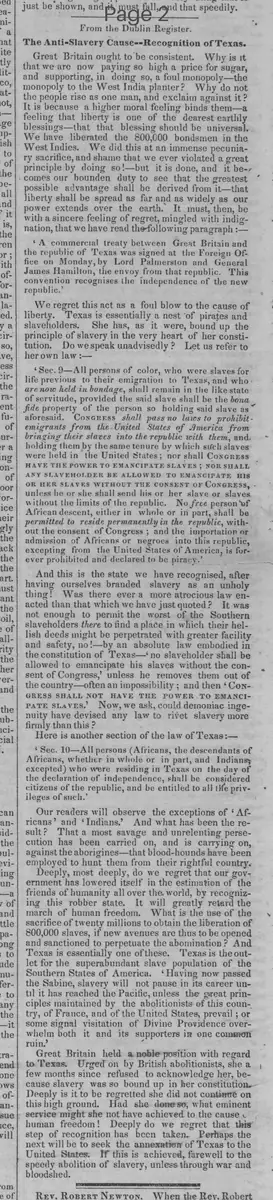
The Anti-Slavery Cause—Recognition of Texas.
Great Britain ought to be consistent. Why is it that we are now paying so high a price for sugar, and supporting, in doing so, a foul monopoly—the monopoly to the West India planter? Why do not the people rise as one man, and exclaim against it? It is because a higher moral feeling binds them—a feeling that liberty is one of the dearest earthly blessings—that that blessing should be universal. We have liberated the 800,000 bondsmen in the West Indies. We did this at an immense pecuniary sacrifice, and shame that we ever violated a great principle by doing so! but it is done, and it becomes our bounden duty to see that the greatest possible advantage shall be derived from it—that liberty shall be spread as far and as widely as our power extends over the earth. It must, then, be with a sincere feeling of regret, mingled with indignation, that we have read the following paragraph: —
A commercial treaty between Great Britain and the republic of Texas was signed at the Foreign Office on Monday, by Lord Palmerston and General James Hamilton, the envoy from that republic. This convention recognises the independence of the new republic.
We regret this act as a foul blow to the cause of liberty. Texas is essentially a nest of pirates and slaveholders. She has, as it were, bound up the principle of slavery in the very heart of her constitution. Do we speak unadvisedly? Let us refer to her own law:
Sec. 9—All persons of color, who were slaves for life previous to their emigration to Texas, and who are now held in bondage, shall remain in the like state of servitude, provided the said slave shall be the bona fide property of the person so holding said slave as aforesaid. Congress shall pass no laws to prohibit emigrants from the United States of America from bringing their slaves into the republic with them, and holding them by the same tenure by which such slaves were held in the United States; nor shall Congress have the power to emancipate slaves; nor shall any slaveholder be allowed to emancipate his or her slaves without the consent of Congress, unless he or she shall send his or her slave or slaves without the limits of the republic. No free person of African descent, either in whole or in part, shall be permitted to reside permanently in the republic, without the consent of Congress; and the importation or admission of Africans or negroes into this republic, excepting from the United States of America, is forever prohibited and declared to be piracy.
And this is the state we have recognised, after having ourselves branded slavery as an unholy thing! Was there ever a more atrocious law enacted than that which we have just quoted? It was not enough to permit the worst of the Southern slaveholders there to find a place in which their hellish deeds might be perpetrated with greater facility and safety, no!—by an absolute law embodied in the constitution of Texas—'no slaveholder shall be allowed to emancipate his slaves without the consent of Congress,' unless he removes them out of the country—often an impossibility; and then 'Congress shall not have the power to emancipate slaves.' Now, we ask, could demoniac ingenuity have devised any law to rivet slavery more firmly than this? Here is another section of the law of Texas: —
Sec. 10—All persons (Africans, the descendants of Africans, whether in whole or in part, and Indians, excepted) who were residing in Texas on the day of the declaration of independence, shall be considered citizens of the republic, and be entitled to all the privileges of such.
Our readers will observe the exceptions of 'Africans' and 'Indians.' And what has been the result? That a most savage and unrelenting persecution has been carried on, and is carrying on, against the aborigines—that blood-hounds have been employed to hunt them from their rightful country. Deeply, most deeply, do we regret that our government has lowered itself in the estimation of the friends of humanity all over the world, by recognising this robber state. It will greatly retard the march of human freedom. What is the use of the sacrifice of twenty millions to obtain the liberation of 800,000 slaves, if new avenues are thus to be opened and sanctioned to perpetuate the abomination? And Texas is essentially one of these. Texas is the outlet for the superabundant slave population of the Southern States of America. Having now passed the Sabine, slavery will not pause in its career until it has reached the Pacific, unless the great principles maintained by the abolitionists of this country, of France, and of the United States, prevail; or some signal visitation of Divine Providence overwhelm both it and its supporters in one common ruin. Great Britain held a noble position with regard to Texas. Urged on by British abolitionists, she a few months since refused to acknowledge her, because slavery was so bound up in her constitution. Deeply is it to be regretted she did not continue on this high ground. Had she done so, what eminent service might she not have achieved to the cause human freedom! Deeply do we regret that this step of recognition has been taken. Perhaps the next will be to seek the annexation of Texas to the United States. If this is achieved, farewell to the speedy abolition of slavery, unless through war and bloodshed.
What sub-type of article is it?
What keywords are associated?
What entities or persons were involved?
Where did it happen?
Foreign News Details
Primary Location
Texas
Event Date
On Monday
Key Persons
Outcome
signing of a commercial treaty recognizing the independence of the republic of texas
Event Details
Great Britain signed a commercial treaty with the Republic of Texas, recognizing its independence, despite Texas's constitution embedding and perpetuating slavery, as quoted in Sections 9 and 10. The article condemns this as a blow to anti-slavery efforts following the emancipation of West Indian slaves.