Thank you for visiting SNEWPapers!
Sign up free
The Daily Ardmoreite
Ardmore, Carter County, Oklahoma
What is this article about?
Report on the Bolshevist uprising in Berlin, comparing it to 1848 events and Paris Commune. Describes mild resistance, little bloodshed, and government's restrained response involving Ebert, Scheidemann, and others. Liebknecht reported dead; negotiations possible.
Clipping
OCR Quality
Full Text
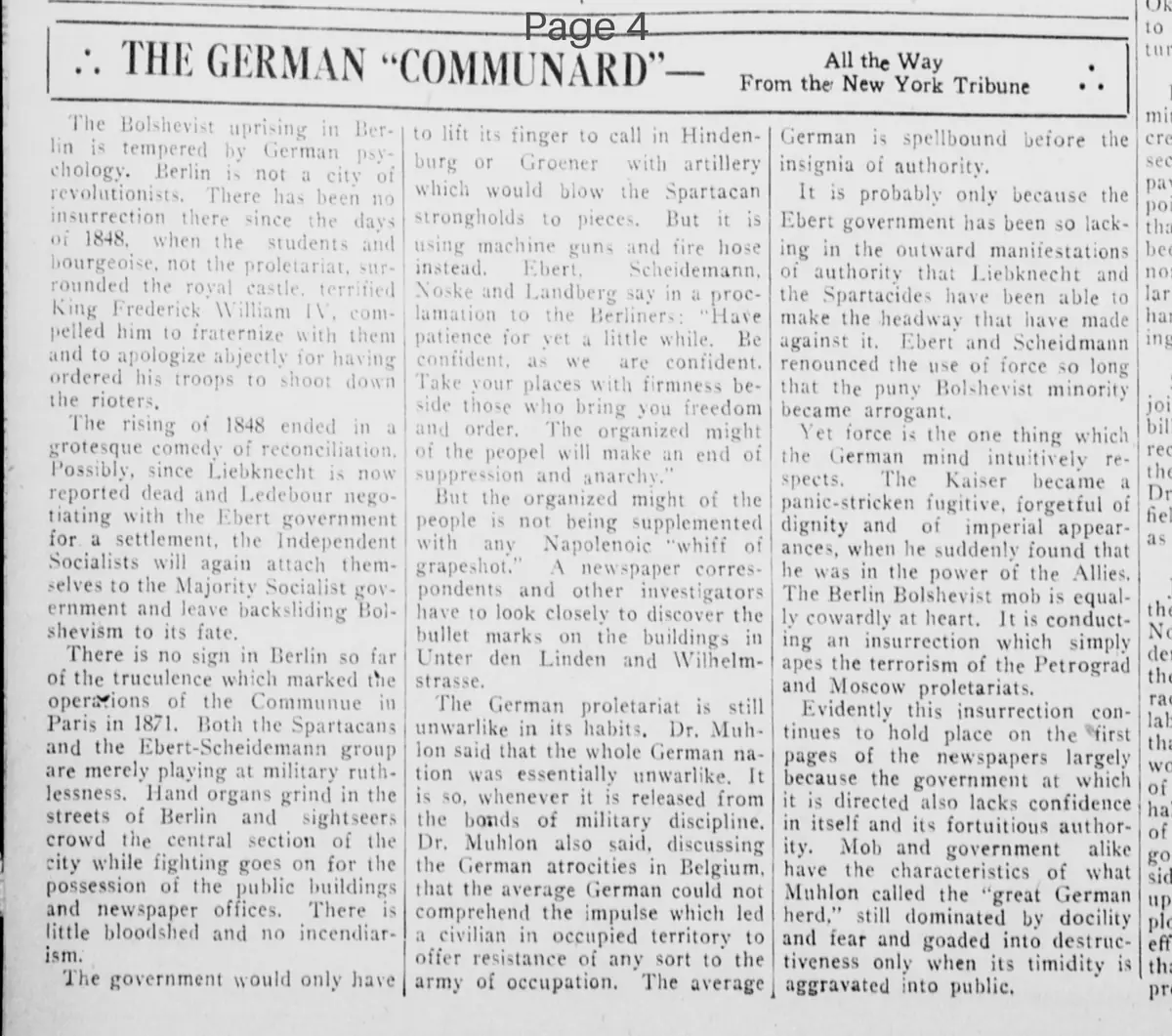
All the Way From the New York Tribune
The Bolshevist uprising in Berlin is tempered by German psychology. Berlin is not a city of revolutionists. There has been no insurrection there since the days of 1848, when the students and bourgeoisie, not the proletariat, surrounded the royal castle, terrified King Frederick William IV, compelled him to fraternize with them and to apologize abjectly for having ordered his troops to shoot down the rioters.
The rising of 1848 ended in a grotesque comedy of reconciliation. Possibly, since Liebknecht is now reported dead and Ledebour negotiating with the Ebert government for a settlement, the Independent Socialists will again attach themselves to the Majority Socialist government and leave backsliding Bolshevism to its fate.
There is no sign in Berlin so far of the truculence which marked the operations of the Commune in Paris in 1871. Both the Spartacans and the Ebert-Scheidemann group are merely playing at military ruthlessness. Hand organs grind in the streets of Berlin and sightseers crowd the central section of the city while fighting goes on for the possession of the public buildings and newspaper offices. There is little bloodshed and no incendiarism.
The government would only have to lift a finger to call in Hindenburg or Groener with artillery which would blow the Spartacan strongholds to pieces. But it is using machine guns and fire hose instead. Ebert, Scheidemann, Noske and Landsberg say in a proclamation to the Berliners: "Have patience for yet a little while. Be confident, as we are confident. Take your places with firmness beside those who bring you freedom and order. The organized might of the people will make an end of suppression and anarchy."
But the organized might of the people is not being supplemented with any Napoleonic "whiff of grapeshot." A newspaper correspondent and other investigators have to look closely to discover the bullet marks on the buildings in Unter den Linden and Wilhelmstrasse.
The German proletariat is still unwarlike in its habits. Dr. Muhlon said that the whole German nation was essentially unwarlike. It is so, whenever it is released from the bonds of military discipline. Dr. Muhlon also said, discussing the German atrocities in Belgium, that the average German could not comprehend the impulse which led a civilian in occupied territory to offer resistance of any sort to the army of occupation. The average German is spellbound before the insignia of authority.
It is probably only because the Ebert government has been so lacking in the outward manifestations of authority that Liebknecht and the Spartacides have been able to make the headway that they have made against it. Ebert and Scheidemann renounced the use of force so long that the puny Bolshevist minority became arrogant.
Yet force is the one thing which the German mind intuitively respects. The Kaiser became a panic-stricken fugitive, forgetful of dignity and of imperial appearances, when he suddenly found that he was in the power of the Allies.
The Berlin Bolshevist mob is equally cowardly at heart. It is conducting an insurrection which simply apes the terrorism of the Petrograd and Moscow proletariats.
Evidently this insurrection continues to hold place on the first pages of the newspapers largely because the government at which it is directed also lacks confidence in itself and its fortuitous authority.
Mob and government alike have the characteristics of what Muhlon called the "great German herd," still dominated by docility and fear and goaded into destructiveness only when its timidity is aggravated into panic.
What sub-type of article is it?
What keywords are associated?
What entities or persons were involved?
Where did it happen?
Foreign News Details
Primary Location
Berlin
Key Persons
Outcome
little bloodshed and no incendiarism. liebknecht reported dead. ledebour negotiating with the ebert government for a settlement.
Event Details
Bolshevist uprising in Berlin involving Spartacans against the Ebert-Scheidemann government. Fighting for public buildings and newspaper offices with minimal violence. Government uses machine guns and fire hose rather than full military force. Possible reconciliation with Independent Socialists. Compared to 1848 rising and Paris Commune of 1871.