Thank you for visiting SNEWPapers!
Sign up free
Editorial
July 20, 1835
Lynchburg Virginian
Lynchburg, Virginia
What is this article about?
This editorial from the National Intelligencer critiques the Baltimore Convention's confirmation of Martin Van Buren's presidential nomination and urges opposition strategy. It praises Henry Clay's merits but focuses on selecting between Daniel Webster and Hugh L. White as candidates, advocating pragmatic state-by-state support to defeat Van Buren.
Clipping
OCR Quality
85%
Good
Full Text
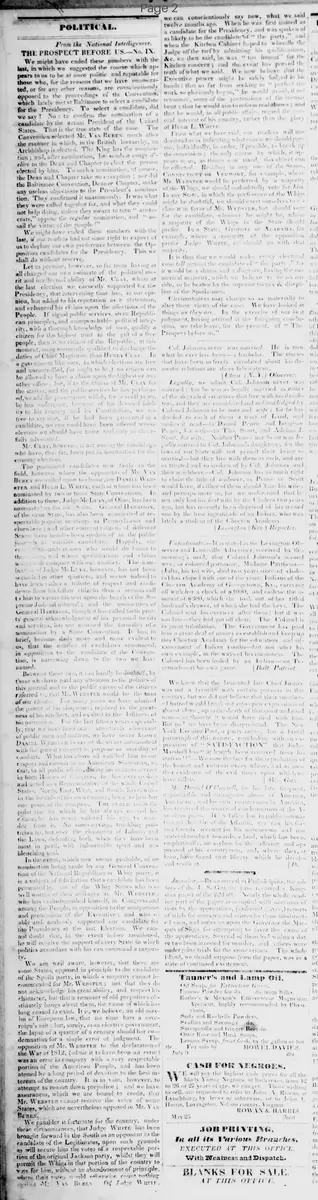
POLITICAL
From the National Intelligencer.
THE PROSPECT BEFORE US.—No. IV.
We might have ended these numbers with the last, in which we suggested the course which appears to us to be at once politic and reputable for those who, for the reasons that we have enumerated, or for any other reasons, are conscientiously opposed to the proceedings of the Convention, which lately met at Baltimore to select a candidate for the Presidency. To select a candidate, did we say? No: to confirm the nomination of a candidate by the actual President of the United States. That is the true state of the case. The Convention selected Mr. Van Buren much after the manner in which, in the British hierarchy, an Archbishop is elected. The King has the nomination: and, after nomination, he sends a conge d'élire to the Dean and Chapter to elect the person elected by him. To such a nomination, of course, the Dean and Chapter take no exception: nor did the Baltimore Convention, Dean or Chapter, make any useless objections to the President's nomination. They confirmed it unanimously. It was that they were called together for, and what they could not help doing, unless they meant to turn 'aristocrats,' oppose the regular nomination, and 'assail the virtue of the people.'
We might have concluded these numbers with the last, if our readers had not some right to expect of us to declare our own preference between the Opposition candidates for the Presidency. This we shall do without reserve.
Let us premise, however, so far from having at all changed our own estimate of the political merit and intellectual ability of Mr. Clay, whom at the last election we earnestly supported for the Presidency, that intervening time has, in our opinion, but added to his reputation as a statesman, and enhanced his claims upon the affections of the People. If signal public services, stern Republican principles, and unimpeachable political integrity, with a thorough knowledge of men, qualify a citizen for the highest trust in the gift of a free people, then no citizen of the Republic, at this moment, more eminently qualified to discharge the duties of Chief Magistrate than Henry Clay. In a government like ours, in which elections are free and uncontrolled, (or ought to be,) no citizen can be allowed to have a claim upon the highest or any other office: but, if to the fitness of Mr. Clay for the station, and the public services he has performed, we add the persecution which, for several years, he has undergone, because of his fidelity to his country and its Constitution, we are free to say this, if he had been presented as a candidate, no one could have been offered whose election we should have more readily or cheerfully advocated.
Mr. Clay, however, is not among the candidates who have, thus far, been put in nomination for the ensuing election.
The prominent candidates now fairly in the field, between whom the opponents of Mr. Van Buren are calling upon to choose, are Daniel Webster and Hugh L. White, each of whom has been nominated by two or more State Conventions. In addition to these, Judge McLean, of Ohio, has been nominated by his own State. General Harrison, of the same State, has also been nominated at respectable popular meetings in Pennsylvania and elsewhere; and other eminent citizens of different States have besides been spoken of in the public journals as suitable candidates. Happily, our country abounds in men who would do honor to the station, and whose qualifications and claims would compare with one another. The nomination of Judge McLean, however, has not been seconded in other quarters, and seems indeed to have been rather a tribute of respect and confidence from his fellow citizens than a serious call to him to vacate his seat upon the bench of the Supreme Judicial tribunal; and the nomination of General Harrison, though it has called forth pretty general acknowledgment of his personal merits and services, has not assumed the formality of a nomination by a State Convention. It has, in brief, become daily more and more evident to us, that the number of candidates announced in opposition to the candidate of the Convention, is narrowing down to the two we have named.
Between these two, it can hardly be doubted, by those who have paid any attention to the politics of this journal and to the public career of the citizens referred to, that Mr. Webster would be the man of our choice. In many years we have admired the power of his eloquence, rejoiced in the greatness of his intellect, in its fitness in the usefulness of his patriotism. To the last fifteen years especially, that we have been an attentive observer of public men and matters, we have never known Daniel Webster so to deport himself as inconsistent with the purest rectitude, purpose or morality of conduct. What has above all entitled him to our respect and esteem as an American Statesman, is, that, to all public affairs, during intestine, civil jars both issues a contrast, he has risen and acted a Representative to the whole Union—States, North, East, West, and South, he, within the bounds of his own country, has to him but one point, on the compass. In political compass the polar star, to which he has always so tended his career, has never faltered to him. No time-serving, truckling politician he, but ever the champion of Labor and the Law, defending both, when they have been most in peril, with indomitable spirit and unbending zeal.
In the event, which now seems probable, of no nomination being made by any General Convention of the National Republican or Whig party, it is a subject of felicitation that a candidate has been presented by two of the Whig States who is well worthy of their suffrage as Mr. Webster, who has distinguished himself, in Congress and among the People, in opposition to the usurpations and pretensions of the Executive: and who has ably and zealously supported our candidate for the Presidency at the last Election. We cannot doubt that, in the event before mentioned, he will receive the support of every State in which politics accordant with his can command a majority.
We are well aware, however, that there are some States, opposed in principle to the candidate of the Spoils party, in which a majority cannot be commanded for Mr. Webster; not that they do not acknowledge his great ability, and respect his character, but that a remnant of old prejudices obstinately hangs about them, the cause of which has long ceased to exist. It is, we believe, an old maxim of European law, that no time bars a sovereign's suit: but, surely, in an elective government, the lapse of a quarter of a century should bar condemnation for a single error of judgment. The opposition of Mr. Webster to the declaration of the War of 1812, (admit it to have been an error:) was an error in company with a very respectable portion of the American People, and has been atoned by a long period of devotion to the best interests of the country. It is in vain, however, to attempt to reason down prejudice; and we have assurances, which we are bound to credit, that Mr. Webster cannot receive the votes of some States, which are nevertheless opposed to Mr. Van Buren.
We consider it fortunate for the country, under these circumstances, that Judge White has been brought forward in the South as an opponent to the candidate of the Legitimates, upon such grounds as will secure him the votes of a respectable portion of the original Jackson party, whilst they will permit the Whigs in that portion of the country to vote for him, without an abandonment of principle, where their votes would otherwise count nothing against Mr. Van Buren. Of Judge White, we can conscientiously say now, what we said twelve months ago. When he was first named as a candidate for the Presidency, and was spoken of as likely to be the candidate of 'the party,' and when the Kitchen Cabinet hoped to wheedle the Judge off the turf by admitting his qualifications, &c. we then said, he was 'too honest' for the Kitchen concern; and the event has proved the truth of what we said. We now believe that the Executive power might be safely lodged in his hands: that so far from seeking to 'perfect the work so gloriously begun,' he would avoid, it may be renounce, some of the pretensions of the incumbent: that he would aim to reform real abuses; and that he would, in all public affairs, regard the general interest of his country, rather than the glory of Hugh L. White.
From what we have said, our readers will understand us as indicating what course we should pursue, individually, in order, if possible, to break up the succession; the only course by which, it appears to us, as things now stand, the object can be effected. Residing in any one of the States Connecticut or Vermont, for example, where Mr. Webster would be preferred by a majority of the Whigs, we should undoubtedly vote for him. In any State, in which the preference of the Whigs might be doubtful, we should exert ourselves to incline it in favor of Mr. Webster, but should vote for the candidate, whoever he might be, whom a majority of the Whigs in the State should prefer. In a State, Georgia or Alabama, for example, where a majority of the opposition prefer Judge White, we should go with that majority.
It is thus that we would make every electoral vote tell against the candidate of 'the party.' It would be a shame and a disgrace, having the numerical majority, which we believe to be on our side, to be beaten by the superior tactics & discipline of the Spoil-men.
Circumstances may change so as materially to alter these views of the case. We have looked at things as they are. In the exercise of our best judgment, having arrived at the foregoing conclusions, we take leave, for the present, of 'The Prospect before us.'
From the National Intelligencer.
THE PROSPECT BEFORE US.—No. IV.
We might have ended these numbers with the last, in which we suggested the course which appears to us to be at once politic and reputable for those who, for the reasons that we have enumerated, or for any other reasons, are conscientiously opposed to the proceedings of the Convention, which lately met at Baltimore to select a candidate for the Presidency. To select a candidate, did we say? No: to confirm the nomination of a candidate by the actual President of the United States. That is the true state of the case. The Convention selected Mr. Van Buren much after the manner in which, in the British hierarchy, an Archbishop is elected. The King has the nomination: and, after nomination, he sends a conge d'élire to the Dean and Chapter to elect the person elected by him. To such a nomination, of course, the Dean and Chapter take no exception: nor did the Baltimore Convention, Dean or Chapter, make any useless objections to the President's nomination. They confirmed it unanimously. It was that they were called together for, and what they could not help doing, unless they meant to turn 'aristocrats,' oppose the regular nomination, and 'assail the virtue of the people.'
We might have concluded these numbers with the last, if our readers had not some right to expect of us to declare our own preference between the Opposition candidates for the Presidency. This we shall do without reserve.
Let us premise, however, so far from having at all changed our own estimate of the political merit and intellectual ability of Mr. Clay, whom at the last election we earnestly supported for the Presidency, that intervening time has, in our opinion, but added to his reputation as a statesman, and enhanced his claims upon the affections of the People. If signal public services, stern Republican principles, and unimpeachable political integrity, with a thorough knowledge of men, qualify a citizen for the highest trust in the gift of a free people, then no citizen of the Republic, at this moment, more eminently qualified to discharge the duties of Chief Magistrate than Henry Clay. In a government like ours, in which elections are free and uncontrolled, (or ought to be,) no citizen can be allowed to have a claim upon the highest or any other office: but, if to the fitness of Mr. Clay for the station, and the public services he has performed, we add the persecution which, for several years, he has undergone, because of his fidelity to his country and its Constitution, we are free to say this, if he had been presented as a candidate, no one could have been offered whose election we should have more readily or cheerfully advocated.
Mr. Clay, however, is not among the candidates who have, thus far, been put in nomination for the ensuing election.
The prominent candidates now fairly in the field, between whom the opponents of Mr. Van Buren are calling upon to choose, are Daniel Webster and Hugh L. White, each of whom has been nominated by two or more State Conventions. In addition to these, Judge McLean, of Ohio, has been nominated by his own State. General Harrison, of the same State, has also been nominated at respectable popular meetings in Pennsylvania and elsewhere; and other eminent citizens of different States have besides been spoken of in the public journals as suitable candidates. Happily, our country abounds in men who would do honor to the station, and whose qualifications and claims would compare with one another. The nomination of Judge McLean, however, has not been seconded in other quarters, and seems indeed to have been rather a tribute of respect and confidence from his fellow citizens than a serious call to him to vacate his seat upon the bench of the Supreme Judicial tribunal; and the nomination of General Harrison, though it has called forth pretty general acknowledgment of his personal merits and services, has not assumed the formality of a nomination by a State Convention. It has, in brief, become daily more and more evident to us, that the number of candidates announced in opposition to the candidate of the Convention, is narrowing down to the two we have named.
Between these two, it can hardly be doubted, by those who have paid any attention to the politics of this journal and to the public career of the citizens referred to, that Mr. Webster would be the man of our choice. In many years we have admired the power of his eloquence, rejoiced in the greatness of his intellect, in its fitness in the usefulness of his patriotism. To the last fifteen years especially, that we have been an attentive observer of public men and matters, we have never known Daniel Webster so to deport himself as inconsistent with the purest rectitude, purpose or morality of conduct. What has above all entitled him to our respect and esteem as an American Statesman, is, that, to all public affairs, during intestine, civil jars both issues a contrast, he has risen and acted a Representative to the whole Union—States, North, East, West, and South, he, within the bounds of his own country, has to him but one point, on the compass. In political compass the polar star, to which he has always so tended his career, has never faltered to him. No time-serving, truckling politician he, but ever the champion of Labor and the Law, defending both, when they have been most in peril, with indomitable spirit and unbending zeal.
In the event, which now seems probable, of no nomination being made by any General Convention of the National Republican or Whig party, it is a subject of felicitation that a candidate has been presented by two of the Whig States who is well worthy of their suffrage as Mr. Webster, who has distinguished himself, in Congress and among the People, in opposition to the usurpations and pretensions of the Executive: and who has ably and zealously supported our candidate for the Presidency at the last Election. We cannot doubt that, in the event before mentioned, he will receive the support of every State in which politics accordant with his can command a majority.
We are well aware, however, that there are some States, opposed in principle to the candidate of the Spoils party, in which a majority cannot be commanded for Mr. Webster; not that they do not acknowledge his great ability, and respect his character, but that a remnant of old prejudices obstinately hangs about them, the cause of which has long ceased to exist. It is, we believe, an old maxim of European law, that no time bars a sovereign's suit: but, surely, in an elective government, the lapse of a quarter of a century should bar condemnation for a single error of judgment. The opposition of Mr. Webster to the declaration of the War of 1812, (admit it to have been an error:) was an error in company with a very respectable portion of the American People, and has been atoned by a long period of devotion to the best interests of the country. It is in vain, however, to attempt to reason down prejudice; and we have assurances, which we are bound to credit, that Mr. Webster cannot receive the votes of some States, which are nevertheless opposed to Mr. Van Buren.
We consider it fortunate for the country, under these circumstances, that Judge White has been brought forward in the South as an opponent to the candidate of the Legitimates, upon such grounds as will secure him the votes of a respectable portion of the original Jackson party, whilst they will permit the Whigs in that portion of the country to vote for him, without an abandonment of principle, where their votes would otherwise count nothing against Mr. Van Buren. Of Judge White, we can conscientiously say now, what we said twelve months ago. When he was first named as a candidate for the Presidency, and was spoken of as likely to be the candidate of 'the party,' and when the Kitchen Cabinet hoped to wheedle the Judge off the turf by admitting his qualifications, &c. we then said, he was 'too honest' for the Kitchen concern; and the event has proved the truth of what we said. We now believe that the Executive power might be safely lodged in his hands: that so far from seeking to 'perfect the work so gloriously begun,' he would avoid, it may be renounce, some of the pretensions of the incumbent: that he would aim to reform real abuses; and that he would, in all public affairs, regard the general interest of his country, rather than the glory of Hugh L. White.
From what we have said, our readers will understand us as indicating what course we should pursue, individually, in order, if possible, to break up the succession; the only course by which, it appears to us, as things now stand, the object can be effected. Residing in any one of the States Connecticut or Vermont, for example, where Mr. Webster would be preferred by a majority of the Whigs, we should undoubtedly vote for him. In any State, in which the preference of the Whigs might be doubtful, we should exert ourselves to incline it in favor of Mr. Webster, but should vote for the candidate, whoever he might be, whom a majority of the Whigs in the State should prefer. In a State, Georgia or Alabama, for example, where a majority of the opposition prefer Judge White, we should go with that majority.
It is thus that we would make every electoral vote tell against the candidate of 'the party.' It would be a shame and a disgrace, having the numerical majority, which we believe to be on our side, to be beaten by the superior tactics & discipline of the Spoil-men.
Circumstances may change so as materially to alter these views of the case. We have looked at things as they are. In the exercise of our best judgment, having arrived at the foregoing conclusions, we take leave, for the present, of 'The Prospect before us.'
What sub-type of article is it?
Partisan Politics
What keywords are associated?
Presidential Election
Van Buren Opposition
Webster Candidacy
White Candidacy
Whig Strategy
Baltimore Convention
Party Nomination
What entities or persons were involved?
Martin Van Buren
Henry Clay
Daniel Webster
Hugh L. White
John Mclean
William Henry Harrison
Baltimore Convention
Whig Party
Editorial Details
Primary Topic
Opposition Strategy Against Van Buren Nomination, Preferring Webster And White
Stance / Tone
Anti Van Buren, Pro Webster With Pragmatic Support For White In Southern States
Key Figures
Martin Van Buren
Henry Clay
Daniel Webster
Hugh L. White
John Mclean
William Henry Harrison
Baltimore Convention
Whig Party
Key Arguments
Baltimore Convention Merely Confirmed Van Buren's Nomination Like A Formality
Henry Clay Remains Highly Qualified But Not Nominated
Daniel Webster Preferred For Eloquence, Intellect, Patriotism, And Unionism
Webster's Past Opposition To War Of 1812 Is Outdated Prejudice
Hugh L. White Suitable For Southern States To Attract Jackson Supporters
State By State Support For Strongest Opposition Candidate To Defeat Van Buren
Whigs Have Numerical Majority But Need Better Tactics