Thank you for visiting SNEWPapers!
Sign up free
Editorial
August 13, 1806
Norfolk Gazette And Publick Ledger
Norfolk, Virginia
What is this article about?
Editorial from National Intelligencer defends U.S. administration against claims of supporting Francisco de Miranda's 1806 expedition to liberate Spanish South America, arguing accusations by opponents like Smith and Ogden lack proof, violate neutrality laws, and stem from partisan malice; acquittal of agents does not implicate executives.
Clipping
OCR Quality
95%
Excellent
Full Text
From the National Intelligencer.
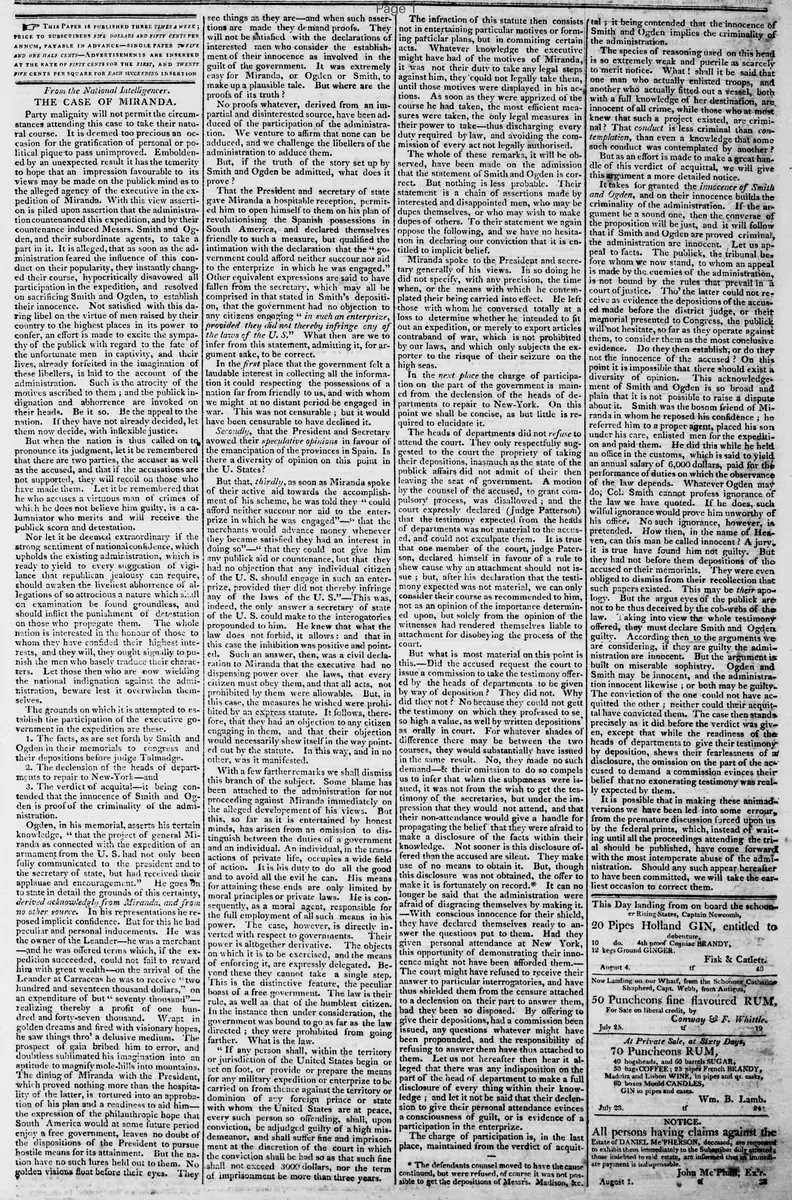
THE CASE OF MIRANDA.
Party malignity will not permit the circumstances attending this case to take their natural course. It is deemed too precious an occasion for the gratification of personal or political pique to pass unimproved. Emboldened by an unexpected result it has the temerity to hope that an impression favourable to its views may be made on the publick mind as to the alleged agency of the executive in the expedition of Miranda. With this view assertion is piled upon assertion that the administration countenanced this expedition, and by their countenance induced Messrs. Smith and Ogden, and their subordinate agents, to take a part in it. It is alleged, that as soon as the administration feared the influence of this conduct on their popularity, they instantly changed their course, hypocritically disavowed all participation in the expedition, and resolved on sacrificing Smith and Ogden, to establish their innocence. Not satisfied with this daring libel on the virtue of men raised by their country to the highest places in its power to confer, an effort is made to excite the sympathy of the publick with regard to the fate of the unfortunate men in captivity, and their lives, already forfeited in the imagination of these libellers, is laid to the account of the administration. Such is the atrocity of the motives ascribed to them; and the publick indignation and abhorrence are invoked on their heads. Be it so. Be the appeal to the nation. If they have not already decided, let them now decide, with inflexible justice.
But when the nation is thus called on to pronounce its judgment, let it be remembered that there are two parties, the accuser as well as the accused, and that if the accusations are not supported, they will recoil on those who have made them. Let it be remembered that he who accuses a virtuous man of crimes of which he does not believe him guilty, is a calumniator who merits and will receive the publick scorn and detestation.
Nor let it be deemed extraordinary if the strong sentiment of national confidence, which upholds the existing administration, which is ready to yield to every suggestion of vigilance that republican jealousy can require, should awaken the liveliest abhorrence of allegations of so atrocious a nature which shall on examination be found groundless, and should inflict the punishment of detestation on those who propagate them. The whole nation is interested in the honour of those to whom they have confided their highest interests, and they will, they ought signally to punish the men who basely traduce their characters. Let those then who are now wielding the national indignation against the administration, beware lest it overwhelm themselves.
The grounds on which it is attempted to establish the participation of the executive government in the expedition are these.
1. The facts, as are set forth by Smith and Ogden in their memorials to congress and their depositions before judge Talmadge.
2. The declension of the heads of departments to repair to New-York and
3. The verdict of acquittal—it being contended that the innocence of Smith and Ogden is proof of the criminality of the administration.
Ogden, in his memorial, asserts his certain knowledge, "that the project of general Miranda as connected with the expedition of an armament from the U. S. had not only been fully communicated to the president and to the secretary of state, but had received their applause and encouragement."
He goes on to state in detail the grounds of this certainty, derived acknowledgedly from Miranda, and from no other source. In his representations he reposed implicit confidence. But for this he had peculiar and personal inducements. He was the owner of the Leander—he was a merchant—and he was offered terms which, if the expedition succeeded, could not fail to reward him with great wealth—on the arrival of the Leander at Carraccas he was to receive "two hundred and seventeen thousand dollars," on an expenditure of but "seventy thousand"—realizing thereby a profit of one hundred and forty-seven thousand. Wrapt in golden dreams and fired with visionary hopes, he saw things thro' a delusive medium. The prospect of gain bribed him to error, and doubtless sublimated his imagination into an aptitude to magnify mole-hills into mountains.
The dining of Miranda with the President, which proved nothing more than the hospitality of the latter, is tortured into an approbation of his plan and a readiness to aid him—the expression of the philanthropic hope that South America would at some future period enjoy a free government, leaves no doubt of the dispositions of the President to pursue hostile means for its attainment. But the nation have no such lures held out to them. No golden visions float before their eyes. They see things as they are—and when such assertions are made they demand proofs. They will not be satisfied with the declarations of interested men who consider the establishment of their innocence as involved in the guilt of the government. It was extremely easy for Miranda, or Ogden or Smith, to make up a plausible tale. But where are the proofs of its truth?
No proofs whatever, derived from an impartial and disinterested source, have been adduced of the participation of the administration. We venture to affirm that none can be adduced, and we challenge the libellers of the administration to adduce them.
But, if the truth of the story set up by Smith and Ogden be admitted, what does it prove?
That the President and secretary of state gave Miranda a hospitable reception, permitted him to open himself to them on his plan of revolutionising the Spanish possessions in South America, and declared themselves friendly to such a measure, but qualified the intimation with the declaration that the "government could afford neither succour nor aid to the enterprize in which he was engaged." Other equivalent expressions are said to have fallen from the secretary, which may all be comprised in that stated in Smith's deposition, that the government had no objection to any citizens engaging "in such an enterprize, provided they did not thereby infringe any of the laws of the U. S." What then are we to infer from this statement, admitting it, for argument sake, to be correct.
In the first place that the government felt a laudable interest in collecting all the information it could respecting the possessions of a nation far from friendly to us, and with whom we might at no distant period be engaged in war. This was not censurable; but it would have been censurable to have declined it.
Secondly, that the President and Secretary avowed their speculative opinions in favour of the emancipation of the provinces in Spain. Is there a diversity of opinion on this point in the U. States?
But that, thirdly, as soon as Miranda spoke of their active aid towards the accomplishment of his scheme, he was told they "could afford neither succour nor aid to the enterprize in which he was engaged"—"that the merchants would advance money whenever they became satisfied they had an interest in doing so"—"that they could not give him any publick aid or countenance, but that they had no objection that any individual citizen of the U. S. should engage in such an enterprize, provided they did not thereby infringe any of the laws of the U. S." This was, indeed, the only answer a secretary of state of the U. S. could make to the interrogatories propounded to him. He knew that what the law does not forbid, it allows: and that in this case the inhibition was positive and pointed. Such an answer, then, was a civil declaration to Miranda that the executive had no dispensing power over the laws, that every citizen must obey them, and that all acts, not prohibited by them were allowable. But, in this case, the measures he wished were prohibited by an express statute. It follows, therefore, that they had an objection to any citizen engaging in them, and that their objection would necessarily shew itself in the way pointed out by the statute. In this way, and in no other, was it manifested.
With a few farther remarks we shall dismiss this branch of the subject. Some blame has been attached to the administration for not proceeding against Miranda immediately on the alleged developement of his views. But this, so far as it is entertained by honest minds, has arisen from an omission to distinguish between the duties of a government and an individual. An individual, in the transactions of private life, occupies a wide field of action. It is his duty to do all the good and to avoid all the evil he can. His means for attaining these ends are only limited by moral principles or private laws. He is consequently, as a moral agent, responsible for the full employment of all such means in his power. The case, however, is directly inverted with respect to governments. Their power is altogether derivative. The objects on which it is to be exercised, and the means of enforcing it, are expressly delegated. Beyond these they cannot take a single step. This is the distinctive feature, the peculiar boast of a free government. The law is their rule, as well as that of the humblest citizen.
In the instance then under consideration, the government was bound to go as far as the law directed; they were prohibited from going farther. What is the law.
"If any person shall, within the territory or jurisdiction of the United States begin or set on foot, or provide or prepare the means for any military expedition or enterprize to be carried on from thence against the territory or dominion of any foreign prince or state with whom the United States are at peace, every such person so offending, shall, upon conviction, be adjudged guilty of a high misdemeanor, and shall suffer fine and imprisonment at the discretion of the court in which the conviction shall be had so as that such fine shall not exceed 3000 dollars, nor the term of imprisonment be more than three years."
The infraction of this statute then consists not in entertaining particular motives or forming particular plans, but in committing certain acts. Whatever knowledge the executive might have had of the motives of Miranda, it was not their duty to take any legal steps against him, they could not legally take them, until those motives were displayed in his actions. As soon as they were apprized of the course he had taken, the most efficient measures were taken, the only legal measures in their power to take—thus discharging every duty required by law, and avoiding the commission of every act not legally authorised.
The whole of these remarks, it will be observed, have been made on the admission that the statement of Smith and Ogden is correct. But nothing is less probable. Their statement is a chain of assertions made by interested and disappointed men, who may be dupes themselves, or who may wish to make dupes of others. To their statement we again oppose the following, and we have no hesitation in declaring our conviction that it is entitled to implicit belief.
Miranda spoke to the President and secretary generally of his views. In so doing he did not specify, with any precision, the time when, or the means with which he contemplated their being carried into effect. He left those with whom he conversed totally at a loss to determine whether he intended to fit out an expedition, or merely to export articles contraband of war, which is not prohibited by our laws, and which only subjects the exporter to the risque of their seizure on the high seas.
In the next place the charge of participation on the part of the government is maintained from the declension of the heads of departments to repair to New-York. On this point we shall be concise, as but little is required to elucidate it.
The heads of departments did not refuse to attend the court. They only respectfully suggested to the court the propriety of taking their depositions, inasmuch as the state of the publick affairs did not admit of their then leaving the seat of government. A motion by the counsel of the accused, to grant compulsory process, was disallowed; and the court expressly declared (judge Patterson) that the testimony expected from the heads of departments was not material to the accused, and could not exculpate them. It is true that one member of the court, judge Patterson, declared himself in favour of a rule to shew cause why an attachment should not issue; but, after his declaration that the testimony expected was not material, we can only consider their course as recommended to him, not as an opinion of the importance determined upon, but solely from the opinion of the witnesses had rendered themselves liable to attachment for disobeying the process of the court.
But what is most material on this point is this.—Did the accused request the court to issue a commission to take the testimony offered by the heads of departments to be given by way of deposition? They did not. Why did they not? No because they could not get the testimony on which they professed to set so high a value, as well by written depositions as orally in court. For whatever shades of difference there may be between the two courses, they would substantially have issued in the same result. No, they made no such demand—& their omission to do so compels us to infer that when the subpœnas were issued, it was not from the wish to get the testimony of the secretaries, but under the impression that they would not attend, and that their non-attendance would give a handle for propagating the belief that they were afraid to make a disclosure of the facts within their knowledge. Not sooner is this disclosure offered than the accused are silent. They make use of no means to obtain it. But, though this disclosure was not obtained, the offer to make it is fortunately on record.* It can no longer be said that the administration were afraid of disgracing themselves by making it.—With conscious innocence for their shield, they have declared themselves ready to answer the questions put to them. Had they given personal attendance at New York, this opportunity of demonstrating their innocence might not have been afforded them.—The court might have refused to receive their answer to particular interrogatories, and have thus shielded them from the censure attached to a declension on their part to answer them, had they been so disposed. By offering to give their depositions, had a commission been issued, any questions whatever might have been propounded, and the responsibility of refusing to answer them have thus attached to them. Let us hereafter then hear it alleged that there was any indisposition on the part of the head of department to make a full disclosure of every thing within their knowledge; and let it not be said that their declension to give their personal attendance evinces a consciousness of guilt, or is evidence of a participation in the enterprize.
The charge of participation is, in the last place, maintained from the verdict of acquittal* : it being contended that the innocence of Smith and Ogden implies the criminality of the administration.
The species of reasoning used on this head is so extremely weak and puerile as scarcely to merit notice. What! shall it be said that one man who actually enlisted troops, and another who actually fitted out a vessel, both with a full knowledge of her destination, are innocent of all crime, while those who at most knew that such a project existed, are criminal? That conduct is less criminal than contemplation, than even a knowledge that some such conduct was contemplated by another?
But as an effort is made to make a great handle of this verdict of acquittal, we will give this argument a more detailed notice.
It takes for granted the innocence of Smith and Ogden, and on their innocence builds the criminality of the administration. If the argument be a sound one, then the converse of the proposition will be just, and it will follow that if Smith and Ogden are proved criminal, the administration are innocent. Let us appeal to acts. The publick, the tribunal before whom we now stand, to whom an appeal is made by the enemies of the administration, is not bound by the rules that prevail in a court of justice. Tho' the latter could not receive as evidence the depositions of the accused made before the district judge, or their memorial presented to Congress, the publick will not hesitate, so far as they operate against them, to consider them as the most conclusive evidence. Do they then establish, or do they not the innocence of the accused? On this point it is impossible that there should exist a diversity of opinion. This acknowledgement of Smith and Ogden is so broad and plain that it is not possible to raise a dispute about it. Smith was the bosom friend of Miranda in whom he reposed his confidence; he referred him to a proper agent, placed his son under his care, enlisted men for the expedition and paid them. He did this while he held an office in the customs, which is said to yield an annual salary of 6000 dollars, paid for the performance of duties on which the observance of the law depends. Whatever Ogden may do; Col: Smith cannot profess ignorance of the law we have quoted. If he does, such wilful ignorance would prove him unworthy of his office. No such ignorance, however, is pretended. How then, in the name of Heaven, can this man be called innocent? A jury, it is true have found him not guilty. But they had not before them depositions of the accused or their memorials. They were even obliged to dismiss from their recollection that such papers existed. This may be their apology. But the argus eyes of the publick are not to be thus deceived by the cob-webs of the law. Taking into view the whole testimony offered, they must declare Smith and Ogden guilty. According then to the arguments we are considering, if they are guilty the administration are innocent. But the argument is built on miserable sophistry. Ogden and Smith may be innocent, and the administration innocent likewise; or both may be guilty. The conviction of the one could not have acquitted the other; neither could their acquittal have convicted them. The case then stands precisely as it did before the verdict was given, except that while the readiness of the heads of departments to give their testimony by deposition, shews their fearlessness of a disclosure, the omission on the part of the accused to demand a commission evinces their belief that no exonerating testimony was really expected by them.
It is possible that in making these animadversions we have been led into some errour, from the premature discussion forced upon us by the federal prints, which, instead of waiting until all the proceedings attending the trial should be published, have come forward with the most intemperate abuse of the administration. Should any such appear hereafter to have been committed, we will take the earliest occasion to correct them.
THE CASE OF MIRANDA.
Party malignity will not permit the circumstances attending this case to take their natural course. It is deemed too precious an occasion for the gratification of personal or political pique to pass unimproved. Emboldened by an unexpected result it has the temerity to hope that an impression favourable to its views may be made on the publick mind as to the alleged agency of the executive in the expedition of Miranda. With this view assertion is piled upon assertion that the administration countenanced this expedition, and by their countenance induced Messrs. Smith and Ogden, and their subordinate agents, to take a part in it. It is alleged, that as soon as the administration feared the influence of this conduct on their popularity, they instantly changed their course, hypocritically disavowed all participation in the expedition, and resolved on sacrificing Smith and Ogden, to establish their innocence. Not satisfied with this daring libel on the virtue of men raised by their country to the highest places in its power to confer, an effort is made to excite the sympathy of the publick with regard to the fate of the unfortunate men in captivity, and their lives, already forfeited in the imagination of these libellers, is laid to the account of the administration. Such is the atrocity of the motives ascribed to them; and the publick indignation and abhorrence are invoked on their heads. Be it so. Be the appeal to the nation. If they have not already decided, let them now decide, with inflexible justice.
But when the nation is thus called on to pronounce its judgment, let it be remembered that there are two parties, the accuser as well as the accused, and that if the accusations are not supported, they will recoil on those who have made them. Let it be remembered that he who accuses a virtuous man of crimes of which he does not believe him guilty, is a calumniator who merits and will receive the publick scorn and detestation.
Nor let it be deemed extraordinary if the strong sentiment of national confidence, which upholds the existing administration, which is ready to yield to every suggestion of vigilance that republican jealousy can require, should awaken the liveliest abhorrence of allegations of so atrocious a nature which shall on examination be found groundless, and should inflict the punishment of detestation on those who propagate them. The whole nation is interested in the honour of those to whom they have confided their highest interests, and they will, they ought signally to punish the men who basely traduce their characters. Let those then who are now wielding the national indignation against the administration, beware lest it overwhelm themselves.
The grounds on which it is attempted to establish the participation of the executive government in the expedition are these.
1. The facts, as are set forth by Smith and Ogden in their memorials to congress and their depositions before judge Talmadge.
2. The declension of the heads of departments to repair to New-York and
3. The verdict of acquittal—it being contended that the innocence of Smith and Ogden is proof of the criminality of the administration.
Ogden, in his memorial, asserts his certain knowledge, "that the project of general Miranda as connected with the expedition of an armament from the U. S. had not only been fully communicated to the president and to the secretary of state, but had received their applause and encouragement."
He goes on to state in detail the grounds of this certainty, derived acknowledgedly from Miranda, and from no other source. In his representations he reposed implicit confidence. But for this he had peculiar and personal inducements. He was the owner of the Leander—he was a merchant—and he was offered terms which, if the expedition succeeded, could not fail to reward him with great wealth—on the arrival of the Leander at Carraccas he was to receive "two hundred and seventeen thousand dollars," on an expenditure of but "seventy thousand"—realizing thereby a profit of one hundred and forty-seven thousand. Wrapt in golden dreams and fired with visionary hopes, he saw things thro' a delusive medium. The prospect of gain bribed him to error, and doubtless sublimated his imagination into an aptitude to magnify mole-hills into mountains.
The dining of Miranda with the President, which proved nothing more than the hospitality of the latter, is tortured into an approbation of his plan and a readiness to aid him—the expression of the philanthropic hope that South America would at some future period enjoy a free government, leaves no doubt of the dispositions of the President to pursue hostile means for its attainment. But the nation have no such lures held out to them. No golden visions float before their eyes. They see things as they are—and when such assertions are made they demand proofs. They will not be satisfied with the declarations of interested men who consider the establishment of their innocence as involved in the guilt of the government. It was extremely easy for Miranda, or Ogden or Smith, to make up a plausible tale. But where are the proofs of its truth?
No proofs whatever, derived from an impartial and disinterested source, have been adduced of the participation of the administration. We venture to affirm that none can be adduced, and we challenge the libellers of the administration to adduce them.
But, if the truth of the story set up by Smith and Ogden be admitted, what does it prove?
That the President and secretary of state gave Miranda a hospitable reception, permitted him to open himself to them on his plan of revolutionising the Spanish possessions in South America, and declared themselves friendly to such a measure, but qualified the intimation with the declaration that the "government could afford neither succour nor aid to the enterprize in which he was engaged." Other equivalent expressions are said to have fallen from the secretary, which may all be comprised in that stated in Smith's deposition, that the government had no objection to any citizens engaging "in such an enterprize, provided they did not thereby infringe any of the laws of the U. S." What then are we to infer from this statement, admitting it, for argument sake, to be correct.
In the first place that the government felt a laudable interest in collecting all the information it could respecting the possessions of a nation far from friendly to us, and with whom we might at no distant period be engaged in war. This was not censurable; but it would have been censurable to have declined it.
Secondly, that the President and Secretary avowed their speculative opinions in favour of the emancipation of the provinces in Spain. Is there a diversity of opinion on this point in the U. States?
But that, thirdly, as soon as Miranda spoke of their active aid towards the accomplishment of his scheme, he was told they "could afford neither succour nor aid to the enterprize in which he was engaged"—"that the merchants would advance money whenever they became satisfied they had an interest in doing so"—"that they could not give him any publick aid or countenance, but that they had no objection that any individual citizen of the U. S. should engage in such an enterprize, provided they did not thereby infringe any of the laws of the U. S." This was, indeed, the only answer a secretary of state of the U. S. could make to the interrogatories propounded to him. He knew that what the law does not forbid, it allows: and that in this case the inhibition was positive and pointed. Such an answer, then, was a civil declaration to Miranda that the executive had no dispensing power over the laws, that every citizen must obey them, and that all acts, not prohibited by them were allowable. But, in this case, the measures he wished were prohibited by an express statute. It follows, therefore, that they had an objection to any citizen engaging in them, and that their objection would necessarily shew itself in the way pointed out by the statute. In this way, and in no other, was it manifested.
With a few farther remarks we shall dismiss this branch of the subject. Some blame has been attached to the administration for not proceeding against Miranda immediately on the alleged developement of his views. But this, so far as it is entertained by honest minds, has arisen from an omission to distinguish between the duties of a government and an individual. An individual, in the transactions of private life, occupies a wide field of action. It is his duty to do all the good and to avoid all the evil he can. His means for attaining these ends are only limited by moral principles or private laws. He is consequently, as a moral agent, responsible for the full employment of all such means in his power. The case, however, is directly inverted with respect to governments. Their power is altogether derivative. The objects on which it is to be exercised, and the means of enforcing it, are expressly delegated. Beyond these they cannot take a single step. This is the distinctive feature, the peculiar boast of a free government. The law is their rule, as well as that of the humblest citizen.
In the instance then under consideration, the government was bound to go as far as the law directed; they were prohibited from going farther. What is the law.
"If any person shall, within the territory or jurisdiction of the United States begin or set on foot, or provide or prepare the means for any military expedition or enterprize to be carried on from thence against the territory or dominion of any foreign prince or state with whom the United States are at peace, every such person so offending, shall, upon conviction, be adjudged guilty of a high misdemeanor, and shall suffer fine and imprisonment at the discretion of the court in which the conviction shall be had so as that such fine shall not exceed 3000 dollars, nor the term of imprisonment be more than three years."
The infraction of this statute then consists not in entertaining particular motives or forming particular plans, but in committing certain acts. Whatever knowledge the executive might have had of the motives of Miranda, it was not their duty to take any legal steps against him, they could not legally take them, until those motives were displayed in his actions. As soon as they were apprized of the course he had taken, the most efficient measures were taken, the only legal measures in their power to take—thus discharging every duty required by law, and avoiding the commission of every act not legally authorised.
The whole of these remarks, it will be observed, have been made on the admission that the statement of Smith and Ogden is correct. But nothing is less probable. Their statement is a chain of assertions made by interested and disappointed men, who may be dupes themselves, or who may wish to make dupes of others. To their statement we again oppose the following, and we have no hesitation in declaring our conviction that it is entitled to implicit belief.
Miranda spoke to the President and secretary generally of his views. In so doing he did not specify, with any precision, the time when, or the means with which he contemplated their being carried into effect. He left those with whom he conversed totally at a loss to determine whether he intended to fit out an expedition, or merely to export articles contraband of war, which is not prohibited by our laws, and which only subjects the exporter to the risque of their seizure on the high seas.
In the next place the charge of participation on the part of the government is maintained from the declension of the heads of departments to repair to New-York. On this point we shall be concise, as but little is required to elucidate it.
The heads of departments did not refuse to attend the court. They only respectfully suggested to the court the propriety of taking their depositions, inasmuch as the state of the publick affairs did not admit of their then leaving the seat of government. A motion by the counsel of the accused, to grant compulsory process, was disallowed; and the court expressly declared (judge Patterson) that the testimony expected from the heads of departments was not material to the accused, and could not exculpate them. It is true that one member of the court, judge Patterson, declared himself in favour of a rule to shew cause why an attachment should not issue; but, after his declaration that the testimony expected was not material, we can only consider their course as recommended to him, not as an opinion of the importance determined upon, but solely from the opinion of the witnesses had rendered themselves liable to attachment for disobeying the process of the court.
But what is most material on this point is this.—Did the accused request the court to issue a commission to take the testimony offered by the heads of departments to be given by way of deposition? They did not. Why did they not? No because they could not get the testimony on which they professed to set so high a value, as well by written depositions as orally in court. For whatever shades of difference there may be between the two courses, they would substantially have issued in the same result. No, they made no such demand—& their omission to do so compels us to infer that when the subpœnas were issued, it was not from the wish to get the testimony of the secretaries, but under the impression that they would not attend, and that their non-attendance would give a handle for propagating the belief that they were afraid to make a disclosure of the facts within their knowledge. Not sooner is this disclosure offered than the accused are silent. They make use of no means to obtain it. But, though this disclosure was not obtained, the offer to make it is fortunately on record.* It can no longer be said that the administration were afraid of disgracing themselves by making it.—With conscious innocence for their shield, they have declared themselves ready to answer the questions put to them. Had they given personal attendance at New York, this opportunity of demonstrating their innocence might not have been afforded them.—The court might have refused to receive their answer to particular interrogatories, and have thus shielded them from the censure attached to a declension on their part to answer them, had they been so disposed. By offering to give their depositions, had a commission been issued, any questions whatever might have been propounded, and the responsibility of refusing to answer them have thus attached to them. Let us hereafter then hear it alleged that there was any indisposition on the part of the head of department to make a full disclosure of every thing within their knowledge; and let it not be said that their declension to give their personal attendance evinces a consciousness of guilt, or is evidence of a participation in the enterprize.
The charge of participation is, in the last place, maintained from the verdict of acquittal* : it being contended that the innocence of Smith and Ogden implies the criminality of the administration.
The species of reasoning used on this head is so extremely weak and puerile as scarcely to merit notice. What! shall it be said that one man who actually enlisted troops, and another who actually fitted out a vessel, both with a full knowledge of her destination, are innocent of all crime, while those who at most knew that such a project existed, are criminal? That conduct is less criminal than contemplation, than even a knowledge that some such conduct was contemplated by another?
But as an effort is made to make a great handle of this verdict of acquittal, we will give this argument a more detailed notice.
It takes for granted the innocence of Smith and Ogden, and on their innocence builds the criminality of the administration. If the argument be a sound one, then the converse of the proposition will be just, and it will follow that if Smith and Ogden are proved criminal, the administration are innocent. Let us appeal to acts. The publick, the tribunal before whom we now stand, to whom an appeal is made by the enemies of the administration, is not bound by the rules that prevail in a court of justice. Tho' the latter could not receive as evidence the depositions of the accused made before the district judge, or their memorial presented to Congress, the publick will not hesitate, so far as they operate against them, to consider them as the most conclusive evidence. Do they then establish, or do they not the innocence of the accused? On this point it is impossible that there should exist a diversity of opinion. This acknowledgement of Smith and Ogden is so broad and plain that it is not possible to raise a dispute about it. Smith was the bosom friend of Miranda in whom he reposed his confidence; he referred him to a proper agent, placed his son under his care, enlisted men for the expedition and paid them. He did this while he held an office in the customs, which is said to yield an annual salary of 6000 dollars, paid for the performance of duties on which the observance of the law depends. Whatever Ogden may do; Col: Smith cannot profess ignorance of the law we have quoted. If he does, such wilful ignorance would prove him unworthy of his office. No such ignorance, however, is pretended. How then, in the name of Heaven, can this man be called innocent? A jury, it is true have found him not guilty. But they had not before them depositions of the accused or their memorials. They were even obliged to dismiss from their recollection that such papers existed. This may be their apology. But the argus eyes of the publick are not to be thus deceived by the cob-webs of the law. Taking into view the whole testimony offered, they must declare Smith and Ogden guilty. According then to the arguments we are considering, if they are guilty the administration are innocent. But the argument is built on miserable sophistry. Ogden and Smith may be innocent, and the administration innocent likewise; or both may be guilty. The conviction of the one could not have acquitted the other; neither could their acquittal have convicted them. The case then stands precisely as it did before the verdict was given, except that while the readiness of the heads of departments to give their testimony by deposition, shews their fearlessness of a disclosure, the omission on the part of the accused to demand a commission evinces their belief that no exonerating testimony was really expected by them.
It is possible that in making these animadversions we have been led into some errour, from the premature discussion forced upon us by the federal prints, which, instead of waiting until all the proceedings attending the trial should be published, have come forward with the most intemperate abuse of the administration. Should any such appear hereafter to have been committed, we will take the earliest occasion to correct them.
What sub-type of article is it?
Partisan Politics
Foreign Affairs
What keywords are associated?
Miranda Expedition
Administration Defense
Smith Ogden Trial
Partisan Libel
South America Revolution
Executive Innocence
What entities or persons were involved?
President
Secretary Of State
Miranda
Smith
Ogden
Administration
Federal Prints
Editorial Details
Primary Topic
Defense Of Administration Against Accusations In Miranda Expedition Case
Stance / Tone
Strongly Defensive Of Administration, Accusatory Of Political Opponents
Key Figures
President
Secretary Of State
Miranda
Smith
Ogden
Administration
Federal Prints
Key Arguments
No Impartial Proof Of Executive Participation In Miranda's Expedition
Hospitality And Expressed Sympathy For South American Independence Do Not Imply Active Support
Government Legally Prohibited From Aiding Foreign Expeditions Against Neutral States
Smith And Ogden's Claims Are Self Interested And Unproven
Acquittal Of Smith And Ogden Does Not Imply Administration Guilt
Heads Of Departments Offered Depositions, Showing Willingness To Disclose Facts