Thank you for visiting SNEWPapers!
Sign up free
Yorkville Enquirer
York, York County, South Carolina
What is this article about?
In autumn 1844, impoverished French Lt. Lannes, Napoleon's veteran and Marshal Lannes' nephew, captivates Hanover, NH students with patriotic songs and autobiography of military service, post-Waterloo alcoholism from brandy given by a Dutch girl, recent shipwreck, and renewed vow of sobriety. (214 chars)
Clipping
OCR Quality
Full Text
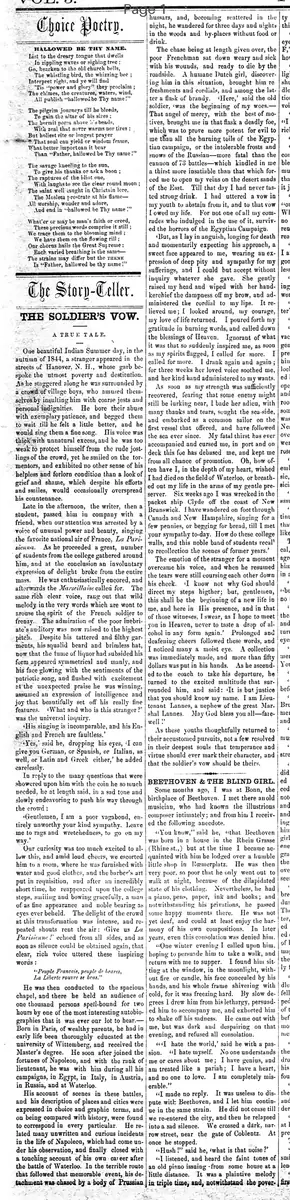
THE SOLDIER'S VOW.
A TRUE TALE.
One beautiful Indian Summer day, in the autumn of 1844, a stranger appeared in the streets of Hanover, N. H., whose garb bespoke the utmost poverty and destitution. As he staggered along he was surrounded by a crowd of village boys, who amused themselves by insulting him with coarse jests and personal indignities. He bore their abuse with exemplary patience, and begged them to wait till he felt a little better, and he would sing them a fine song. His voice was thick with unnatural excess, and he was too weak to protect himself from the rude jostlings of the crowd, yet he smiled on the tormentors, and exhibited no other sense of his helpless and forlorn condition than a look of grief and shame, which despite his efforts and smiles, would occasionally overspread his countenance.
Late in the afternoon, the writer, then a student, passed him in company with a friend, when our attention was arrested by a voice of unusual power and beauty, singing the favorite national air of France, La Parisienne. As he proceeded a great number of students from the college gathered around him, and at the conclusion an involuntary expression of delight broke from the entire mass. He was enthusiastically encored, and afterwards the Marseillaise called for. The same rich clear voice rang out that wild melody in the very words which are wont to arouse the spirit of the French soldier to frenzy. The admiration of the poor inebriate's auditory was now raised to the highest pitch. Despite his tattered and filthy garments, his squalid beard and brimless hat, now that the fume of liquor had subsided his form appeared symmetrical and manly, and his face glowing with the sentiments of the patriotic song, and flushed with excitement at the unexpected praise he was winning, assumed an expression of intelligence and joy that beautifully set off his really fine features. What and who is this stranger? was the universal inquiry. His singing is incomparable, and his English and French are faultless. "Yes," said he, dropping his eyes, "I can give you German, or Spanish, or Italian, as well, or Latin and Greek either," he added carelessly.
In reply to the many questions that were showered upon him with the coin he so much needed, he at length said, in a sad tone and slowly endeavoring to push his way through the crowd: "Gentlemen, I am a poor vagabond, entirely unworthy your kind sympathy. Leave me to rags and wretchedness, to go on my way."
Our curiosity was too much excited to allow this, and amid loud cheers, we escorted him to a room, where he was furnished with water and good clothes, and the barber's art put in requisition, and after an incredibly short time, he reappeared upon the college steps, smiling and bowing gracefully, a man of as fine appearance and noble bearing as eyes ever beheld. The delight of the crowd at this transformation was intense, and repeated shouts rent the air: "Give us La Parisienne!" echoed from all sides, and as soon as silence could be obtained again, that clear, rich voice uttered these inspiring words:
"Peuple Français, peuple de braves,
La Liberté rouvre ses bras."
He was then conducted to the spacious chapel, and there he held an audience of one thousand persons spell-bound for two hours by one of the most interesting autobiographies that it was ever our lot to hear. Born in Paris, of wealthy parents, he had in early life been thoroughly educated at the university of Wittemberg, and received the Master's degree. He soon after joined the fortunes of Napoleon, and with the rank of lieutenant, he was with him during all his campaigns, in Egypt, in Italy, in Austria, in Russia, and at Waterloo.
His account of scenes in these battles, and his description of places and cities were expressed in choice and graphic terms, and on being compared with history, were found to correspond in every particular. He related many unwritten and curious incidents in the life of Napoleon, which had come under his observation, and finally closed with a touching account of his own career after the battle of Waterloo. In the terrible rout that followed that memorable event, his detachment was chased by a body of Prussian hussars, and, becoming scattered in the night, he wandered for three days and nights in the woods and by-places without food or drink.
The chase being at length given over, the poor Frenchman sat down weary and sick with his wounds, and ready to die by the roadside. A humane Dutch girl, discovering him in this situation, brought him refreshments and cordials, and among the latter a flask of brandy. "Here," said the old soldier, "was the beginning of my woes. That angel of mercy, with the best of motives, brought me in that flask a deadly foe, which was to prove more potent for evil to me than all the burning toils of the Egyptian campaign, or the intolerable frosts and snows of the Russian—more fatal than the cannon of 73 battles—which kindled in me a thirst more insatiable than that which forced me to open my veins on the desert sands of the East. Till that day I had never tasted strong drink. I had uttered a vow in my youth to abstain from it, and to that vow I owed my life. For not one of all my comrades who indulged in the use of it, survived the horrors of the Egyptian Campaign.
But, as I lay in anguish, longing for death and momentarily expecting his approach, a sweet face appeared to me, wearing an expression of deep pity and sympathy for my sufferings, and I could but accept without inquiry whatever she gave. She gently raised my head and wiped with her handkerchief the dampness off my brow, and administered the cordial to my lips. It relieved me; I looked around, my courage, my love of life returned. I poured forth my gratitude in burning words, and called down the blessings of Heaven. Ignorant of what it was that so suddenly inspired me, as soon as my spirits flagged, I called for more. I called for more. I drank again and again; for three weeks her loved voice soothed me, and her kind hand administered to my wants. As soon as my strength was sufficiently recovered, fearing that some enemy might still be lurking near, I bade her adieu, with many thanks and tears, sought the sea-side, and embarked as a common sailor on the first vessel that offered, and have followed the sea ever since. My fatal thirst has ever accompanied and cursed me, in port and on deck this foe has debased me, and kept me from all chance of promotion. Oh, how often have I, in the depth of my heart, wished I had died on the field of Waterloo, or breathed out my life in the arms of my gentle preserver. Six weeks ago I was wrecked in the packet ship Clyde off the coast of New Brunswick. I have wandered on foot through Canada and New Hampshire, singing for a few pennies, or begging for bread, till I met your sympathy to-day. How do these college walls, and this noble band of students recall to recollection the scenes of former years."
The emotion of the stranger for a moment overcame his voice, and when he resumed the tears were still coursing each other down his cheek. "I know not why God should direct my steps hither; but, gentlemen, this shall be the beginning of a new life in me, and here in His presence, and in that of those witnesses, I swear, as I hope to meet you in Heaven, never to taste a drop of alcohol in any form again." Prolonged and deafening cheers followed these words, and I noticed many a moist eye. A collection was immediately made, and more than fifty dollars was put in his hands. As he ascended to the coach to take his departure, he turned to the excited multitude that surrounded him, and said: "It is but justice that you should know my name. I am Lieutenant Lannes, a nephew of the great Marshal Lannes. May God bless you all—farewell!"
As these youths thoughtfully returned to their accustomed pursuits, not a few resolved in their deepest souls that temperance and virtue should ever mark their character, and that the soldier's vow should be theirs.
What sub-type of article is it?
What themes does it cover?
What keywords are associated?
What entities or persons were involved?
Where did it happen?
Story Details
Key Persons
Location
Hanover, N. H.
Event Date
Autumn Of 1844
Story Details
A destitute Napoleonic veteran, Lieutenant Lannes, nephew of Marshal Lannes, appears in Hanover, NH, singing French songs despite his drunken state. Students help him clean up, and he recounts his life: educated in Paris and Wittemberg, served in Napoleon's campaigns from Egypt to Waterloo, became alcoholic after brandy from a Dutch girl post-Waterloo, wrecked ship recently, vows sobriety before departing.