Thank you for visiting SNEWPapers!
Sign up free
The Gazette
Cleveland, Cuyahoga County, Ohio
What is this article about?
Research engineer H. Rabezzana calculates that spark plugs in Colonel Lindbergh's plane produced sparks equivalent to 91 miles of continuous light during his 34,905-mile flights to Paris, Mexico City, and across the U.S., highlighting the extreme engine strain compared to auto races.
Clipping
OCR Quality
Full Text
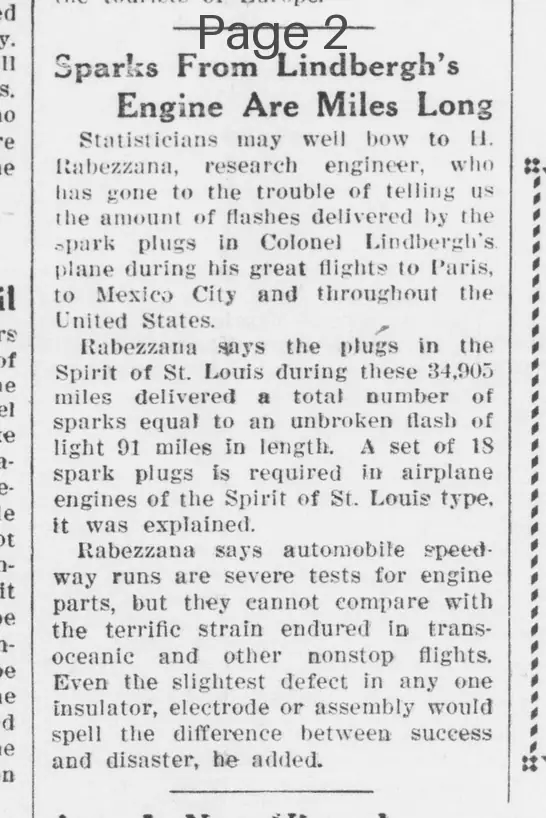
Statisticians may well bow to H. Rabezzana, research engineer, who has gone to the trouble of telling us the amount of flashes delivered by the spark plugs in Colonel Lindbergh's plane during his great flights to Paris, to Mexico City and throughout the United States.
Rabezzana says the plugs in the Spirit of St. Louis during these 34.905 miles delivered a total number of sparks equal to an unbroken flash of light 91 miles in length. A set of 18 spark plugs is required in airplane engines of the Spirit of St. Louis type, it was explained.
Rabezzana says automobile speed-way runs are severe tests for engine parts, but they cannot compare with the terrific strain endured in trans-oceanic and other nonstop flights.
Even the slightest defect in any one insulator, electrode or assembly would spell the difference between success and disaster, he added.
What sub-type of article is it?
What themes does it cover?
What keywords are associated?
What entities or persons were involved?
Story Details
Key Persons
Event Date
During His Great Flights To Paris, To Mexico City And Throughout The United States
Story Details
H. Rabezzana calculates that the spark plugs in Colonel Lindbergh's Spirit of St. Louis delivered a total number of sparks equal to an unbroken flash of light 91 miles in length over 34.905 miles of flight. Automobile speed-way runs cannot compare with the strain of trans-oceanic and nonstop flights, where any defect could mean disaster.