Thank you for visiting SNEWPapers!
Sign up free
Letter to Editor
April 7, 1806
Alexandria Daily Advertiser
Alexandria, Virginia
What is this article about?
In a letter dated March 27, 1806, from Morristown, former Commodore Richard V. Morris responds to a Senate committee report criticizing his 1803 actions in the Barbary War. He denies violating U.S. engagements with ex-Bashaw Hamet Caramalli, explaining no official treaty was authorized under his command and defending his squadron's departure from the African coast.
Clipping
OCR Quality
95%
Excellent
Full Text
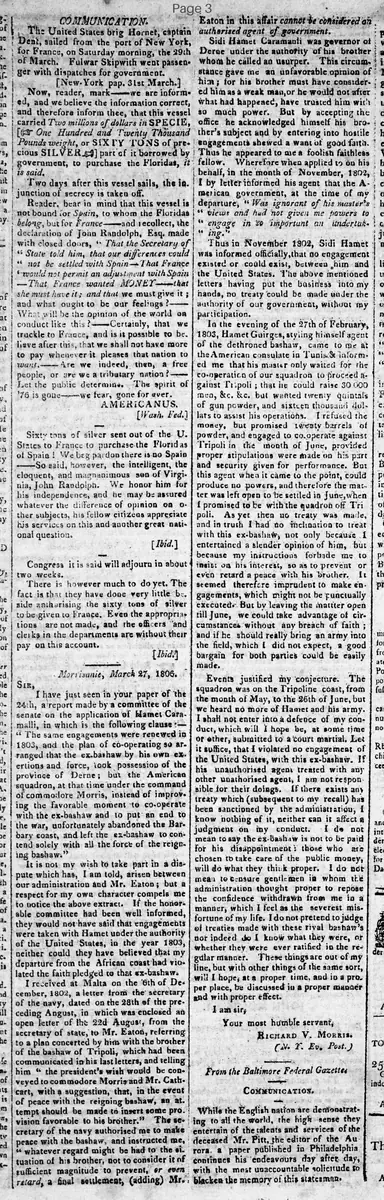
Morristown, March 27, 1806.
SIR,
I have just seen in your paper of the 24th, a report made by a committee of the senate on the application of Hamet Caramalli, in which is the following clause:
"The same engagements were renewed in 1803, and the plan of co-operating so arranged that the ex-bashaw by his own exertions and force, took possession of the province of Derne; but the American squadron, at that time under the command of commodore Morris, instead of improving the favorable moment to co-operate with the ex-bashaw and to put an end to the war, unfortunately abandoned the Barbary coast, and left the ex-bashaw to contend solely with all the force of the reigning bashaw."
It is not my wish to take part in a dispute which has, I am told, arisen between our administration and Mr. Eaton; but a respect for my own character compels me to notice the above extract. If the honorable committee had been well informed, they would not have said that engagements were taken with Hamet under the authority of the United States, in the year 1803, neither could they have believed that my departure from the African coast had violated the faith pledged to that ex-bashaw.
I received at Malta on the 6th of December, 1802, a letter from the secretary of the navy, dated on the 28th of the preceding August, in which was enclosed an open letter of the 22d August, from the secretary of state, to Mr. Eaton, referring to a plan concerted by him with the brother of the bashaw of Tripoli, which had been communicated in his last letters, and telling him "the president's wish would be conveyed to commodore Morris and Mr. Cathcart, with a suggestion, that, in the event of peace with the reigning bashaw, an attempt should be made to insert some provision favorable to his brother." The secretary of the navy authorised me to make peace with the bashaw, and instructed me, "whatever regard might be had to the situation of his brother, not to consider it of sufficient magnitude to prevent, or even retard, a final settlement, (adding) Mr. Eaton in this affair cannot be considered an authorised agent of government."
Sidi Hamet Caramalli was governor of Derne under the authority of his brother whom he called an usurper. This circumstance gave me an unfavorable opinion of him; for his brother must have considered him as a weak man, or he would not after what had happened, have trusted him with so much power. But by accepting the office he acknowledged himself his brother's subject and by entering into hostile engagements shewed a want of good faith. Thus he appeared to me a foolish faithless fellow. Wherefore when applied to on his behalf, in the month of November, 1802, I by letter informed his agent that the American government, at the time of my departure, "Was ignorant of his master's views and had not given me powers to engage in so important an undertaking."
Thus in November 1802, Sidi Hamet was informed officially, that no engagement existed or could exist, between him and the United States. The above mentioned letters having put the business into my hands, no treaty could be made under the authority of our government, without my participation.
In the evening of the 27th of February, 1803, Hamet Guirges, styling himself agent of the dethroned bashaw, came to me at the American consulate in Tunis & informed me that his master only waited for the co-operation of our squadron to proceed against Tripoli; that he could raise 30,000 men, &c. &c. but wanted twenty quintals of gun powder, and sixteen thousand dollars to assist his operations. I refused the money. but promised twenty barrels of powder, and engaged to co-operate against Tripoli in the month of June, provided proper stipulations were made on his part and security given for performance. But this agent when it came to the point. could produce no powers, and therefore the matter was left open to be settled in June, when I promised to be with the squadron off Tripoli. As yet then no treaty was made, and in truth I had no inclination to treat with this ex-bashaw, not only because I entertained a slender opinion of him. but because my instructions forbade me to insist on his interest, so as to prevent or even retard a peace with his brother. It seemed therefore imprudent to make engagements, which might not be punctually executed. But by leaving the matter open till June, we could take advantage of circumstances—without any breach of faith; and if he should really bring an army into the field, which I did not expect, a good bargain for both parties could be easily made.
Events justified my conjecture. The squadron was on the Tripoline coast, from the month of May, to the 26th of June, but we heard no more of Hamet and his army.
I shall not enter into a defence of my conduct, which will I hope be, at some time or other, submitted to a court martial. Let it suffice, that I violated no engagement of the United States: with this ex-bashaw. If his unauthorised agent treated with any other unauthorised agent, I am not responsible for their doings. If there exists any treaty which (subsequent to my recall) has been sanctioned by the administration, I know nothing of it, neither can it affect a judgment on my conduct. I do not mean to say the ex-bashaw is not to be paid for his disappointment: those who are chosen to take care of the public money, will do what they think proper. I do not mean to censure gentlemen to whom the administration thought proper to repose the confidence withdrawn from me in a manner, which I feel as the severest misfortune of my life. I do not pretend to judge of treaties made with these rival bashaws nor indeed do I know what they were, or whether they were ever ratified in the regular manner. These things are out of my line, but with other things of the same sort, will I hope, at a proper time, and in a proper place, be discussed in a proper manner and with proper effect.
I am sir,
Your most humble servant,
Richard V. Morris.
(N. Y. Ev. Post.)
SIR,
I have just seen in your paper of the 24th, a report made by a committee of the senate on the application of Hamet Caramalli, in which is the following clause:
"The same engagements were renewed in 1803, and the plan of co-operating so arranged that the ex-bashaw by his own exertions and force, took possession of the province of Derne; but the American squadron, at that time under the command of commodore Morris, instead of improving the favorable moment to co-operate with the ex-bashaw and to put an end to the war, unfortunately abandoned the Barbary coast, and left the ex-bashaw to contend solely with all the force of the reigning bashaw."
It is not my wish to take part in a dispute which has, I am told, arisen between our administration and Mr. Eaton; but a respect for my own character compels me to notice the above extract. If the honorable committee had been well informed, they would not have said that engagements were taken with Hamet under the authority of the United States, in the year 1803, neither could they have believed that my departure from the African coast had violated the faith pledged to that ex-bashaw.
I received at Malta on the 6th of December, 1802, a letter from the secretary of the navy, dated on the 28th of the preceding August, in which was enclosed an open letter of the 22d August, from the secretary of state, to Mr. Eaton, referring to a plan concerted by him with the brother of the bashaw of Tripoli, which had been communicated in his last letters, and telling him "the president's wish would be conveyed to commodore Morris and Mr. Cathcart, with a suggestion, that, in the event of peace with the reigning bashaw, an attempt should be made to insert some provision favorable to his brother." The secretary of the navy authorised me to make peace with the bashaw, and instructed me, "whatever regard might be had to the situation of his brother, not to consider it of sufficient magnitude to prevent, or even retard, a final settlement, (adding) Mr. Eaton in this affair cannot be considered an authorised agent of government."
Sidi Hamet Caramalli was governor of Derne under the authority of his brother whom he called an usurper. This circumstance gave me an unfavorable opinion of him; for his brother must have considered him as a weak man, or he would not after what had happened, have trusted him with so much power. But by accepting the office he acknowledged himself his brother's subject and by entering into hostile engagements shewed a want of good faith. Thus he appeared to me a foolish faithless fellow. Wherefore when applied to on his behalf, in the month of November, 1802, I by letter informed his agent that the American government, at the time of my departure, "Was ignorant of his master's views and had not given me powers to engage in so important an undertaking."
Thus in November 1802, Sidi Hamet was informed officially, that no engagement existed or could exist, between him and the United States. The above mentioned letters having put the business into my hands, no treaty could be made under the authority of our government, without my participation.
In the evening of the 27th of February, 1803, Hamet Guirges, styling himself agent of the dethroned bashaw, came to me at the American consulate in Tunis & informed me that his master only waited for the co-operation of our squadron to proceed against Tripoli; that he could raise 30,000 men, &c. &c. but wanted twenty quintals of gun powder, and sixteen thousand dollars to assist his operations. I refused the money. but promised twenty barrels of powder, and engaged to co-operate against Tripoli in the month of June, provided proper stipulations were made on his part and security given for performance. But this agent when it came to the point. could produce no powers, and therefore the matter was left open to be settled in June, when I promised to be with the squadron off Tripoli. As yet then no treaty was made, and in truth I had no inclination to treat with this ex-bashaw, not only because I entertained a slender opinion of him. but because my instructions forbade me to insist on his interest, so as to prevent or even retard a peace with his brother. It seemed therefore imprudent to make engagements, which might not be punctually executed. But by leaving the matter open till June, we could take advantage of circumstances—without any breach of faith; and if he should really bring an army into the field, which I did not expect, a good bargain for both parties could be easily made.
Events justified my conjecture. The squadron was on the Tripoline coast, from the month of May, to the 26th of June, but we heard no more of Hamet and his army.
I shall not enter into a defence of my conduct, which will I hope be, at some time or other, submitted to a court martial. Let it suffice, that I violated no engagement of the United States: with this ex-bashaw. If his unauthorised agent treated with any other unauthorised agent, I am not responsible for their doings. If there exists any treaty which (subsequent to my recall) has been sanctioned by the administration, I know nothing of it, neither can it affect a judgment on my conduct. I do not mean to say the ex-bashaw is not to be paid for his disappointment: those who are chosen to take care of the public money, will do what they think proper. I do not mean to censure gentlemen to whom the administration thought proper to repose the confidence withdrawn from me in a manner, which I feel as the severest misfortune of my life. I do not pretend to judge of treaties made with these rival bashaws nor indeed do I know what they were, or whether they were ever ratified in the regular manner. These things are out of my line, but with other things of the same sort, will I hope, at a proper time, and in a proper place, be discussed in a proper manner and with proper effect.
I am sir,
Your most humble servant,
Richard V. Morris.
(N. Y. Ev. Post.)
What sub-type of article is it?
Persuasive
Informative
Historical
What themes does it cover?
Military War
Politics
What keywords are associated?
Barbary War
Hamet Caramalli
Commodore Morris
Tripoli Bashaw
Us Squadron
Naval Engagements
Senate Committee
William Eaton
What entities or persons were involved?
Richard V. Morris
Sir
Letter to Editor Details
Author
Richard V. Morris
Recipient
Sir
Main Argument
morris asserts that no official u.s. engagements were made with hamet caramalli in 1803 under his command, and his squadron's departure did not violate any pledged faith, as preliminary discussions were unauthorized and left open without commitment.
Notable Details
Response To Senate Committee Report On Hamet Caramalli's Application
Letter From Secretary Of Navy Dated August 28, 1802, Received December 6, 1802
Instructions Not To Let Brother's Situation Retard Peace
Refusal Of $16,000 But Promise Of 20 Barrels Of Powder In February 1803
No Appearance Of Hamet's Army By June 1803
Desire For Court Martial To Defend Conduct