Thank you for visiting SNEWPapers!
Sign up free
Story
February 12, 1912
The Fairmont West Virginian
Fairmont, Marion County, West Virginia
What is this article about?
Eulogistic portrait of Abraham Lincoln as a prophetic liberator whose Emancipation Proclamation, rooted in primal justice and divine truth, freed slaves, uplifted American society, and inspired enduring moral and spiritual progress amid Civil War turmoil.
Clipping
OCR Quality
98%
Excellent
Full Text
LINCOLN, THE LIBERATOR.
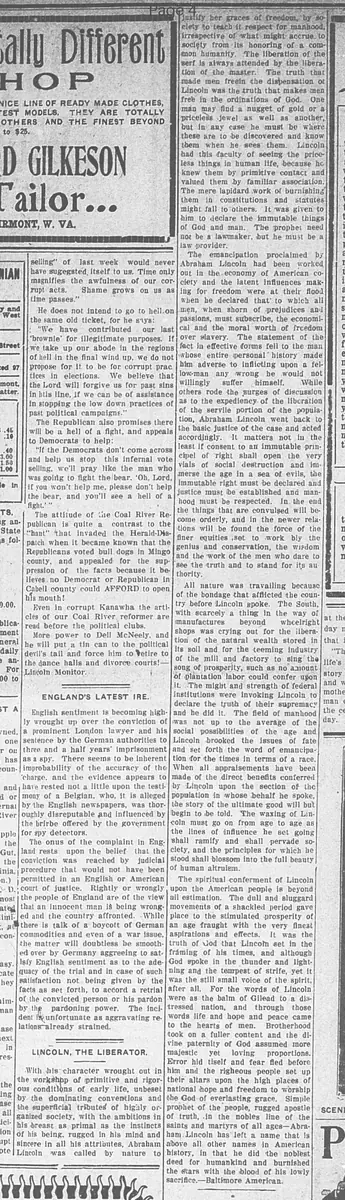
With his character wrought out in the workshop of primitive and rigorous conditions of early life, unbeset by the dominating conventions and the superficial tributes of highly organized society, with the ambitions in his breast as primal as the instincts of his being, rugged in his mind and sincere in all his attributes, Abraham Lincoln was called by nature to justify her graces of freedom, by society to teach it respect for manhood, irrespective of what might accrue to society from its honoring of a common humanity. The liberation of the serf is always attended by the liberation of the master. The truth that made men free in the dispensation of Lincoln was the truth that makes men free in the ordinations of God. One man may find a nugget of gold or a priceless jewel as well as another, but in any case he must be where these are to be discovered and know them when he sees them. Lincoln had this faculty of seeing the priceless things in human life, because he knew them by primitive contact and valued them by familiar association. The mere lapidary work of burnishing them in constitutions and statutes might fall to others. It was given to him to declare the immutable things of God and man. The prophet need not be a lawmaker, but he must be a law provider.
The emancipation proclaimed by Abraham Lincoln had been worked out in the economy of American society and the latent influences making for freedom were at their flood when he declared that to which all men, when shorn of prejudices and passions, must subscribe, the economical and the moral worth of freedom over slavery. The statement of the fact in effective forms fell to the man whose entire personal history made him adverse to inflicting upon a fellow-man any wrong he would not willingly suffer himself.
While others rode the surges of discussion as to the expediency of the liberation of the servile portion of the population, Abraham Lincoln went back to the basic justice of the case and acted accordingly. It matters not in the least if consent to an immutable principle of right shall open the very vials of social destruction and immerse the age in a sea of evils, the immutable right must be declared and justice must be established and manhood must be respected. In the end the things that are convulsed will become orderly, and in the newer relations will be found the force of the finer equities, set to work by the genius and conservation, the wisdom and the work of the men who dare to see the truth and to stand for its authority.
All nature was travailing because of the bondage that afflicted the country before Lincoln spoke. The South, with scarcely a thing in the way of manufactures beyond wheelright shops was crying out for the liberation of the natural wealth stored in its soil and for the teeming industry of the mill and factory to sing the song of prosperity, such as no amount of plantation labor could confer upon it. The might and strength of federal institutions were invoking Lincoln to declare the truth of their supremacy and he did it. The field of manhood was not up to the average of the social possibilities of the age and Lincoln brooked the issues of fate and set forth the word of emancipation for the times in terms of a race.
When all appraisements have been made of the direct benefits conferred by Lincoln upon the section of the population in whose behalf he spoke, the story of the ultimate good will but begin to be told. The waxing of Lincoln must go on from age to age as the lines of influence he set going shall ramify and pervade society, and the principles for which he stood shall blossom into the full beauty of human altruism.
The spiritual conferment of Lincoln upon the American people is beyond all estimation. The dull and sluggard movements of a shackled period gave place to the stimulated prosperity of an age fraught with the very finest aspirations and effects. It was the truth of God that Lincoln set in the framing of his times, and although God spoke in the thunder and lightning and the tempest of strife, yet it was the still small voice of the spirit, after all. For the words of Lincoln were as the balm of Gilead to a distressed nation, and through those words life and hope and peace came to the hearts of men. Brotherhood took on a fuller content and the divine paternity of God assumed more majestic yet loving proportions. Error hid itself and fear fled before him and the righteous people set up their altars upon the high places of national hope and freedom to worship the God of everlasting grace.
Simple prophet of the people, rugged apostle of truth, in the noble line of the saints and martyrs of all ages—Abraham Lincoln has left a name that is above all other names in American history, in that he did the noblest deed for humankind and burnished the stars with the blood of his lowly sacrifice.
Baltimore American.
With his character wrought out in the workshop of primitive and rigorous conditions of early life, unbeset by the dominating conventions and the superficial tributes of highly organized society, with the ambitions in his breast as primal as the instincts of his being, rugged in his mind and sincere in all his attributes, Abraham Lincoln was called by nature to justify her graces of freedom, by society to teach it respect for manhood, irrespective of what might accrue to society from its honoring of a common humanity. The liberation of the serf is always attended by the liberation of the master. The truth that made men free in the dispensation of Lincoln was the truth that makes men free in the ordinations of God. One man may find a nugget of gold or a priceless jewel as well as another, but in any case he must be where these are to be discovered and know them when he sees them. Lincoln had this faculty of seeing the priceless things in human life, because he knew them by primitive contact and valued them by familiar association. The mere lapidary work of burnishing them in constitutions and statutes might fall to others. It was given to him to declare the immutable things of God and man. The prophet need not be a lawmaker, but he must be a law provider.
The emancipation proclaimed by Abraham Lincoln had been worked out in the economy of American society and the latent influences making for freedom were at their flood when he declared that to which all men, when shorn of prejudices and passions, must subscribe, the economical and the moral worth of freedom over slavery. The statement of the fact in effective forms fell to the man whose entire personal history made him adverse to inflicting upon a fellow-man any wrong he would not willingly suffer himself.
While others rode the surges of discussion as to the expediency of the liberation of the servile portion of the population, Abraham Lincoln went back to the basic justice of the case and acted accordingly. It matters not in the least if consent to an immutable principle of right shall open the very vials of social destruction and immerse the age in a sea of evils, the immutable right must be declared and justice must be established and manhood must be respected. In the end the things that are convulsed will become orderly, and in the newer relations will be found the force of the finer equities, set to work by the genius and conservation, the wisdom and the work of the men who dare to see the truth and to stand for its authority.
All nature was travailing because of the bondage that afflicted the country before Lincoln spoke. The South, with scarcely a thing in the way of manufactures beyond wheelright shops was crying out for the liberation of the natural wealth stored in its soil and for the teeming industry of the mill and factory to sing the song of prosperity, such as no amount of plantation labor could confer upon it. The might and strength of federal institutions were invoking Lincoln to declare the truth of their supremacy and he did it. The field of manhood was not up to the average of the social possibilities of the age and Lincoln brooked the issues of fate and set forth the word of emancipation for the times in terms of a race.
When all appraisements have been made of the direct benefits conferred by Lincoln upon the section of the population in whose behalf he spoke, the story of the ultimate good will but begin to be told. The waxing of Lincoln must go on from age to age as the lines of influence he set going shall ramify and pervade society, and the principles for which he stood shall blossom into the full beauty of human altruism.
The spiritual conferment of Lincoln upon the American people is beyond all estimation. The dull and sluggard movements of a shackled period gave place to the stimulated prosperity of an age fraught with the very finest aspirations and effects. It was the truth of God that Lincoln set in the framing of his times, and although God spoke in the thunder and lightning and the tempest of strife, yet it was the still small voice of the spirit, after all. For the words of Lincoln were as the balm of Gilead to a distressed nation, and through those words life and hope and peace came to the hearts of men. Brotherhood took on a fuller content and the divine paternity of God assumed more majestic yet loving proportions. Error hid itself and fear fled before him and the righteous people set up their altars upon the high places of national hope and freedom to worship the God of everlasting grace.
Simple prophet of the people, rugged apostle of truth, in the noble line of the saints and martyrs of all ages—Abraham Lincoln has left a name that is above all other names in American history, in that he did the noblest deed for humankind and burnished the stars with the blood of his lowly sacrifice.
Baltimore American.
What sub-type of article is it?
Biography
Historical Event
Heroic Act
What themes does it cover?
Justice
Bravery Heroism
Providence Divine
What keywords are associated?
Abraham Lincoln
Emancipation Proclamation
Slavery Abolition
Divine Providence
National Liberation
Moral Justice
What entities or persons were involved?
Abraham Lincoln
Where did it happen?
United States
Story Details
Key Persons
Abraham Lincoln
Location
United States
Story Details
Tribute to Abraham Lincoln as a rugged, sincere leader who, through his primitive wisdom and moral conviction, proclaimed emancipation, liberating slaves and society from bondage, invoking divine truth and justice to foster national prosperity, brotherhood, and human altruism.