Thank you for visiting SNEWPapers!
Sign up free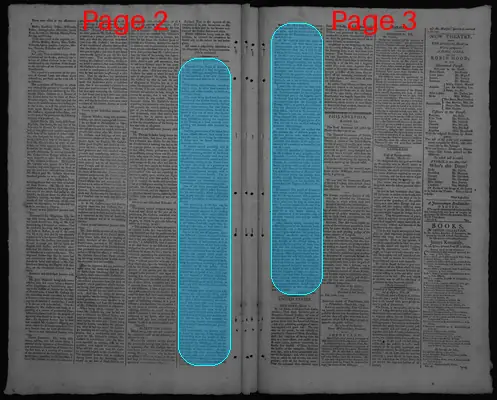
Gazette Of The United States & Evening Advertiser
Philadelphia, Philadelphia County, Pennsylvania
What is this article about?
An editorial critiques Kentucky's demand for free navigation of the Mississippi River through Spanish territory, arguing it lacks strong legal basis and could harm U.S. interests by encouraging premature western settlement. It urges caution in federal involvement with Spain.
Merged-components note: Continuation of the piece on Kentucky's Mississippi navigation claim; signed 'EXAMINER' indicates editorial opinion.
Clippings

1 of 2
OCR Quality
Full Text
The case of the People of Kentucky, in their demand of a free navigation of the river Mississippi, through the dominions of the Spaniards, is but little known or understood—and deserves to be considered.
The States, then Colonies, confederating in 1775, to assert their common liberties, had either definite, or indefinite, territorial claims.
The whole being saved and secured by the arms of the United States, no other expectation was entertained on the settling of our independences, but that States, having the indefinite claims, Should be allowed to take out of them what further it might be convenient to add, to their local jurisdiction, leaving the remainder to the Union, as a fund towards extinguishing the national debt incurred by the war.
Had the government of the union been in any respect efficient, such would have been the event, but it being far otherwise it rested upon the States themselves to make the transfers.
A partial interest prevailing over so equitable a consideration, and over the sense of common good, few of the States made cessions to Congress until they had cut off for themselves the nearest and fairest portions, leaving to the Union scarce any parts that could in a generation be brought into use—Such accession of property, in consequence brought, with it rather a burthen than benefit. The injured states remonstrated in vain—the confederation was threatened in its consummation, and for a time endangered.
One of the states particularly assumed and sold out the district called Kentucky for her Own benefit ; which besides putting money into her treasury afforded a profitable speculation to her individual citizens.
This proceeding of the state was far from an adherence to the rule spoken of—the space already occupied by her existing settlers, was then of an extent sufficient for local jurisdiction, for by her own consent Kentucky was set apart from her as a new state—Kentucky ought then, according to the rule, to have been in the allotment to the general government.
Injured in the loss of property, America sustained a further and more serious injury by. this measure—inasmuch as it was an attempt, of bad example, to form premature settlements of the back lands, which were necessarily to lead off great numbers of inhabitants from the maritime country, that country which ought to have been the object of our immediate hope and care ! thus proportionably backening its growth or retarding it progress—contrary to all true policy, which would rather seek to consolidate our population than to spread it out thinly over the vast expanse of Western wilderness, where beyond the waters of the Atlantic an interest would grow up of its own, as wide apart from ours as the two countries are wide in space.
An enlarged spirit of patriotism will. however, not object to any thing while the object is to better the condition of men—true! but is it bettering the condition of any men to take them from situations where every species of industry is happily retributed, and turns to its full account, and to set them down where from circumstances of locality their faculties and their labours are so little available, as that according to, their own complaining representation " wretchedness and poverty await them."
But wretchedness and poverty would no longer be their lot, if the Spaniards, in withholding from the people of Kentucky and other western settlers, the free navigation of the Mississippi, did not deprive them of the natural market for the productions of their industry. A right they claim, and which they passionately and clamorously call upon the United States to vindicate for them, with a threat that if refused they will take redress into their own hands.
Before the call is complied with it may not be improper to consider the nature of the right, and the reasonableness of the demand on the United States to assert it on their behalf.
1st. No right to follow the course of air, wherever the wind blows, has yet been pretended, but to go with the waters, wherever they run, is held by the Church of Kentucky, to be jure divino, & therefore rivers are a common right—but leaving the spiritual doctors as unsafe guides in things terrestrial, and looking into the world, we shall find that things are there otherwise ordered—and that the sovereignty and exclusive use of a river changes with the property of the country through which it happens to run, and that where the use is not exclusive, consent or stipulation has been understood.
I cannot say this point has been invariably agreed—the late Emperor, Joseph the Second, contended for the navigation of the Dutch part of the Scheldt, under the laws of God and nature, against human convention—but the sovereigns of Europe, dreading no good to her own corps from the allowance of such authority in their affairs, objected to the precedent—the Emperor's plea was over-ruled, and it was adjudged that neither God nor nature should direct in the navigation of rivers, but that it was an affair belonging to men or rather to kings.
Indeed it is difficult not to allow that the common use, of different people, to the same waters, under whatever principles, would produce nearly the same uncertainty, and disorder in the police and economy of a country, as it would in the case of a road.
Under this impression of inconvenience the use is seldom a mixt property—The Rhone the Po and the Rhine all take their rise in Switzerland—but the people of the Cantons do not therefore traffic, in their boats, along the whole course of these rivers to their issues in the Mediterranean, the Adriatic or the fens of Holland? Do the Germans pursue the Danube from Suabia, through Hungary and Turkey, into the Black Sea, or the Spaniards follow down the Tagus to Lisbon in Portugal.
No matter! The people of Kentucky have another count in their declaration—the hole in the heavenly title is patched by an earthly document, supplied by the treaty made with the king of Great-Britain. I have not looked into it—but if as I suspect his own title was not good, there must be a link fatally wanting in the chain—and if he has given only a common warranty they may go whistle for the right.
2ndly. Having already remarked that a state assumption of the Kentucky lands, in particular, was in derogation of Continental right—and that the premature settlement, occasioned thereby of such distant regions, operated greatly to the best interests of the United States, it could hardly be expected of them, even were the title indisputable, that they should in complying with the call labour at a point, which if gained would but the more enhance the evils they already complained of—but as the title appears at least doubtful let us hope that the public peace or general prosperity may not be disturbed or put to hazard by our contests with the kingdom of Spain on that account. And that if the Kentuckians attempt alone to redress what they call a grievance, they may, being disowned by the general government, be left alone to the consequences of their own presumption and iniquity.
EXAMINER.
What sub-type of article is it?
What keywords are associated?
What entities or persons were involved?
Editorial Details
Primary Topic
Kentucky's Demand For Free Navigation Of The Mississippi Through Spanish Dominions
Stance / Tone
Critical Of Kentucky's Claims And Cautious On Federal Intervention
Key Figures
Key Arguments