Thank you for visiting SNEWPapers!
Sign up free
The Milwaukee Leader
Milwaukee, Milwaukee County, Wisconsin
What is this article about?
Explores Hydrocotyle Asiatica, an Indian herb claimed to promote longevity and youthfulness, as per 250-year-old Li Ching-Yun. Details its medicinal uses, brain-energizing properties, and governmental research in India, Ceylon, and Algiers, emphasizing proper diet for health benefits.
Clipping
OCR Quality
Full Text
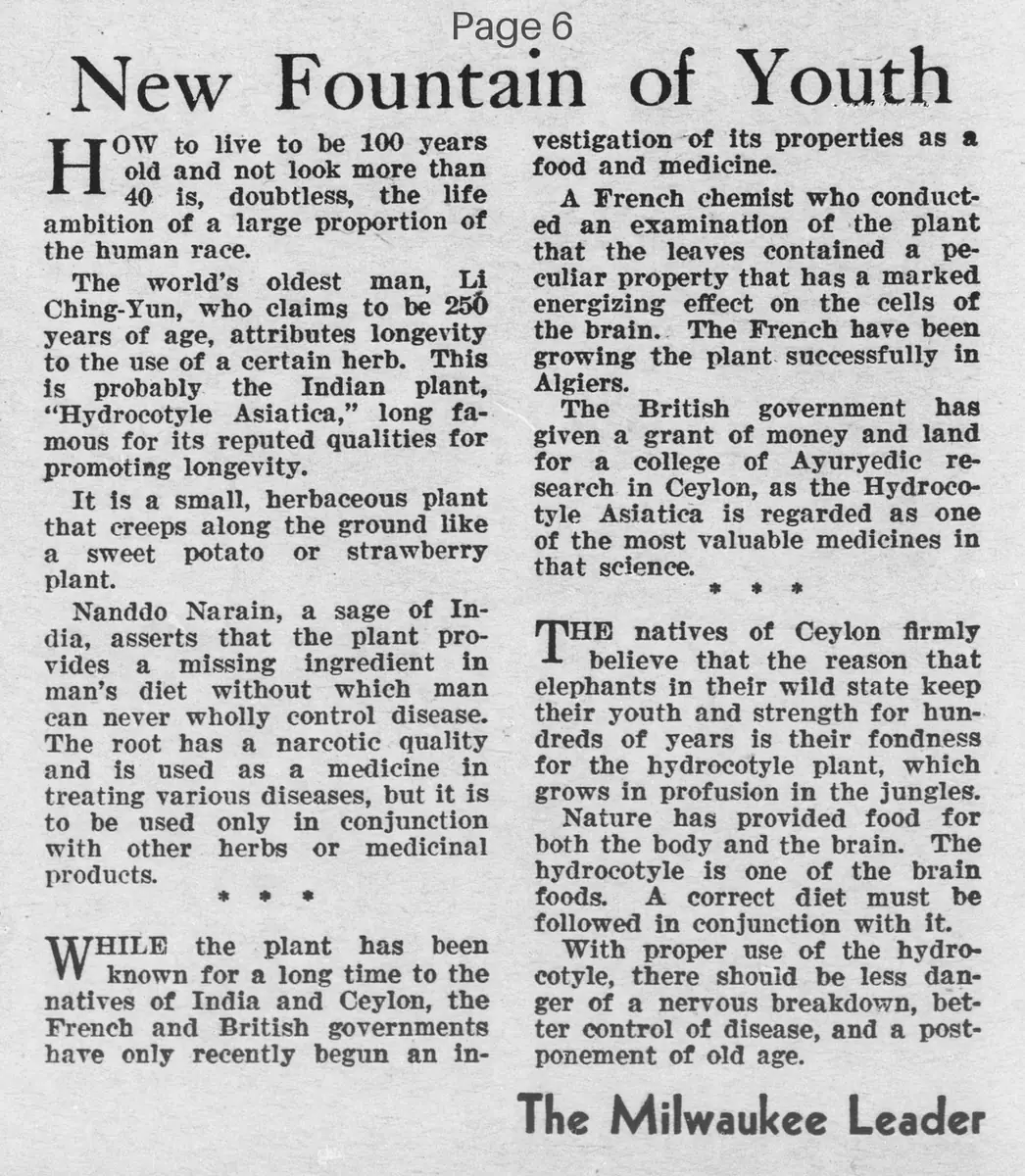
How to live to be 100 years old and not look more than 40 is, doubtless, the life ambition of a large proportion of the human race.
The world's oldest man, Li Ching-Yun, who claims to be 250 years of age, attributes longevity to the use of a certain herb.
This is probably the Indian plant, "Hydrocotyle Asiatica," long famous for its reputed qualities for promoting longevity.
It is a small, herbaceous plant that creeps along the ground like a sweet potato or strawberry plant.
Nanddo Narain, a sage of India, asserts that the plant provides a missing ingredient in man's diet without which man can never wholly control disease.
The root has a narcotic quality and is used as a medicine in treating various diseases, but it is to be used only in conjunction with other herbs or medicinal products.
While the plant has been known for a long time to the natives of India and Ceylon, the French and British governments have only recently begun an investigation of its properties as a food and medicine.
A French chemist who conducted an examination of the plant found that the leaves contained a peculiar property that has a marked energizing effect on the cells of the brain.
The French have been growing the plant successfully in Algiers.
The British government has given a grant of money and land for a college of Ayurvedic research in Ceylon, as the Hydrocotyle Asiatica is regarded as one of the most valuable medicines in that science.
The natives of Ceylon firmly believe that the reason that elephants in their wild state keep their youth and strength for hundreds of years is their fondness for the hydrocotyle plant, which grows in profusion in the jungles.
Nature has provided food for both the body and the brain.
The hydrocotyle is one of the brain foods.
A correct diet must be followed in conjunction with it.
With proper use of the hydrocotyle, there should be less danger of a nervous breakdown, better control of disease, and a postponement of old age.
What sub-type of article is it?
What themes does it cover?
What keywords are associated?
What entities or persons were involved?
Where did it happen?
Story Details
Key Persons
Location
India, Ceylon, Algiers
Story Details
The article explores Hydrocotyle Asiatica, an Indian herb reputed for promoting longevity, as claimed by the 250-year-old Li Ching-Yun. It describes the plant's properties, uses in medicine, and investigations by French and British governments, suggesting it energizes brain cells and prevents aging when used with proper diet.