Thank you for visiting SNEWPapers!
Sign up free
The National Intelligencer And Washington Advertiser
Washington, District Of Columbia
What is this article about?
Letter from Thomas T. Davis in Kaskaskias, Indiana Territory, October 18, 1803, describing travels through the region, assessing land fertility inferior to Kentucky, settlement opportunities, economic potential for cotton and hemp, depopulation due to slavery fears under American governance, peaceful Indians, and calls for legal reforms on appeals and slave policies.
Clipping
OCR Quality
Full Text
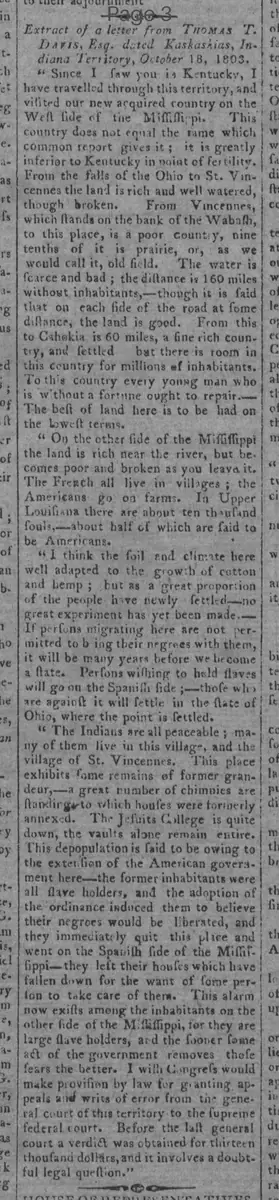
"Since I saw you in Kentucky, I have travelled through this territory, and visited our new acquired country on the West side of the Mississippi. This country does not equal the fame which common report gives it; it is greatly inferior to Kentucky in point of fertility. From the falls of the Ohio to St. Vincennes the land is rich and well watered, though broken. From Vincennes, which stands on the bank of the Wabash, to this place, is a poor country, nine tenths of it is prairie, or, as we would call it, old field. The water is scarce and bad; the distance is 160 miles without inhabitants, though it is said that on each side of the road at some distance, the land is good. From this to Cahokia is 60 miles, a fine rich country, and settled but there is room in this country for millions of inhabitants.
To this country every young man who is without a fortune ought to repair. The best of land here is to be had on the lowest terms.
On the other side of the Mississippi the land is rich near the river, but becomes poor and broken as you leave it. The French all live in villages; the Americans go on farms. In Upper Louisiana there are about ten thousand souls,—about half of which are said to be Americans.
I think the soil and climate here well adapted to the growth of cotton and hemp; but as a great proportion of the people have newly settled no great experiment has yet been made. If persons migrating here are not permitted to bring their negroes with them, it will be many years before we become a state. Persons wishing to hold slaves will go on the Spanish side;—those who are against it will settle in the state of Ohio, where the point is settled.
The Indians are all peaceable; many of them live in this village, and the village of St. Vincennes. This place exhibits some remains of former grandeur,—a great number of chimnies are standing to which houses were formerly annexed. The Jesuits College is quite down, the vaults alone remain entire. This depopulation is said to be owing to the extension of the American government here the former inhabitants were all slave holders, and the adoption of the ordinance induced them to believe their negroes would be liberated, and they immediately quit this place and went on the Spanish side of the Mississippi—they left their houses which have fallen down for the want of some person to take care of them. This alarm now exists among the inhabitants on the other side of the Mississippi, for they are large slave holders, and the sooner some act of the government removes those fears the better. I wish Congress would make provision by law for granting appeals and writs of error from the general court of this territory to the supreme federal court. Before the last general court a verdict was obtained for thirteen thousand dollars, and it involves a doubtful legal question."
What sub-type of article is it?
What keywords are associated?
What entities or persons were involved?
Where did it happen?
Domestic News Details
Primary Location
Kaskaskias, Indiana Territory
Event Date
October 18, 1803
Key Persons
Outcome
depopulation of kaskaskias due to fears of slave liberation under american ordinance; former inhabitants moved to spanish side of mississippi, leaving houses to decay; ongoing alarm among slaveholders in upper louisiana; suggestion for congressional law on appeals to federal court following a $13,000 verdict involving legal question.
Event Details
Thomas T. Davis describes travels through Indiana Territory and west of Mississippi, noting land fertility inferior to Kentucky, poor stretches with prairies and scarce water, rich areas near Cahokia with room for millions; advises young men without fortune to settle for cheap land; French in villages, Americans on farms; Upper Louisiana has 10,000 souls, half American; soil suited for cotton and hemp but untested; slavery restrictions hinder statehood, driving slaveholders to Spanish side or Ohio; peaceful Indians in villages; Kaskaskias shows ruins from depopulation caused by American governance fears over slaves.