Thank you for visiting SNEWPapers!
Sign up free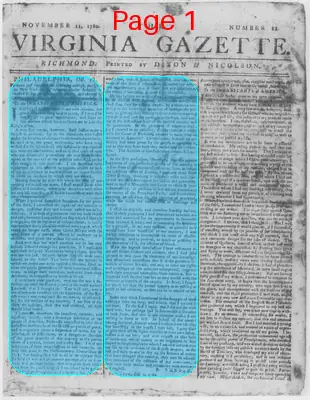
Story
November 11, 1780
The Virginia Gazette
Richmond, Williamsburg, Richmond County, Virginia
What is this article about?
Benedict Arnold's address to Americans justifying his defection to the British, arguing that independence was unnecessary after Britain's peace offers and criticizing the alliance with France. Dated New York, Oct. 7, 1780; published in Philadelphia, Oct. 19.
Clipping
OCR Quality
92%
Excellent
Full Text
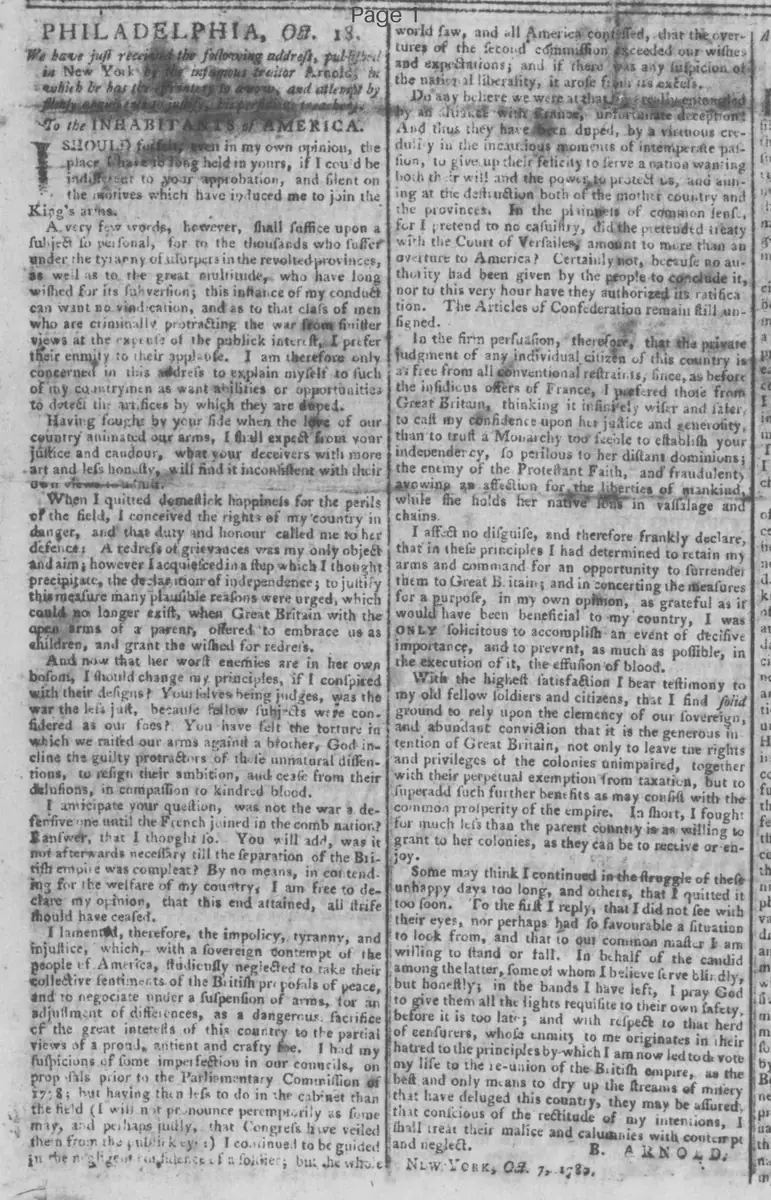
PHILADELPHIA, Oct. 19.
We have just received the following address, published in New York by the infamous traitor Arnold, in which he has the temerity to avow, and attempt by
TO THE INHABITANTS OF AMERICA.
Should forfeit, even in my own opinion, the place I have so long held in yours, if I could be indifferent to your approbation, and silent on the motives which have induced me to join the King's arms.
A very few words, however, shall suffice upon a subject so personal, for to the thousands who suffer under the tyranny of usurpers in the revolted provinces, as well as to the great multitude, who have long wished for its subversion; this instance of my conduct can want no vindication, and as to that class of men who are criminally protracting the war from sinister views at the expense of the public interest, I prefer their enmity to their applause. I am therefore only concerned in this address to explain myself to such of my countrymen as want abilities or opportunities to detect the artifices by which they are duped.
Having fought by your side when the love of our country animated our arms, I shall expect from your justice and candour, what your deceivers with more art and less honesty, will find it inconsistent with their own views to admit.
When I quitted domestic happiness for the perils of the field, I conceived the rights of my country in danger, and that duty and honour called me to her defence: A redress of grievances was my only object and aim; however I acquiesced in a step which I thought precipitate, the declaration of independence; to justify this measure many plausible reasons were urged, which could no longer exist, when Great Britain with the open arms of a parent, offered to embrace us as children, and grant the wished for redress.
And now that her worst enemies are in her own bosom, I should change my principles, if I conspired with their designs? Yourselves being judges, was the war the less just, because fellow subjects were considered as our foes? You have felt the torture in which we raised our arms against a brother, God incline the guilty protractors of those unnatural divisions, to rein their ambition, and cease from their delusions, in compassion to kindred blood.
I anticipate your question, was not the war a defensive one until the French joined in the combination? Answer, that I thought so. You will add, was it not afterwards necessary till the separation of the British empire was complete? By no means, I contend. ing for the welfare of my country, I am free to declare my opinion, that this end attained, all strife should have ceased.
I lament, therefore, the impolicy, tyranny, and injustice, which, with a sovereign contempt of the people of America, ridiculously neglected to take their collective sentiments of the British proposals of peace, and to negotiate under a suspension of arms, for an adjustment of differences, as a dangerous sacrifice of the great interests of this country to the partial views of a proud, ancient and crafty foe. I had my suspicions of some imperfection in our councils, on proposals prior to the Parliamentary Commission of 1778; but having the less to do in the cabinet than the field (I will not pronounce peremptorily as some may, and perhaps justly, that Congress have veiled them from the public eye:) I continued to be guided in the high confidence of a soldier; but the whole world saw, and all America confessed, that the overtures of the second commission exceeded our wishes and expectations; and if there was any suspicion of the national liberality, it arose from its excess.
Do any believe we were at that time really entangled by an alliance with France, unfortunate deception! And thus they have been duped, by a virtuous credulity in the incautious moments of intemperate passion, to give up their felicity to serve a nation wanting both the will! and the power to protect us, and aiming at the destruction both of the mother country and the provinces. In the principles of common sense, for I pretend to no casuistry, did the pretended treaty with the Court of Versailles, amount to more than an overture to America? Certainly not, because no authority had been given by the people to conclude it, nor to this very hour have they authorized its ratification. The Articles of Confederation remain still unsigned.
In the firm persuasion, therefore, that the private judgment of any individual citizen of this country is as free from all conventional restraints. since. as before the insidious offers of France, I preferred those from Great Britain, thinking it infinitely wiser and safer, to cast my confidence upon her justice and generosity, than to trust a Monarchy too feeble to establish your independency, so perilous to her distant dominions; the enemy of the Protestant Faith, and fraudulent, avowing an affection for the liberties of mankind, while she holds her native sons in vassalage and chains.
I affect no disguise, and therefore frankly declare, that in these principles I had determined to retain my arms and command for an opportunity to surrender them to Great Britain; and in concerting the measures for a purpose, in my own opinion, as grateful as it would have been beneficial to my country, I was ONLY solicitous to accomplish an event of decisive importance, and to prevent, as much as possible, in the execution of it, the effusion of blood.
With the highest satisfaction I bear testimony to my old fellow soldiers and citizens, that I find solid ground to rely upon the clemency of our sovereign, and abundant conviction that it is the generous intention of Great Britain, not only to leave the rights and privileges of the colonies unimpaired, together with their perpetual exemption from taxation, but to superadd such further benefits as may consist with the common prosperity of the empire. In short, I fought for much less than the parent country is as willing to grant to her colonies, as they can be to receive or enjoy.
Some may think I continued in the struggle of these unhappy days too long, and others, that I quitted it too soon. To the first I reply, that I did not see with their eyes, nor perhaps had so favourable a situation to look from, and that to our common master I am willing to stand or fall. In behalf of the candid among the latter, some of whom I believe serve blindly, but honestly; in the hands I have left, I pray God to give them all the lights requisite to their own safety, before it is too late; and with respect to that herd of censurers, whose commits to me originates in their hatred to the principles by which I am now led to devote my life to the re-union of the British empire, as the best and only means to dry up the streams of misery that have deluged this country, they may be assured, that conscious of the rectitude of my intentions, I shall treat their malice and calumnies with contempt and neglect.
B. ARNOLD:
NEW YORK, Oct. 7, 1780,
We have just received the following address, published in New York by the infamous traitor Arnold, in which he has the temerity to avow, and attempt by
TO THE INHABITANTS OF AMERICA.
Should forfeit, even in my own opinion, the place I have so long held in yours, if I could be indifferent to your approbation, and silent on the motives which have induced me to join the King's arms.
A very few words, however, shall suffice upon a subject so personal, for to the thousands who suffer under the tyranny of usurpers in the revolted provinces, as well as to the great multitude, who have long wished for its subversion; this instance of my conduct can want no vindication, and as to that class of men who are criminally protracting the war from sinister views at the expense of the public interest, I prefer their enmity to their applause. I am therefore only concerned in this address to explain myself to such of my countrymen as want abilities or opportunities to detect the artifices by which they are duped.
Having fought by your side when the love of our country animated our arms, I shall expect from your justice and candour, what your deceivers with more art and less honesty, will find it inconsistent with their own views to admit.
When I quitted domestic happiness for the perils of the field, I conceived the rights of my country in danger, and that duty and honour called me to her defence: A redress of grievances was my only object and aim; however I acquiesced in a step which I thought precipitate, the declaration of independence; to justify this measure many plausible reasons were urged, which could no longer exist, when Great Britain with the open arms of a parent, offered to embrace us as children, and grant the wished for redress.
And now that her worst enemies are in her own bosom, I should change my principles, if I conspired with their designs? Yourselves being judges, was the war the less just, because fellow subjects were considered as our foes? You have felt the torture in which we raised our arms against a brother, God incline the guilty protractors of those unnatural divisions, to rein their ambition, and cease from their delusions, in compassion to kindred blood.
I anticipate your question, was not the war a defensive one until the French joined in the combination? Answer, that I thought so. You will add, was it not afterwards necessary till the separation of the British empire was complete? By no means, I contend. ing for the welfare of my country, I am free to declare my opinion, that this end attained, all strife should have ceased.
I lament, therefore, the impolicy, tyranny, and injustice, which, with a sovereign contempt of the people of America, ridiculously neglected to take their collective sentiments of the British proposals of peace, and to negotiate under a suspension of arms, for an adjustment of differences, as a dangerous sacrifice of the great interests of this country to the partial views of a proud, ancient and crafty foe. I had my suspicions of some imperfection in our councils, on proposals prior to the Parliamentary Commission of 1778; but having the less to do in the cabinet than the field (I will not pronounce peremptorily as some may, and perhaps justly, that Congress have veiled them from the public eye:) I continued to be guided in the high confidence of a soldier; but the whole world saw, and all America confessed, that the overtures of the second commission exceeded our wishes and expectations; and if there was any suspicion of the national liberality, it arose from its excess.
Do any believe we were at that time really entangled by an alliance with France, unfortunate deception! And thus they have been duped, by a virtuous credulity in the incautious moments of intemperate passion, to give up their felicity to serve a nation wanting both the will! and the power to protect us, and aiming at the destruction both of the mother country and the provinces. In the principles of common sense, for I pretend to no casuistry, did the pretended treaty with the Court of Versailles, amount to more than an overture to America? Certainly not, because no authority had been given by the people to conclude it, nor to this very hour have they authorized its ratification. The Articles of Confederation remain still unsigned.
In the firm persuasion, therefore, that the private judgment of any individual citizen of this country is as free from all conventional restraints. since. as before the insidious offers of France, I preferred those from Great Britain, thinking it infinitely wiser and safer, to cast my confidence upon her justice and generosity, than to trust a Monarchy too feeble to establish your independency, so perilous to her distant dominions; the enemy of the Protestant Faith, and fraudulent, avowing an affection for the liberties of mankind, while she holds her native sons in vassalage and chains.
I affect no disguise, and therefore frankly declare, that in these principles I had determined to retain my arms and command for an opportunity to surrender them to Great Britain; and in concerting the measures for a purpose, in my own opinion, as grateful as it would have been beneficial to my country, I was ONLY solicitous to accomplish an event of decisive importance, and to prevent, as much as possible, in the execution of it, the effusion of blood.
With the highest satisfaction I bear testimony to my old fellow soldiers and citizens, that I find solid ground to rely upon the clemency of our sovereign, and abundant conviction that it is the generous intention of Great Britain, not only to leave the rights and privileges of the colonies unimpaired, together with their perpetual exemption from taxation, but to superadd such further benefits as may consist with the common prosperity of the empire. In short, I fought for much less than the parent country is as willing to grant to her colonies, as they can be to receive or enjoy.
Some may think I continued in the struggle of these unhappy days too long, and others, that I quitted it too soon. To the first I reply, that I did not see with their eyes, nor perhaps had so favourable a situation to look from, and that to our common master I am willing to stand or fall. In behalf of the candid among the latter, some of whom I believe serve blindly, but honestly; in the hands I have left, I pray God to give them all the lights requisite to their own safety, before it is too late; and with respect to that herd of censurers, whose commits to me originates in their hatred to the principles by which I am now led to devote my life to the re-union of the British empire, as the best and only means to dry up the streams of misery that have deluged this country, they may be assured, that conscious of the rectitude of my intentions, I shall treat their malice and calumnies with contempt and neglect.
B. ARNOLD:
NEW YORK, Oct. 7, 1780,
What sub-type of article is it?
Historical Event
Biography
Crime Story
What themes does it cover?
Betrayal
Justice
Deception
What keywords are associated?
Benedict Arnold
Treason
American Revolution
British Loyalty
French Alliance
Peace Proposals
What entities or persons were involved?
B. Arnold
Where did it happen?
America, New York, Philadelphia
Story Details
Key Persons
B. Arnold
Location
America, New York, Philadelphia
Event Date
Oct. 7, 1780
Story Details
Benedict Arnold justifies his treason by arguing that Britain's peace offers made independence unnecessary, criticizes the French alliance as deceptive, and affirms his intent to reunite the British empire without further bloodshed.