Thank you for visiting SNEWPapers!
Sign up free
Editorial
October 5, 1802
Alexandria Advertiser And Commercial Intelligencer
Alexandria, Virginia
What is this article about?
This editorial defends the legality and necessity of confidential expenditures in the War, Navy, and State Departments, criticizing a congressional committee's report for misinterpreting laws from 1790-1800 and historical practices under Presidents Washington and Adams. It argues for presidential discretion to ensure national security without public disclosure.
Clipping
OCR Quality
88%
Good
Full Text
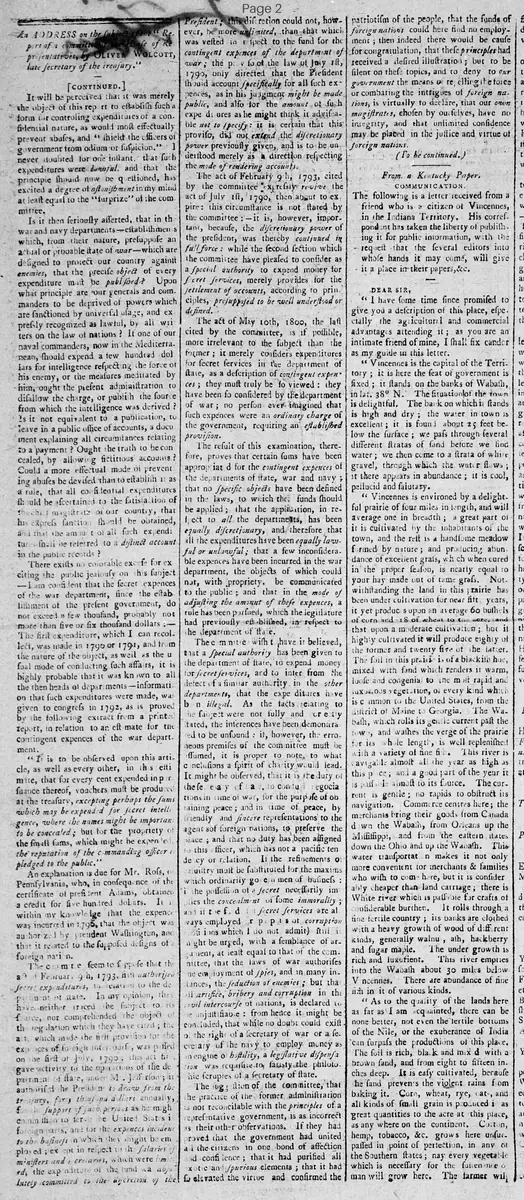
An ADDRESS on the subject of the report of a committee of a confidential nature, as would most effectually prevent abuses, and "shield the officers of government from odium or suspicion."
I never doubted for one instant, that such expenditures were lawful. and that the principle should now be questioned, has excited a degree of astonishment in my mind at least equal to the "surprise" of the committee.
Is it then seriously asserted, that in the war and navy departments--establishments which, from their nature, presuppose an actual or probable state of war-which are designed to protect our country against enemies, that the precise object of every expenditure must be published: Upon what principle are Our generals and commanders to be deprived of powers which are sanctioned by universal usage, and expressly recognized as lawful, by all writers on the law of nations?
If one of our naval commanders, now in the Mediterranean, should expend a few hundred dollars for intelligence respecting the force of his enemy, or the measures meditated by him, --ought the present administration to disallow the charge, or publish the source from which the intelligence was derived?
Is it not equivalent to a publication, to leave in a public office of accounts, a document explaining all circumstances relating to a payment? Ought the truth to be concealed, by allowing fictitious accounts?
Could a more effectual mode of preventing abuses be devised than to establish it as a rule, that all confidential expenditures should be ascertained to the satisfaction of the chief magistrate of our country, that his express sanction, should be obtained. and that the amount of all such expenditures shall be referred to a distinct account in the public records?
There exists no colorable excuse for exciting the public jealousy on this subject --I am confident that the secret expenses of the war department, since the establishment of the present government, do not exceed a few thousand, probably not more than five or six thousand dollars :-- The first expenditure, which I can recollect, was made in 1790 or 1791, and from the nature of the object, as well as the usual mode of conducting such affairs, it is highly probable that it was known to all the then heads of departments --information that such expenditures were made, was given to congress in 1792, as is proved by the following extract from a printed report, in relation to an estimate for the contingent expenses of the war department.
" It is to be observed upon this article, as well as every other, in this estimate, that for every cent expended in pursuance thereof, vouchers must be produced at the treasury, excepting perhaps the sums which may be expended for secret intelligence, where the names might be important to be concealed ; but for the propriety of the small sums, which might be expended, the reputation of the commanding officer is pledged to the public."
An explanation is due for Mr. Ross. of Pennsylvania, who, in consequence of the certificate of president Adams, obtained a credit for five hundred dollars. It is within my knowledge that the expense was incurred in 1790, that the object was authorized by president Washington, and that it related to the supposed designs of a foreign nation.
The committee seem to profess that the act February 9th, 1793, must authorize secret expenditures, tending to the department of state. In my opinion, they have neither traced the subject to its source, nor comprehended the object of the regulation which they have cited ; the act, which made the first provision for the expenses of foreign intercourse, was passed on the first of July, 1790; this act first gave activity to the operations of the department of state, under Mr. Jefferson ; it authorized the President to draw from the treasury, twenty thousand dollars annually, for his support of such persons as he might commission to act for the United States in foreign parts, and for the expenses incident to the business in which they might be employed ; except in respect to the salaries of ministers and secretaries, which were limited the expenditure of the fund was absolutely committed to the discretion of the President; this discretion could not, however, be more unlimited. .than-that which was vested in respect to the fund for the contingent expenses of the department of war; the proviso of the law of July 1st, 1790, only directed that the President should account specifically for all such expenses, as in his judgment might be made public, and also for the amount of such expenditures as he might think it advisable not to specify: it is certain that this proviso, did not extend the discretionary power previously given,, and is to be understood merely as a direction respecting the mode of rendering accounts
The act of February 9th, 1793, cited by the committee expressly revives the act of July 1st, 1790, then about to expire: this circumstance is not stated by the committee : -it is; however, important, because, the discretionary power of the president, was thereby continued in full force : while the second section which the committee have pleased to consider as a special authority to expend money for secret services, merely provides for the settlement of accounts, according to principles, presupposed to be well understood or defined.
The act of May 10th, 1800, the last cited by the committee, is if possible, more irrelevant to the subject than the former ; it merely considers expenditures for secret services in the department of state, as a description of contingent expenses ; they must truly be so viewed : they have been so considered by the department of war; no person ever imagined that such expenses were an ordinary charge of the government, requiring an established provision.
The result of this examination, therefore, proves that certain sums have been appropriated for the contingent expenses of the departments of state, war and navy ; that no specific objects have been defined in the laws. to which these funds should be applied: that the application. in respect to all the departments, has been equally discretionary, and therefore that all the expenditures have been equally lawful or unlawful; that a few inconsiderable expenses have been incurred in the war department, the objects of which could not, with propriety. be communicated to the public ; and that in the mode adjusting the amount of these expenses, a rule has been pursued, which the legislature had previously established, in respect to the department of state.
The committee with to have it believed, that a special authority has been given to the department of state, to expend money for secret services, and to infer from the defect of a similar authority.in the other departments, that the expenditures have been illegal. As the facts.relating to the subject were not fully and correctly stated, the inferences have been demonstrated to be unfounded : it, however, the erroneous premises of the committee must be assumed, it is proper to note, to what conclusions a spirit of charity would lead.
It might be observed, that it is the duty of these envoys of a free people to conduct negotiations in time of war, for the purpose of obtaining peace; and in time of peace, by friendly and sincere representations to the agents of foreign nations, to preserve the peace ; and that no duty has been assigned to this officer, which has not a pacific tendency or relation.
If the refinements of casuistry must be substituted for the maxims which ordinarily govern men of business : if the possession of a secret necessarily implies the concealment of some immorality ; and if the fund : for secret services are always employed in purposes of corruption (opinions which I do not admit) then it ought be urged, with a semblance of argument, at least equal to that of the committee, that the laws of war authorize the employment of spies, and in many instances, the seduction of enemies ; but that artifice, bribery and corruption in the civil intercourse of nations, is declared to be unjustifiable : from hence it might be concluded, that while no doubt could exist on the right of a secretary of war or a secretary of the navy to employ money as an engine of hostility, a legislative dispensation was required to satisfy.the philosophic scruples of a secretary of state.
The suggestion of the committee, that the practice of the. former administration is not reconcilable with the principles of a representative government, is as incorrect as their other observations. If they had proved that the government had united all the citizens in one bond of affection and confidence ; that it had purified all exotic and spurious elements ; that it had so elevated the virtue and confirmed the patriotism of the people, that the funds of foreign nations could here find no employ- ment ; then indeed there would be cause for congratulation, that these principles had received a desired illustration ; but to be silent on these topics, and to deny to our government the means of repelling.the force or combating the intrigues of foreign na- tions, is virtually to declare, that our own magistrates, chosen by ourselves, have no integrity, and that unlimited confidence may be placed in the justice and virtue of foreign nations.
(To be continued.)
I never doubted for one instant, that such expenditures were lawful. and that the principle should now be questioned, has excited a degree of astonishment in my mind at least equal to the "surprise" of the committee.
Is it then seriously asserted, that in the war and navy departments--establishments which, from their nature, presuppose an actual or probable state of war-which are designed to protect our country against enemies, that the precise object of every expenditure must be published: Upon what principle are Our generals and commanders to be deprived of powers which are sanctioned by universal usage, and expressly recognized as lawful, by all writers on the law of nations?
If one of our naval commanders, now in the Mediterranean, should expend a few hundred dollars for intelligence respecting the force of his enemy, or the measures meditated by him, --ought the present administration to disallow the charge, or publish the source from which the intelligence was derived?
Is it not equivalent to a publication, to leave in a public office of accounts, a document explaining all circumstances relating to a payment? Ought the truth to be concealed, by allowing fictitious accounts?
Could a more effectual mode of preventing abuses be devised than to establish it as a rule, that all confidential expenditures should be ascertained to the satisfaction of the chief magistrate of our country, that his express sanction, should be obtained. and that the amount of all such expenditures shall be referred to a distinct account in the public records?
There exists no colorable excuse for exciting the public jealousy on this subject --I am confident that the secret expenses of the war department, since the establishment of the present government, do not exceed a few thousand, probably not more than five or six thousand dollars :-- The first expenditure, which I can recollect, was made in 1790 or 1791, and from the nature of the object, as well as the usual mode of conducting such affairs, it is highly probable that it was known to all the then heads of departments --information that such expenditures were made, was given to congress in 1792, as is proved by the following extract from a printed report, in relation to an estimate for the contingent expenses of the war department.
" It is to be observed upon this article, as well as every other, in this estimate, that for every cent expended in pursuance thereof, vouchers must be produced at the treasury, excepting perhaps the sums which may be expended for secret intelligence, where the names might be important to be concealed ; but for the propriety of the small sums, which might be expended, the reputation of the commanding officer is pledged to the public."
An explanation is due for Mr. Ross. of Pennsylvania, who, in consequence of the certificate of president Adams, obtained a credit for five hundred dollars. It is within my knowledge that the expense was incurred in 1790, that the object was authorized by president Washington, and that it related to the supposed designs of a foreign nation.
The committee seem to profess that the act February 9th, 1793, must authorize secret expenditures, tending to the department of state. In my opinion, they have neither traced the subject to its source, nor comprehended the object of the regulation which they have cited ; the act, which made the first provision for the expenses of foreign intercourse, was passed on the first of July, 1790; this act first gave activity to the operations of the department of state, under Mr. Jefferson ; it authorized the President to draw from the treasury, twenty thousand dollars annually, for his support of such persons as he might commission to act for the United States in foreign parts, and for the expenses incident to the business in which they might be employed ; except in respect to the salaries of ministers and secretaries, which were limited the expenditure of the fund was absolutely committed to the discretion of the President; this discretion could not, however, be more unlimited. .than-that which was vested in respect to the fund for the contingent expenses of the department of war; the proviso of the law of July 1st, 1790, only directed that the President should account specifically for all such expenses, as in his judgment might be made public, and also for the amount of such expenditures as he might think it advisable not to specify: it is certain that this proviso, did not extend the discretionary power previously given,, and is to be understood merely as a direction respecting the mode of rendering accounts
The act of February 9th, 1793, cited by the committee expressly revives the act of July 1st, 1790, then about to expire: this circumstance is not stated by the committee : -it is; however, important, because, the discretionary power of the president, was thereby continued in full force : while the second section which the committee have pleased to consider as a special authority to expend money for secret services, merely provides for the settlement of accounts, according to principles, presupposed to be well understood or defined.
The act of May 10th, 1800, the last cited by the committee, is if possible, more irrelevant to the subject than the former ; it merely considers expenditures for secret services in the department of state, as a description of contingent expenses ; they must truly be so viewed : they have been so considered by the department of war; no person ever imagined that such expenses were an ordinary charge of the government, requiring an established provision.
The result of this examination, therefore, proves that certain sums have been appropriated for the contingent expenses of the departments of state, war and navy ; that no specific objects have been defined in the laws. to which these funds should be applied: that the application. in respect to all the departments, has been equally discretionary, and therefore that all the expenditures have been equally lawful or unlawful; that a few inconsiderable expenses have been incurred in the war department, the objects of which could not, with propriety. be communicated to the public ; and that in the mode adjusting the amount of these expenses, a rule has been pursued, which the legislature had previously established, in respect to the department of state.
The committee with to have it believed, that a special authority has been given to the department of state, to expend money for secret services, and to infer from the defect of a similar authority.in the other departments, that the expenditures have been illegal. As the facts.relating to the subject were not fully and correctly stated, the inferences have been demonstrated to be unfounded : it, however, the erroneous premises of the committee must be assumed, it is proper to note, to what conclusions a spirit of charity would lead.
It might be observed, that it is the duty of these envoys of a free people to conduct negotiations in time of war, for the purpose of obtaining peace; and in time of peace, by friendly and sincere representations to the agents of foreign nations, to preserve the peace ; and that no duty has been assigned to this officer, which has not a pacific tendency or relation.
If the refinements of casuistry must be substituted for the maxims which ordinarily govern men of business : if the possession of a secret necessarily implies the concealment of some immorality ; and if the fund : for secret services are always employed in purposes of corruption (opinions which I do not admit) then it ought be urged, with a semblance of argument, at least equal to that of the committee, that the laws of war authorize the employment of spies, and in many instances, the seduction of enemies ; but that artifice, bribery and corruption in the civil intercourse of nations, is declared to be unjustifiable : from hence it might be concluded, that while no doubt could exist on the right of a secretary of war or a secretary of the navy to employ money as an engine of hostility, a legislative dispensation was required to satisfy.the philosophic scruples of a secretary of state.
The suggestion of the committee, that the practice of the. former administration is not reconcilable with the principles of a representative government, is as incorrect as their other observations. If they had proved that the government had united all the citizens in one bond of affection and confidence ; that it had purified all exotic and spurious elements ; that it had so elevated the virtue and confirmed the patriotism of the people, that the funds of foreign nations could here find no employ- ment ; then indeed there would be cause for congratulation, that these principles had received a desired illustration ; but to be silent on these topics, and to deny to our government the means of repelling.the force or combating the intrigues of foreign na- tions, is virtually to declare, that our own magistrates, chosen by ourselves, have no integrity, and that unlimited confidence may be placed in the justice and virtue of foreign nations.
(To be continued.)
What sub-type of article is it?
Constitutional
Military Affairs
Foreign Affairs
What keywords are associated?
Confidential Expenditures
Secret Services
Presidential Discretion
War Department
Foreign Intercourse
Congressional Committee
National Security
Contingent Expenses
What entities or persons were involved?
President Washington
President Adams
Mr. Jefferson
Mr. Ross Of Pennsylvania
Congressional Committee
Department Of War
Department Of State
Department Of Navy
Editorial Details
Primary Topic
Defense Of Confidential Government Expenditures
Stance / Tone
Strongly Supportive Of Executive Discretion And Critical Of Congressional Committee
Key Figures
President Washington
President Adams
Mr. Jefferson
Mr. Ross Of Pennsylvania
Congressional Committee
Department Of War
Department Of State
Department Of Navy
Key Arguments
Confidential Expenditures In War And Navy Departments Are Lawful And Necessary For National Security.
Presidential Discretion In Such Funds Is Sanctioned By Laws From 1790 1800 And Historical Practice.
Committee's Report Misinterprets Legislation And Excites Unnecessary Public Jealousy.
Secret Intelligence Expenditures Have Been Minimal And Properly Accounted For To The President.
Denying Such Powers Would Hinder Military And Diplomatic Operations.
Practice Aligns With Principles Of Representative Government By Trusting Elected Officials.