Thank you for visiting SNEWPapers!
Sign up free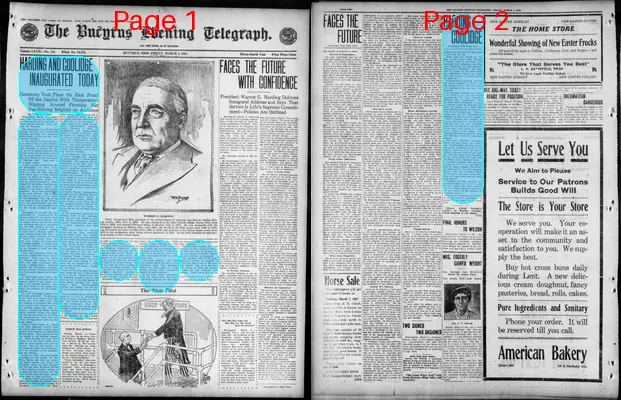
The Bucyrus Evening Telegraph
Bucyrus, Crawford County, Ohio
What is this article about?
Warren G. Harding and Calvin Coolidge were inaugurated as President and Vice President on March 4, 1921, in Washington, D.C., amid clear, cold weather. The subdued ceremony featured a motor procession from the White House, where frail outgoing President Woodrow Wilson participated briefly before departing.
Merged-components note: Headline and body of the inauguration ceremony story by George B. Holmes, continued from page 1 to page 2.
Clippings
1 of 2
OCR Quality
Full Text
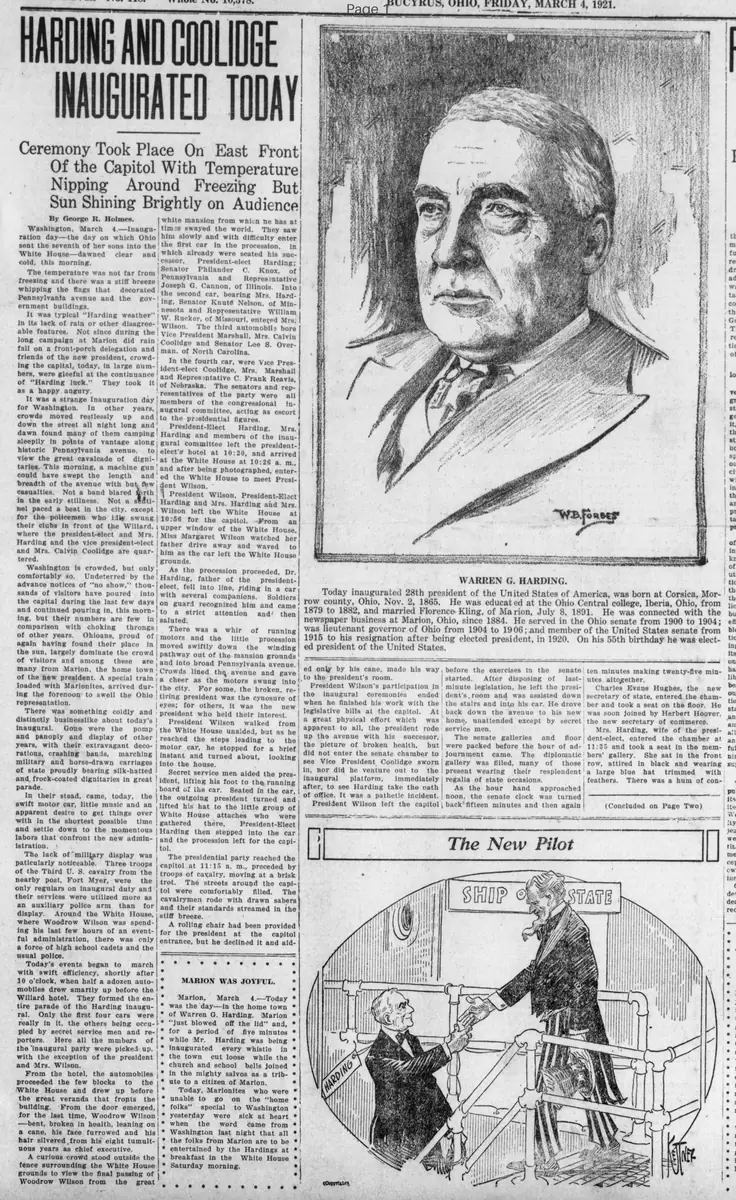
INAUGURATED TODAY
Ceremony Took Place On East Front Of the Capitol With Temperature Nipping Around Freezing But Sun Shining Brightly on Audience
By George B. Holmes,
Washington, March 4.—Inauguration day—the day on which Ohio sent the seventh of her sons into the White House—dawned clear and cold this morning.
The temperature was not far from freezing and there was a stiff breeze whipping the flags that decorated Pennsylvania avenue and the government buildings.
It was typical "Harding weather" in its lack of rain or other disagreeable features. Not since during the long campaign at Marion did rain fall on a front-porch delegation and friends of the new president, crowding the capital today in large numbers, were gleeful at the continuance of "Harding luck." They took it as a happy augury.
It was a strange inauguration day for Washington. In other years crowds moved restlessly up and down the street all night long and dawn found many of them camping sleepily in points of vantage along historic Pennsylvania avenue to view the great cavalcade of dignitaries. This morning a machine gun could have swept the length and breadth of the avenue with but few casualties. Not a band blared out in the early stillness. Not a sentinel paced a beat in the city, except for the policemen who idly swung their clubs in front of the Willard, where the president-elect and Mrs. Harding and the vice president-elect and Mrs. Calvin Coolidge are quartered.
Washington is crowded, but only comfortably so. Undeterred by the advance notices of "no show," thousands of visitors have poured into the capital during the last few days and continued pouring in this morning, but their numbers are few in comparison with choking throngs of other years. Ohioans, proud of again having found their place in the sun, largely dominate the crowd of visitors and among these are many from Marion, the home town of the new president. A special train loaded with Marionites arrived during the forenoon to swell the Ohio representation.
There was something coldly and distinctly businesslike about today's inaugural. Gone were the pomp and panoply and display of other years, with their extravagant decorations, crashing bands, marching military and horse-drawn carriages of state proudly bearing silk-hatted and frock-coated dignitaries in great parade.
In their stead came today the swift motor car, little music and an apparent desire to get things over with in the shortest possible time and settle down to the momentous labors that confront the new administration.
The lack of military display was particularly noticeable. Three troops of the Third U. S. cavalry from the nearby post, Fort Myer, were the only regulars on inaugural duty and their services were utilized more as an auxiliary police arm than for display. Around the White House, where Woodrow Wilson was spending his last few hours of an eventful administration, there was only a force of high school cadets and the usual police.
Today's events began to march with swift efficiency shortly after 10 o'clock, when half a dozen automobiles drew smartly up before the Willard hotel. They formed the entire parade of the Harding inaugural. Only the first four cars were really in it, the others being occupied by secret service men and reporters. Here all the members of the inaugural party were picked up, with the exception of the president and Mrs. Wilson.
From the hotel the automobiles proceeded the few blocks to the White House and drew up before the great veranda that fronts the building. From the door emerged, for the last time, Woodrow Wilson—bent, broken in health, leaning on a cane, his face furrowed and his hair silvered from his eight tumultuous years as chief executive.
A curious crowd stood outside the fence surrounding the White House grounds to view the final passing of Woodrow Wilson from the great white mansion from which he has at times swayed the world. They saw him slowly and with difficulty enter the first car in the procession, in which already were seated his successor, President-elect Harding; Senator Philander C. Knox of Pennsylvania and Representative Joseph G. Cannon of Illinois.
Into the second car, bearing Mrs. Harding, Senator Knute Nelson of Minnesota and Representative William W. Rucker of Missouri, entered Mrs. Wilson. The third automobile bore Vice President Marshall, Mrs. Calvin Coolidge and Senator Lee S. Overman of North Carolina.
In the fourth car were Vice President-elect Coolidge, Mrs. Marshall and Representative C. Frank Reavis of Nebraska. The senators and representatives of the party were all members of the congressional inaugural committee, acting as escort to the presidential figures.
President-elect Harding, Mrs. Harding and members of the inaugural committee left the president-elect's hotel at 10:20 and arrived at the White House at 10:26 a.m., and after being photographed, entered the White House to meet President Wilson.
President Wilson, President-elect Harding and Mrs. Harding and Mrs. Wilson left the White House at 10:56 for the capitol. From an upper window of the White House, Miss Margaret Wilson watched her father drive away and waved to him as the car left the White House grounds.
As the procession proceeded, Dr. Harding, father of the president-elect, fell into line, riding in a car with several companions. Soldiers on guard recognized him and came to a strict attention and then saluted.
There was a whir of running motors and the little procession moved swiftly down the winding pathway out of the mansion grounds and into broad Pennsylvania avenue.
Crowds lined the avenue and gave a cheer as the motors swung into the city.
For some the broken, retiring president was the cynosure of eyes; for others it was the new president who held their interest.
President Wilson walked from the White House unaided, but as he reached the steps leading to the motor car he stopped for a brief instant and turned about, looking into the house.
Secret service men aided the president, lifting his foot to the running board of the car. Seated in the car, the outgoing president turned and lifted his hat to the little group of White House attaches who were gathered there.
President-elect Harding then stepped into the car and the procession left for the capitol.
The presidential party reached the capitol at 11:15 a.m., preceded by troops of cavalry moving at a brisk trot.
The streets around the capitol were comfortably filled. The cavalrymen rode with drawn sabers and their standards streamed in the stiff breeze.
A rolling chair had been provided for the president at the capitol entrance, but he declined it and aided only by his cane, made his way to the president's room.
President Wilson's participation in the inaugural ceremonies ended when he finished his work with the legislative bills at the capitol. At a great physical effort which was apparent to all, the president rode up the avenue with his successor, the picture of broken health, but did not enter the senate chamber to see Vice President Coolidge sworn in, nor did he venture out to the inaugural platform immediately after to see Harding take the oath of office. It was a pathetic incident.
President Wilson left the capitol before the exercises in the senate started. After disposing of last-minute legislation, he left the president's room and was assisted down the stairs and into his car. He drove back down the avenue to his new home, unattended except by secret service men.
The senate galleries and floor were packed before the hour of adjournment came. The diplomatic gallery was filled, many of those present wearing their resplendent regalia of state occasions.
As the hour hand approached noon, the senate clock was turned back fifteen minutes and then again ten minutes making twenty-five minutes altogether.
Charles Evans Hughes, the new secretary of state, entered the chamber and took a seat on the floor. He was soon joined by Herbert Hoover, the new secretary of commerce.
Mrs. Harding, wife of the president-elect, entered the chamber at 11:35 and took a seat in the members' gallery. She sat in the front row, attired in black and wearing a large blue hat trimmed with feathers.
There was a hum of conversation.
(Concluded on Page Two)
HARDING
COOLIDGE
(Continued from Page One)
conversation as the new first lady came in and took her seat.
There were two women on the floor of the senate—Mrs. Thomas D. Schall, wife of the blind congressman from Minnesota and Miss Alice Robertson, the new congresswoman from Oklahoma. The spectacle of women on the senate floor was sufficiently unusual to make them the cynosure of many eyes in the galleries.
President-Elect Harding entered the senate chamber at 12:18. He was greeted with a round of tumultuous applause from the floor and galleries.
Vice President Coolidge was sworn in at 12:20 p. m., the oath being administered by Vice President Marshall, who, immediately after the oath, began his speech. A wave of applause swept the floor and galleries as "Silent Cal." with right hand uplifted, became the vice president of the United States. The applause was led by Massachusetts members of the house and senate.
When Marshall had finished, he turned and bowed to his successor and then the new vice president faced the crowded floor and delivered his short, terse speech in a clear voice. When it had ended, Vice President Marshall banged his gavel and officially closed the sixty-sixth congress.
After Vice President Coolidge's speech the new senate was organized. President-Elect Harding returning to the president's room in the Capitol, where at 1:15 he was escorted to the east front of the Capitol, and was sworn in as President of the United States by Chief Justice White of the Supreme Court.
President Harding took the oath of office at 1:17 p. m., and after a blare of bugles sounded "To Colors" the band played "The Star Spangled Banner" and then President Harding stepped to the front of the platform and began delivering his inaugural address.
President Harding finished his inaugural address at 1:55 p. m. and left the capitol, but before returning to the White House he addressed the new senate for five minutes in executive session.
The senate confirmed the personnel of the new cabinet, immediately on receipt of the names of the members.
What sub-type of article is it?
What themes does it cover?
What keywords are associated?
What entities or persons were involved?
Where did it happen?
Story Details
Key Persons
Location
Washington, D.C.
Event Date
March 4
Story Details
The inauguration featured a brief motor procession from the Willard Hotel to the White House and Capitol. Frail President Wilson joined Harding for the ride to the Capitol but did not attend the swearing-ins. Coolidge was sworn in at 12:20 p.m. by Marshall, and Harding at 1:17 p.m. by Chief Justice White, followed by Harding's address until 1:55 p.m. The event was subdued with minimal military display and focused on efficiency.