Thank you for visiting SNEWPapers!
Sign up free
Editorial
February 28, 1962
The Nome Nugget
Nome, Nome County, Alaska
What is this article about?
The editorial supports the Governor's Advisory Committee's resolution for Project Chariot, an atomic blast at Cape Thompson to create a ship harbor, emphasizing economic benefits for Alaska while proposing relocation and improved housing for affected Eskimo villages of Pt. Hope, Kivalina, and Noatak to address health and employment needs.
Clipping
OCR Quality
95%
Excellent
Full Text
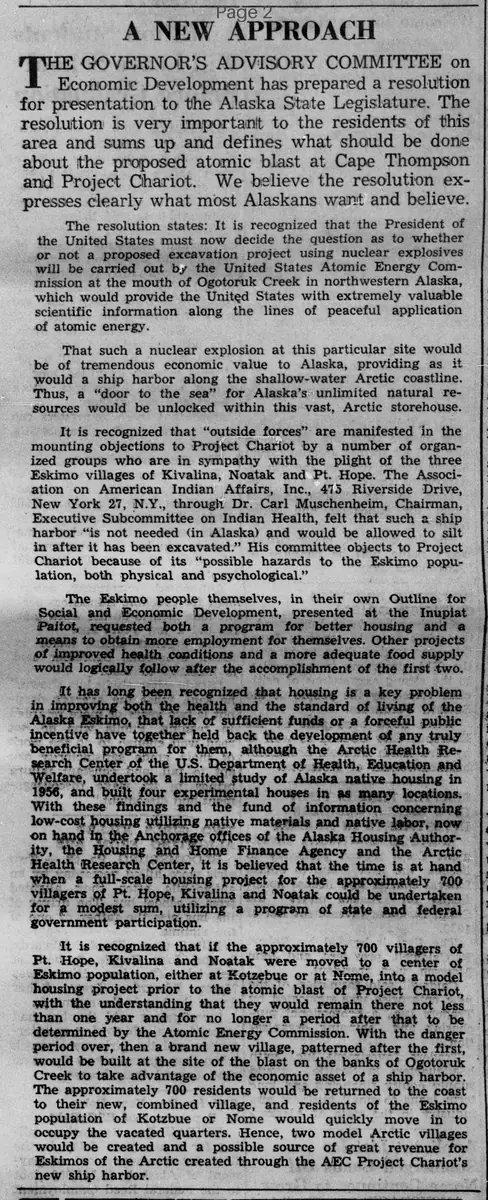
A NEW APPROACH
THE GOVERNOR'S ADVISORY COMMITTEE on Economic Development has prepared a resolution for presentation to the Alaska State Legislature. The resolution is very important to the residents of this area and sums up and defines what should be done about the proposed atomic blast at Cape Thompson and Project Chariot. We believe the resolution expresses clearly what most Alaskans want and believe.
The resolution states: It is recognized that the President of the United States must now decide the question as to whether or not a proposed excavation project using nuclear explosives will be carried out by the United States Atomic Energy Commission at the mouth of Ogotoruk Creek in northwestern Alaska, which would provide the United States with extremely valuable scientific information along the lines of peaceful application of atomic energy.
That such a nuclear explosion at this particular site would be of tremendous economic value to Alaska, providing as it would a ship harbor along the shallow-water Arctic coastline. Thus, a "door to the sea" for Alaska's unlimited natural resources would be unlocked within this vast, Arctic storehouse.
It is recognized that "outside forces" are manifested in the mounting objections to Project Chariot by a number of organized groups who are in sympathy with the plight of the three Eskimo villages of Kivalina, Noatak and Pt. Hope. The Association on American Indian Affairs, Inc., 475 Riverside Drive, New York 27, N.Y., through Dr. Carl Muschenheim, Chairman, Executive Subcommittee on Indian Health, felt that such a ship harbor "is not needed (in Alaska) and would be allowed to silt in after it has been excavated." His committee objects to Project Chariot because of its "possible hazards to the Eskimo population, both physical and psychological."
The Eskimo people themselves, in their own Outline for Social and Economic Development, presented at the Inupiat Paitot, requested both a program for better housing and a means to obtain more employment for themselves. Other projects of improved health conditions and a more adequate food supply would logically follow after the accomplishment of the first two.
It has long been recognized that housing is a key problem in improving both the health and the standard of living of the Alaska Eskimo, that lack of sufficient funds or a forceful public incentive have together held back the development of any truly beneficial program for them, although the Arctic Health Research Center of the U.S. Department of Health, Education and Welfare, undertook a limited study of Alaska native housing in 1956, and built four experimental houses in as many locations.
With these findings and the fund of information concerning low-cost housing utilizing native materials and native labor, now on hand in the Anchorage offices of the Alaska Housing Authority, the Housing and Home Finance Agency and the Arctic Health Research Center, it is believed that the time is at hand when a full-scale housing project for the approximately 700 villagers of Pt. Hope, Kivalina and Noatak could be undertaken for a modest sum, utilizing a program of state and federal government participation.
It is recognized that if the approximately 700 villagers of Pt. Hope, Kivalina and Noatak were moved to a center of Eskimo population, either at Kotzebue or at Nome, into a model housing project prior to the atomic blast of Project Chariot, with the understanding that they would remain there not less than one year and for no longer a period after that to be determined by the Atomic Energy Commission. With the danger period over, then a brand new village, patterned after the first, would be built at the site of the blast on the banks of Ogotoruk Creek to take advantage of the economic asset of a ship harbor.
The approximately 700 residents would be returned to the coast to their new, combined village, and residents of the Eskimo population of Kotzebue or Nome would quickly move in to occupy the vacated quarters. Hence, two model Arctic villages would be created and a possible source of great revenue for Eskimos of the Arctic created through the AEC Project Chariot's new ship harbor.
THE GOVERNOR'S ADVISORY COMMITTEE on Economic Development has prepared a resolution for presentation to the Alaska State Legislature. The resolution is very important to the residents of this area and sums up and defines what should be done about the proposed atomic blast at Cape Thompson and Project Chariot. We believe the resolution expresses clearly what most Alaskans want and believe.
The resolution states: It is recognized that the President of the United States must now decide the question as to whether or not a proposed excavation project using nuclear explosives will be carried out by the United States Atomic Energy Commission at the mouth of Ogotoruk Creek in northwestern Alaska, which would provide the United States with extremely valuable scientific information along the lines of peaceful application of atomic energy.
That such a nuclear explosion at this particular site would be of tremendous economic value to Alaska, providing as it would a ship harbor along the shallow-water Arctic coastline. Thus, a "door to the sea" for Alaska's unlimited natural resources would be unlocked within this vast, Arctic storehouse.
It is recognized that "outside forces" are manifested in the mounting objections to Project Chariot by a number of organized groups who are in sympathy with the plight of the three Eskimo villages of Kivalina, Noatak and Pt. Hope. The Association on American Indian Affairs, Inc., 475 Riverside Drive, New York 27, N.Y., through Dr. Carl Muschenheim, Chairman, Executive Subcommittee on Indian Health, felt that such a ship harbor "is not needed (in Alaska) and would be allowed to silt in after it has been excavated." His committee objects to Project Chariot because of its "possible hazards to the Eskimo population, both physical and psychological."
The Eskimo people themselves, in their own Outline for Social and Economic Development, presented at the Inupiat Paitot, requested both a program for better housing and a means to obtain more employment for themselves. Other projects of improved health conditions and a more adequate food supply would logically follow after the accomplishment of the first two.
It has long been recognized that housing is a key problem in improving both the health and the standard of living of the Alaska Eskimo, that lack of sufficient funds or a forceful public incentive have together held back the development of any truly beneficial program for them, although the Arctic Health Research Center of the U.S. Department of Health, Education and Welfare, undertook a limited study of Alaska native housing in 1956, and built four experimental houses in as many locations.
With these findings and the fund of information concerning low-cost housing utilizing native materials and native labor, now on hand in the Anchorage offices of the Alaska Housing Authority, the Housing and Home Finance Agency and the Arctic Health Research Center, it is believed that the time is at hand when a full-scale housing project for the approximately 700 villagers of Pt. Hope, Kivalina and Noatak could be undertaken for a modest sum, utilizing a program of state and federal government participation.
It is recognized that if the approximately 700 villagers of Pt. Hope, Kivalina and Noatak were moved to a center of Eskimo population, either at Kotzebue or at Nome, into a model housing project prior to the atomic blast of Project Chariot, with the understanding that they would remain there not less than one year and for no longer a period after that to be determined by the Atomic Energy Commission. With the danger period over, then a brand new village, patterned after the first, would be built at the site of the blast on the banks of Ogotoruk Creek to take advantage of the economic asset of a ship harbor.
The approximately 700 residents would be returned to the coast to their new, combined village, and residents of the Eskimo population of Kotzebue or Nome would quickly move in to occupy the vacated quarters. Hence, two model Arctic villages would be created and a possible source of great revenue for Eskimos of the Arctic created through the AEC Project Chariot's new ship harbor.
What sub-type of article is it?
Economic Policy
Indian Affairs
Infrastructure
What keywords are associated?
Project Chariot
Atomic Blast
Eskimo Relocation
Ship Harbor
Economic Development
Housing Program
Arctic Resources
Indigenous Welfare
What entities or persons were involved?
Governor's Advisory Committee On Economic Development
Alaska State Legislature
President Of The United States
United States Atomic Energy Commission
Eskimo Villages Of Kivalina, Noatak, Pt. Hope
Association On American Indian Affairs, Inc.
Dr. Carl Muschenheim
Arctic Health Research Center
Alaska Housing Authority
Housing And Home Finance Agency
Editorial Details
Primary Topic
Support For Project Chariot Atomic Excavation With Eskimo Relocation And Housing Improvements
Stance / Tone
Supportive Of The Project With Provisions For Indigenous Welfare And Economic Benefits
Key Figures
Governor's Advisory Committee On Economic Development
Alaska State Legislature
President Of The United States
United States Atomic Energy Commission
Eskimo Villages Of Kivalina, Noatak, Pt. Hope
Association On American Indian Affairs, Inc.
Dr. Carl Muschenheim
Arctic Health Research Center
Alaska Housing Authority
Housing And Home Finance Agency
Key Arguments
Project Chariot Would Provide Valuable Scientific Information On Peaceful Atomic Energy Use
Nuclear Explosion At Ogotoruk Creek Would Create A Ship Harbor Of Tremendous Economic Value To Alaska
Unlocks Access To Arctic Natural Resources Via A 'Door To The Sea'
Opposition From Outside Groups Like Association On American Indian Affairs Due To Hazards To Eskimos
Eskimos Request Better Housing And Employment In Their Outline For Social And Economic Development
Housing Is Key To Improving Eskimo Health And Living Standards
Existing Studies And Resources Enable Full Scale Housing Project For 700 Villagers
Relocate Villagers To Kotzebue Or Nome Temporarily Before Blast, Then Build New Village At Site
Creates Two Model Arctic Villages And Revenue Source Through New Harbor