Thank you for visiting SNEWPapers!
Sign up free
Story
May 15, 1857
Alexandria Gazette
Alexandria, Alexandria County, District Of Columbia
What is this article about?
Article analyzes Count of Aranda's 1783 memorial to Charles III warning of dangers from American independence, contrasting Spanish fears with French strategist Beaumarchais's advocacy for aiding colonists to counter British power, highlighting diplomatic tensions post-Revolutionary War.
Clipping
OCR Quality
98%
Excellent
Full Text
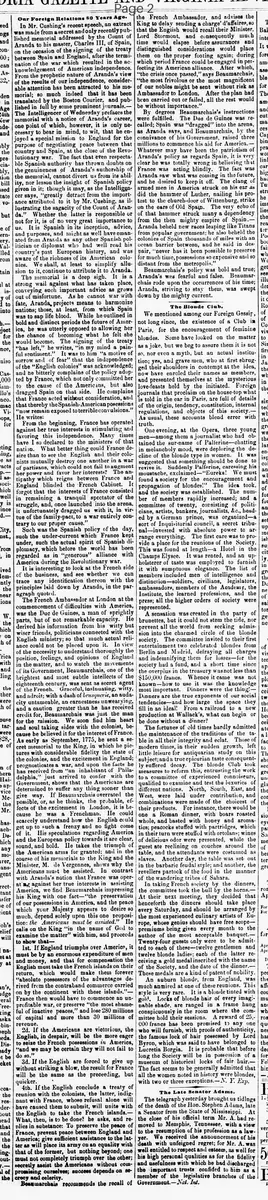
Our Foreign Relations 50 Years Ago.
In Mr. Cushing's recent speech, an extract was made from a secret and only recently published memorial addressed by the Count of Aranda to his master, Charles III. of Spain, on the occasion of the signing of the treaty between Spain and England, after the termination of the war which resulted in the acknowledgement of American independence.
From the prophetic nature of Aranda's view of the results of our independence, considerable attention has been attracted to his memorial; so much indeed that it has been translated by the Boston Courier, and published in full by some prominent journals. The Intelligencer of Wednesday prefaces the memorial with a notice of Aranda's career, one point of which, however, it is only necessary to bear in mind, to wit, that he enjoyed a special mission to England for the purpose of negotiating peace between that country and Spain, at the close of the Revolutionary war. The fact that even respectable Spanish authority has thrown doubts on the genuineness of Aranda's authorship of the memorial, cannot divert us from its ability, nor lessen the insight of Spanish policy given in it; though it may, as the Intelligencer says, "greatly detract from the importance attributed to it by Mr. Cushing, as illustrating the sagacity of the Count of Aranda." Whether the latter is responsible or not for it, is of no very great importance to us. It is Spanish in its inception, advice, and purposes, and might as well have emanated from Aranda as any other Spanish politician or diplomat who had well read his country's past European history, and was aware of the richness of its American colonies. We shall, at least to simplify allusion to it, continue to attribute it to Aranda.
The memorial is a deep sigh. It is a strong wail against what has taken place, conveying such important advice as grows out of misfortune. As he cannot war with fate, Aranda projects means to harmonize with it, or at least with those portions of it from which Spain was to sap life blood. While he outlined in bold and distinct periods the future of America, he was utterly opposed to allowing her the chance of becoming what he felt she would become. The signing of the treaty "has left," he writes, "in my mind a painful sentiment." It was to him "a motive of sorrow and of fear" that the independence of the "English colonies" was acknowledged; and he bitterly complains of the policy adopted by France, which not only committed her to the cause of the Americans, but also dragged Spain on that side. He complains that France acted without consideration, and that thereby the Spanish-American possessions "now remain exposed to terrible convulsions."
He writes:
From the beginning, France has operated against her true interests in stimulating and favoring this independence. Many times have I so declared to the ministers of that nation. What better thing could France desire than to see the English and their colonists mutually destroy one another in a war of partisans, which could not fail to augment her power and favor her interests? The antipathy which reigns between France and England blinded the French Cabinet. It forgot that the interests of France consisted in remaining a tranquil spectator of the struggle, and, once launched into the arena, it unfortunately dragged us with it, in virtue of the family-pact, to a war entirely contrary to our proper cause.
Such was the Spanish policy of the day, such the under-current which France kept under, such the actual spirit of Spanish diplomacy, which before the world has been regarded as in "generous" alliance with America during the Revolutionary war.
It is interesting to look at the French side of the business, and see whether we can trace any identification thereon with the principles laid down by Aranda, in the paragraph quoted.
The French Ambassador at London at the commencement of difficulties with America was the Due de Guines, a man of sprightly parts, but of not remarkable capacity. He derived his information from his witty but wiser friends, politicians connected with the English ministry; so that much actual reliance could not be placed upon it. In view of the necessity to understand thoroughly the position, feelings, and opinions of England in the matter, and to watch the movements of its Government, Beaumarchais, one of the brightest and most subtle intellects of the eighteenth century, was sent as secret agent of the French. Graceful, insinuating, witty, and adroit; with a dash of brusquerie, an audacity untameable, an earnestness unwearying and a caution greater than he has received credit for, Beaumarchais was just the man for the mission. We soon find him heart and soul taking sides with the colonists, because he believed it for the interest of France.
As early as September, 1775, he sent a secret memorial to the King, in which he pictures with considerable fidelity the state of the colonies, and the excitement in England; prognosticates a war, and upon the facts he has received from "an inhabitant of Philadelphia," just arrived to confer with the Government, shows that the Americans are determined to suffer anything sooner than give way. If Beaumarchais overrated the possible, or, as he thinks, the probable, effects of the excitement in London, it is because he was a Frenchman. He could scarcely understand how the English could get up to such a frenzy and no fight come of it. His speculations regarding America and the European policy towards it are clear, sound, and bold. He takes the triumph of the American arms for granted; and in the course of his memorials to the King and the Minister, M. de Vergennes, shows why the Americans must be assisted. In contrast with Aranda's notion that France was operating against her true interests in assisting America, we find Beaumarchais impressing his King with one fact- "the preservation of our possessions in America, and the peace which your Majesty appears to desire so much, depend solely upon this one proposition: the Americans must be assisted." He calls on the King "in the name of God to examine the matter" with him, and proceeds to show that-
1st. If England triumphs over America, it must be by an enormous expenditure of men and money, and that for compensation the English must take the French islands on their return, which would make them forever "absolute possessors of the advantages derived from the contraband commerce carried on by the continent with these islands."
France then would have to commence an unprofitable war, or preserve "the most shameful of inactive peaces," and lose 250 millions of capital and more than 30 millions of revenue.
2d. If the Americans are victorious, the English, in despair, will be the more eager to seize the French possessions in America, "and we may be certain they will not fail to do so."
3d. If the English are forced to give up without striking a blow, the result for France will be the same as the preceding, but quicker.
4th. If the English conclude a treaty of reunion with the colonists, the latter, indignant with France, whose refusal alone will have caused them to submit, will unite with the English to take the French islands.
What, then, is to be done? he asks, and replies in substance: To preserve the peace of France, prevent peace between England and America; give sufficient assistance to the latter as will place its army on an equality with that of the former, but nothing beyond: one must not completely triumph over the other; secretly assist the Americans without compromising ourselves; success depends on secrecy and celerity.
Beaumarchais recommends the recall of the French Ambassador, and advises the King to delay sending a charge d'affaires, so that the English would recall their Minister, Lord Stormont, and consequently much time would elapse before assurances and distinguished considerations would place them on the proper footing again; during which period France could be engaged in perfecting its American alliance. After which, "the crisis once passed," says Beaumarchais, "the most frivolous or the most magnificent of our nobles might be sent without risk as Ambassador to London. After the plan had been carried out or failed, all the rest would be without importance."
By degrees Beaumarchais's instructions were fulfilled. The Due de Guines was recalled; Spain was "dragged" into the arena, as Aranda says, and Beaumarchais, by the connivance of his Government, raised three millions to commence his aid for America.
Whatever may have been the patriotism of Aranda's policy as regards Spain, it is very clear he was totally wrong in believing that France was acting blindly. The fact was Aranda saw what was coming in the future, and he desired to keep it off. The clang of armed men in America struck on his ear as did the hammer of Luther, nailing his protest to the church-door of Wittenberg, strike on the ears of Old Spain. The very echo of that hammer struck many a dependency from the then mighty empire of Spain. Aranda beheld new races leaping like Titans from popular government; he also beheld the colonies of Spain thousands of miles with an ocean barrier between, and he said in despair, "never has it been possible to preserve for much time, possessions so expensive and so distant from the metropolis."
Beaumarchais's policy was bold and true; Aranda's was fearful and false. Beaumarchais rode upon the occurrences of his time; Aranda, striving to stay them, was swept down by the mighty current.
In Mr. Cushing's recent speech, an extract was made from a secret and only recently published memorial addressed by the Count of Aranda to his master, Charles III. of Spain, on the occasion of the signing of the treaty between Spain and England, after the termination of the war which resulted in the acknowledgement of American independence.
From the prophetic nature of Aranda's view of the results of our independence, considerable attention has been attracted to his memorial; so much indeed that it has been translated by the Boston Courier, and published in full by some prominent journals. The Intelligencer of Wednesday prefaces the memorial with a notice of Aranda's career, one point of which, however, it is only necessary to bear in mind, to wit, that he enjoyed a special mission to England for the purpose of negotiating peace between that country and Spain, at the close of the Revolutionary war. The fact that even respectable Spanish authority has thrown doubts on the genuineness of Aranda's authorship of the memorial, cannot divert us from its ability, nor lessen the insight of Spanish policy given in it; though it may, as the Intelligencer says, "greatly detract from the importance attributed to it by Mr. Cushing, as illustrating the sagacity of the Count of Aranda." Whether the latter is responsible or not for it, is of no very great importance to us. It is Spanish in its inception, advice, and purposes, and might as well have emanated from Aranda as any other Spanish politician or diplomat who had well read his country's past European history, and was aware of the richness of its American colonies. We shall, at least to simplify allusion to it, continue to attribute it to Aranda.
The memorial is a deep sigh. It is a strong wail against what has taken place, conveying such important advice as grows out of misfortune. As he cannot war with fate, Aranda projects means to harmonize with it, or at least with those portions of it from which Spain was to sap life blood. While he outlined in bold and distinct periods the future of America, he was utterly opposed to allowing her the chance of becoming what he felt she would become. The signing of the treaty "has left," he writes, "in my mind a painful sentiment." It was to him "a motive of sorrow and of fear" that the independence of the "English colonies" was acknowledged; and he bitterly complains of the policy adopted by France, which not only committed her to the cause of the Americans, but also dragged Spain on that side. He complains that France acted without consideration, and that thereby the Spanish-American possessions "now remain exposed to terrible convulsions."
He writes:
From the beginning, France has operated against her true interests in stimulating and favoring this independence. Many times have I so declared to the ministers of that nation. What better thing could France desire than to see the English and their colonists mutually destroy one another in a war of partisans, which could not fail to augment her power and favor her interests? The antipathy which reigns between France and England blinded the French Cabinet. It forgot that the interests of France consisted in remaining a tranquil spectator of the struggle, and, once launched into the arena, it unfortunately dragged us with it, in virtue of the family-pact, to a war entirely contrary to our proper cause.
Such was the Spanish policy of the day, such the under-current which France kept under, such the actual spirit of Spanish diplomacy, which before the world has been regarded as in "generous" alliance with America during the Revolutionary war.
It is interesting to look at the French side of the business, and see whether we can trace any identification thereon with the principles laid down by Aranda, in the paragraph quoted.
The French Ambassador at London at the commencement of difficulties with America was the Due de Guines, a man of sprightly parts, but of not remarkable capacity. He derived his information from his witty but wiser friends, politicians connected with the English ministry; so that much actual reliance could not be placed upon it. In view of the necessity to understand thoroughly the position, feelings, and opinions of England in the matter, and to watch the movements of its Government, Beaumarchais, one of the brightest and most subtle intellects of the eighteenth century, was sent as secret agent of the French. Graceful, insinuating, witty, and adroit; with a dash of brusquerie, an audacity untameable, an earnestness unwearying and a caution greater than he has received credit for, Beaumarchais was just the man for the mission. We soon find him heart and soul taking sides with the colonists, because he believed it for the interest of France.
As early as September, 1775, he sent a secret memorial to the King, in which he pictures with considerable fidelity the state of the colonies, and the excitement in England; prognosticates a war, and upon the facts he has received from "an inhabitant of Philadelphia," just arrived to confer with the Government, shows that the Americans are determined to suffer anything sooner than give way. If Beaumarchais overrated the possible, or, as he thinks, the probable, effects of the excitement in London, it is because he was a Frenchman. He could scarcely understand how the English could get up to such a frenzy and no fight come of it. His speculations regarding America and the European policy towards it are clear, sound, and bold. He takes the triumph of the American arms for granted; and in the course of his memorials to the King and the Minister, M. de Vergennes, shows why the Americans must be assisted. In contrast with Aranda's notion that France was operating against her true interests in assisting America, we find Beaumarchais impressing his King with one fact- "the preservation of our possessions in America, and the peace which your Majesty appears to desire so much, depend solely upon this one proposition: the Americans must be assisted." He calls on the King "in the name of God to examine the matter" with him, and proceeds to show that-
1st. If England triumphs over America, it must be by an enormous expenditure of men and money, and that for compensation the English must take the French islands on their return, which would make them forever "absolute possessors of the advantages derived from the contraband commerce carried on by the continent with these islands."
France then would have to commence an unprofitable war, or preserve "the most shameful of inactive peaces," and lose 250 millions of capital and more than 30 millions of revenue.
2d. If the Americans are victorious, the English, in despair, will be the more eager to seize the French possessions in America, "and we may be certain they will not fail to do so."
3d. If the English are forced to give up without striking a blow, the result for France will be the same as the preceding, but quicker.
4th. If the English conclude a treaty of reunion with the colonists, the latter, indignant with France, whose refusal alone will have caused them to submit, will unite with the English to take the French islands.
What, then, is to be done? he asks, and replies in substance: To preserve the peace of France, prevent peace between England and America; give sufficient assistance to the latter as will place its army on an equality with that of the former, but nothing beyond: one must not completely triumph over the other; secretly assist the Americans without compromising ourselves; success depends on secrecy and celerity.
Beaumarchais recommends the recall of the French Ambassador, and advises the King to delay sending a charge d'affaires, so that the English would recall their Minister, Lord Stormont, and consequently much time would elapse before assurances and distinguished considerations would place them on the proper footing again; during which period France could be engaged in perfecting its American alliance. After which, "the crisis once passed," says Beaumarchais, "the most frivolous or the most magnificent of our nobles might be sent without risk as Ambassador to London. After the plan had been carried out or failed, all the rest would be without importance."
By degrees Beaumarchais's instructions were fulfilled. The Due de Guines was recalled; Spain was "dragged" into the arena, as Aranda says, and Beaumarchais, by the connivance of his Government, raised three millions to commence his aid for America.
Whatever may have been the patriotism of Aranda's policy as regards Spain, it is very clear he was totally wrong in believing that France was acting blindly. The fact was Aranda saw what was coming in the future, and he desired to keep it off. The clang of armed men in America struck on his ear as did the hammer of Luther, nailing his protest to the church-door of Wittenberg, strike on the ears of Old Spain. The very echo of that hammer struck many a dependency from the then mighty empire of Spain. Aranda beheld new races leaping like Titans from popular government; he also beheld the colonies of Spain thousands of miles with an ocean barrier between, and he said in despair, "never has it been possible to preserve for much time, possessions so expensive and so distant from the metropolis."
Beaumarchais's policy was bold and true; Aranda's was fearful and false. Beaumarchais rode upon the occurrences of his time; Aranda, striving to stay them, was swept down by the mighty current.
What sub-type of article is it?
Historical Event
Biography
What themes does it cover?
Fortune Reversal
Misfortune
Triumph
What keywords are associated?
American Independence
Spanish Memorial
French Diplomacy
Aranda Policy
Beaumarchais Mission
Revolutionary War
Treaty Of Paris
What entities or persons were involved?
Count Of Aranda
Charles Iii Of Spain
Beaumarchais
Due De Guines
M. De Vergennes
Where did it happen?
Spain, France, England, American Colonies
Story Details
Key Persons
Count Of Aranda
Charles Iii Of Spain
Beaumarchais
Due De Guines
M. De Vergennes
Location
Spain, France, England, American Colonies
Event Date
1783
Story Details
Count of Aranda's memorial warns of American independence's threat to Spanish colonies, criticizing French involvement; contrasts with Beaumarchais's secret advocacy for aiding Americans to protect French interests and prolong conflict with England.