Thank you for visiting SNEWPapers!
Sign up free
Berkeley And Jefferson Intelligencer
Martinsburg, Berkeley County, Virginia
What is this article about?
Reports from Frederick-Town on June 14 detail caterpillar infestations devastating wheat, rye, corn, and grass crops in Maryland and Virginia. Some farms suffer total destruction, while others remain unaffected. Various control methods like shaking off with ropes and using swine or lime are attempted, with hopes of natural transformation to flies.
Merged-components note: Continuation of the same article on caterpillar ravages in Frederick-Town, split across pages.
Clippings
1 of 2
OCR Quality
Full Text
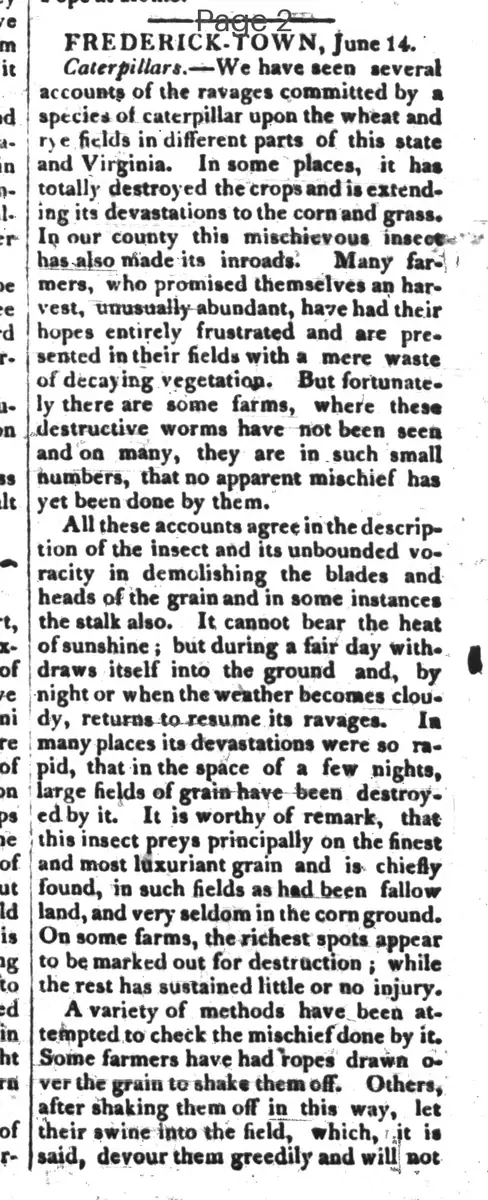
Caterpillars. We have seen several accounts of the ravages committed by a species of caterpillar upon the wheat and rye fields in different parts of this state and Virginia. In some places, it has totally destroyed the crops and is extending its devastations to the corn and grass. In our county this mischievous insect has also made its inroads: Many farmers, who promised themselves a harvest unusually abundant, have had their hopes entirely frustrated and are presented in their fields with a mere waste of decaying vegetation. But fortunately there are some farms, where these destructive worms have not been seen and on many, they are in such small numbers, that no apparent mischief has yet been done by them.
All these accounts agree in the description of the insect and its unbounded voracity in demolishing the blades and heads of the grain and in some instances the stalk also. It cannot bear the heat of sunshine; but during a fair day withdraws itself into the ground and, by night or when the weather becomes cloudy, returns to resume its ravages.
In many places its devastations were so rapid, that in the space of a few nights, large fields of grain have been destroyed by it. It is worthy of remark, that this insect preys principally on the finest and most luxuriant grain and is chiefly found, in such fields as had been fallow land, and very seldom in the corn ground. On some farms, the richest spots appear to be marked out for destruction; while the rest has sustained little or no injury.
A variety of methods have been attempted to check the mischief done by it. Some farmers have had ropes drawn over the grain to shake them off. Others, after shaking them off in this way, let their swine into the field, which, it is said, devour them greedily and will not
meddle with the grain, as long as any worms can be found. Lime is also said to have been made use of. And experiments have been made with powdered plaister of Paris but to no effect.
It is hoped, that from its nature, this insect cannot long remain in its present destructive shape; but will undergo the transformation to which all that race of worms appear to be destined. It is asserted in the Richmond Enquirer, that it has already been found in some places in the chrysalis or aurelian state. From this state it changes into a fly, when it is supposed to deposit its eggs for the continuance of its species. It would be worthy the attention of some ingenious farmer to preserve some of them in earth to ascertain what kind of fly it is, that is the parent of this most mischievous of all the caterpillar kind. Some have conjectured, that it is the same species of insect, that for some years past committed so much injury on the crops of cotton in Georgia and South Carolina.
What sub-type of article is it?
What keywords are associated?
Where did it happen?
Domestic News Details
Primary Location
Frederick Town
Event Date
June 14
Outcome
total crop destruction in some areas, partial in others; control methods attempted with mixed results; hopes for natural transformation to fly stage.
Event Details
Caterpillars ravaging wheat, rye, corn, and grass fields in Maryland and Virginia; insect hides from sun, active at night or cloudy weather; targets luxuriant grain on fallow land; methods include shaking off with ropes, swine consumption, lime, and plaster of Paris (ineffective).