Thank you for visiting SNEWPapers!
Sign up free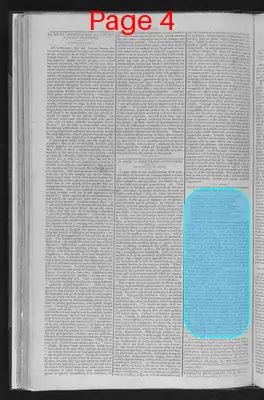
Literary
July 25, 1789
Gazette Of The United States
New York, New York County, New York
What is this article about?
Issue No. XIV of The National Monitor features a quote from Alexander Pope's Essay on Man on self-love expanding to universal benevolence, followed by an essay defending local attachments and partial prejudices as natural, beneficial forces that underpin patriotism, sympathy, and societal progress, against their common condemnation.
Clipping
OCR Quality
98%
Excellent
Full Text
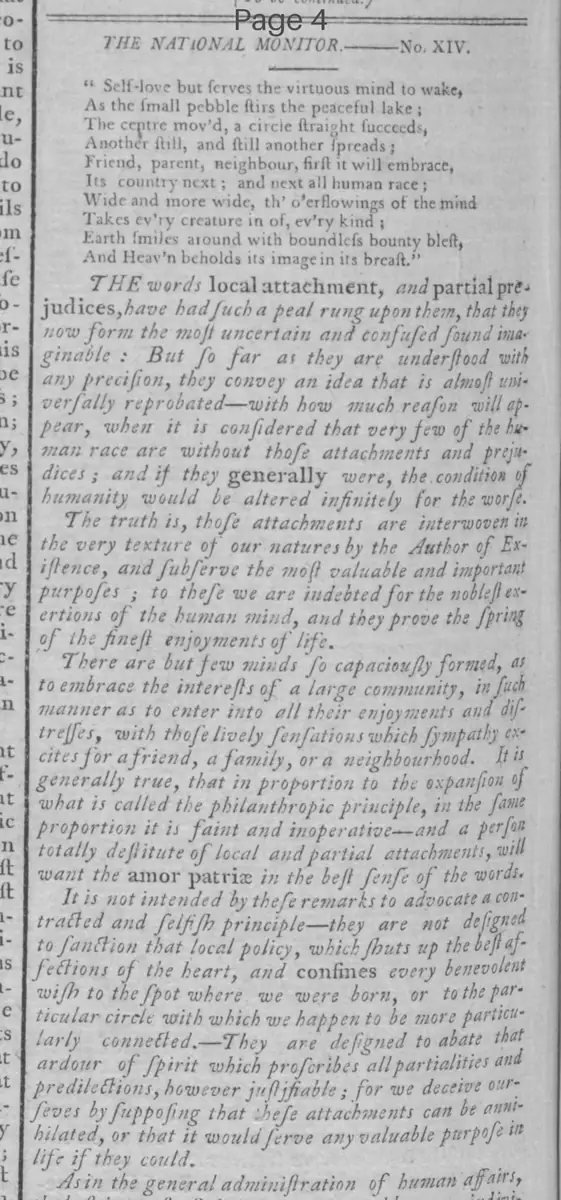
THE NATIONAL MONITOR.
No. XIV.
"Self-love but serves the virtuous mind to wake,
As the small pebble stirs the peaceful lake;
The centre mov'd, a circle straight succeeds,
Another still, and still another spreads;
Friend, parent, neighbour, first it will embrace,
Its country next; and next all human race;
Wide and more wide, th' overflowings of the mind
Takes ev'ry creature in of ev'ry kind;
Earth smiles around with boundless bounty blest,
And Heav'n beholds its image in its breast."
THE words local attachment, and partial prejudices, have had such a peal rung upon them, that they now form the most uncertain and confused sound imaginable: But so far as they are understood with any precision, they convey an idea that is almost universally reprobated—with how much reason will appear, when it is considered that very few of the human race are without those attachments and prejudices; and if they generally were, the condition of humanity would be altered infinitely for the worse. The truth is, those attachments are interwoven in the very texture of our natures by the Author of Existence, and subserve the most valuable and important purposes; to these we are indebted for the noblest exertions of the human mind, and they prove the spring of the finest enjoyments of life. There are but few minds so capaciously formed, as to embrace the interests of a large community, in such manner as to enter into all their enjoyments and distresses, with those lively Sensations which Sympathy excites for a friend, a family, or a neighbourhood. It is generally true, that in proportion to the expansion of what is called the philanthropic principle, in the same proportion it is faint and inoperative—and a person totally destitute of local and partial attachments, will want the amor patriae in the best sense of the words. It is not intended by these remarks to advocate a contracted and selfish principle—they are not designed to sanction that local policy, which shuts up the best affections of the heart, and confines every benevolent wish to the spot where we were born, or to the particular circle with which we happen to be more particularly connected.—They are designed to abate that ardour of spirit which proscribes all partialities and predilections, however justifiable; for we deceive ourselves by supposing that these attachments can be annihilated, or that it would serve any valuable purpose in life if they could. As in the general administration of human affairs, the best interest of society is promoted by every individual's pursuing with steadiness, and perseverance their own particular advantage in conformity to the laws—so the great objects of patriotism are most essentially advanced, by the attachments which are discovered by every person to the state, the country, the town, the neighbourhood, the family, &c. with which they are more immediately connected—this is nature, reason, and common sense.
No. XIV.
"Self-love but serves the virtuous mind to wake,
As the small pebble stirs the peaceful lake;
The centre mov'd, a circle straight succeeds,
Another still, and still another spreads;
Friend, parent, neighbour, first it will embrace,
Its country next; and next all human race;
Wide and more wide, th' overflowings of the mind
Takes ev'ry creature in of ev'ry kind;
Earth smiles around with boundless bounty blest,
And Heav'n beholds its image in its breast."
THE words local attachment, and partial prejudices, have had such a peal rung upon them, that they now form the most uncertain and confused sound imaginable: But so far as they are understood with any precision, they convey an idea that is almost universally reprobated—with how much reason will appear, when it is considered that very few of the human race are without those attachments and prejudices; and if they generally were, the condition of humanity would be altered infinitely for the worse. The truth is, those attachments are interwoven in the very texture of our natures by the Author of Existence, and subserve the most valuable and important purposes; to these we are indebted for the noblest exertions of the human mind, and they prove the spring of the finest enjoyments of life. There are but few minds so capaciously formed, as to embrace the interests of a large community, in such manner as to enter into all their enjoyments and distresses, with those lively Sensations which Sympathy excites for a friend, a family, or a neighbourhood. It is generally true, that in proportion to the expansion of what is called the philanthropic principle, in the same proportion it is faint and inoperative—and a person totally destitute of local and partial attachments, will want the amor patriae in the best sense of the words. It is not intended by these remarks to advocate a contracted and selfish principle—they are not designed to sanction that local policy, which shuts up the best affections of the heart, and confines every benevolent wish to the spot where we were born, or to the particular circle with which we happen to be more particularly connected.—They are designed to abate that ardour of spirit which proscribes all partialities and predilections, however justifiable; for we deceive ourselves by supposing that these attachments can be annihilated, or that it would serve any valuable purpose in life if they could. As in the general administration of human affairs, the best interest of society is promoted by every individual's pursuing with steadiness, and perseverance their own particular advantage in conformity to the laws—so the great objects of patriotism are most essentially advanced, by the attachments which are discovered by every person to the state, the country, the town, the neighbourhood, the family, &c. with which they are more immediately connected—this is nature, reason, and common sense.
What sub-type of article is it?
Essay
What themes does it cover?
Patriotism
Moral Virtue
Political
What keywords are associated?
Local Attachments
Partial Prejudices
Patriotism
Sympathy
Human Nature
Philanthropy
Benevolence
Literary Details
Title
No. Xiv
Subject
On Local Attachments And Partial Prejudices
Key Lines
"Self Love But Serves The Virtuous Mind To Wake,... And Heav'n Beholds Its Image In Its Breast."
Those Attachments Are Interwoven In The Very Texture Of Our Natures By The Author Of Existence
The Great Objects Of Patriotism Are Most Essentially Advanced, By The Attachments... This Is Nature, Reason, And Common Sense.