Thank you for visiting SNEWPapers!
Sign up free
Editorial
April 23, 1850
Oxford Democrat
Paris, South Paris, Oxford County, Maine
What is this article about?
Historical critique of the Federalist and Whig parties' failures in U.S. politics, from John Adams' administration and the Alien and Sedition Laws to Zachary Taylor's corrupt cabinet and the Galphin claims scandal, portrayed from a pro-Democratic perspective emphasizing party rejections by the people.
Clipping
OCR Quality
95%
Excellent
Full Text
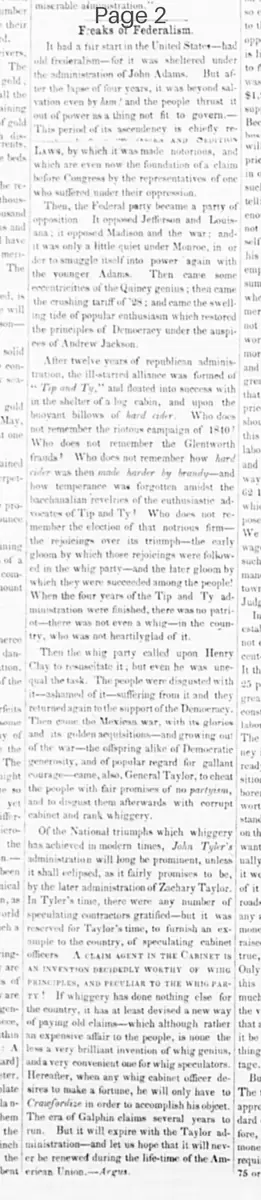
Freaks of Federalism.
It had a fair start in the United States—had old federalism—for it was sheltered under the administration of John Adams. But after the lapse of four years, it was beyond salvation even by Ames, and the people thrust it out of power as a thing not fit to govern.
This period of its ascendency is chiefly remarkable for the Alien and Sedition Laws, by which it was made notorious, and which are even now the foundation of a claim before Congress by the representatives of one who suffered under their oppression.
Then, the Federal party became a party of opposition. It opposed Jefferson and Louisiana; it opposed Madison and the war; and, it was only a little quiet under Monroe, in order to smuggle itself into power again with the younger Adams. Then came some eccentricities of the Quincy genius; then came the crushing tariff of '28; and came the swelling tide of popular enthusiasm which restored the principles of Democracy under the auspices of Andrew Jackson.
After twelve years of republican administration, the ill-starred alliance was formed of "Tip and Ty," and floated into success within the shelter of a log cabin, and upon the buoyant billows of hard cider. Who does not remember the riotous campaign of 1840? Who does not remember the Glentworth flag? Who does not remember how hard cider was then made harder by brandy and how temperance was forgotten amidst the bacchanalian revelries of the enthusiastic advocates of Tip and Ty! Who does not remember the election of that notorious firm—the rejoicings over its triumph—the early gloom by which those rejoicings were followed in the whig party—and the later gloom by which they were succeeded among the people?
When the four years of the Tip and Ty administration were finished, there was no patriot—there was not even a whig—in the country, who was not heartily glad of it.
Then the whig party called upon Henry Clay to resuscitate it, but even he was unequal the task. The people were disgusted with it—ashamed of it—suffering from it and they returned again to the support of the Democracy.
Then comes the Mexican war, with its glories and its golden acquisitions—and growing out of the war—the offspring alike of Democratic generosity, and of popular regard for gallant courage—came, also, General Taylor, to cheat the people with fair promises of no partyism, and to disgust them afterwards with corrupt cabinet and rank whiggery.
Of the National triumphs which whiggery has achieved in modern times, John Tyler's administration will long be prominent, unless it shall eclipsed, as it fairly promises to be, by the later administration of Zachary Taylor.
In Tyler's time, there were any number of speculating contractors gratified—but it was reserved for Taylor's time, to furnish an example to the country, of speculating cabinet officers.
A CLAIM AGENT IN THE CABINET IS AN INVENTION DECIDEDLY WORTHY OF WHIG PRINCIPLES, AND PECULIAR TO THE WHIG PARTY. If whiggery has done nothing else for the country, it has at least devised a new way of paying old claims—which although rather an expensive affair to the people, is none the less a very brilliant invention of whig genius, and a very convenient one for whig speculators.
Hereafter, when any whig cabinet officer desires to make a fortune, he will only have to Crawfordize in order to accomplish his object.
The era of Galphin claims has several years to run. But it will expire with the Taylor administration—and let us hope that it will never be renewed during the life-time of the American Union.—Argus
It had a fair start in the United States—had old federalism—for it was sheltered under the administration of John Adams. But after the lapse of four years, it was beyond salvation even by Ames, and the people thrust it out of power as a thing not fit to govern.
This period of its ascendency is chiefly remarkable for the Alien and Sedition Laws, by which it was made notorious, and which are even now the foundation of a claim before Congress by the representatives of one who suffered under their oppression.
Then, the Federal party became a party of opposition. It opposed Jefferson and Louisiana; it opposed Madison and the war; and, it was only a little quiet under Monroe, in order to smuggle itself into power again with the younger Adams. Then came some eccentricities of the Quincy genius; then came the crushing tariff of '28; and came the swelling tide of popular enthusiasm which restored the principles of Democracy under the auspices of Andrew Jackson.
After twelve years of republican administration, the ill-starred alliance was formed of "Tip and Ty," and floated into success within the shelter of a log cabin, and upon the buoyant billows of hard cider. Who does not remember the riotous campaign of 1840? Who does not remember the Glentworth flag? Who does not remember how hard cider was then made harder by brandy and how temperance was forgotten amidst the bacchanalian revelries of the enthusiastic advocates of Tip and Ty! Who does not remember the election of that notorious firm—the rejoicings over its triumph—the early gloom by which those rejoicings were followed in the whig party—and the later gloom by which they were succeeded among the people?
When the four years of the Tip and Ty administration were finished, there was no patriot—there was not even a whig—in the country, who was not heartily glad of it.
Then the whig party called upon Henry Clay to resuscitate it, but even he was unequal the task. The people were disgusted with it—ashamed of it—suffering from it and they returned again to the support of the Democracy.
Then comes the Mexican war, with its glories and its golden acquisitions—and growing out of the war—the offspring alike of Democratic generosity, and of popular regard for gallant courage—came, also, General Taylor, to cheat the people with fair promises of no partyism, and to disgust them afterwards with corrupt cabinet and rank whiggery.
Of the National triumphs which whiggery has achieved in modern times, John Tyler's administration will long be prominent, unless it shall eclipsed, as it fairly promises to be, by the later administration of Zachary Taylor.
In Tyler's time, there were any number of speculating contractors gratified—but it was reserved for Taylor's time, to furnish an example to the country, of speculating cabinet officers.
A CLAIM AGENT IN THE CABINET IS AN INVENTION DECIDEDLY WORTHY OF WHIG PRINCIPLES, AND PECULIAR TO THE WHIG PARTY. If whiggery has done nothing else for the country, it has at least devised a new way of paying old claims—which although rather an expensive affair to the people, is none the less a very brilliant invention of whig genius, and a very convenient one for whig speculators.
Hereafter, when any whig cabinet officer desires to make a fortune, he will only have to Crawfordize in order to accomplish his object.
The era of Galphin claims has several years to run. But it will expire with the Taylor administration—and let us hope that it will never be renewed during the life-time of the American Union.—Argus
What sub-type of article is it?
Partisan Politics
Satire
What keywords are associated?
Federalism
Whig Party
Alien And Sedition Laws
Tip And Ty
Hard Cider Campaign
Mexican War
Taylor Administration
Galphin Claims
Partisan Politics
What entities or persons were involved?
John Adams
Federal Party
Ames
Jefferson
Madison
Monroe
Younger Adams
Andrew Jackson
Tip And Ty
Henry Clay
General Taylor
John Tyler
Zachary Taylor
Editorial Details
Primary Topic
Historical Failures Of Federalism And Whiggery
Stance / Tone
Strongly Anti Federalist And Anti Whig, Pro Democratic
Key Figures
John Adams
Federal Party
Ames
Jefferson
Madison
Monroe
Younger Adams
Andrew Jackson
Tip And Ty
Henry Clay
General Taylor
John Tyler
Zachary Taylor
Key Arguments
Federalism Had A Fair Start Under Adams But Was Rejected After Four Years Due To Unfitness
Alien And Sedition Laws Made Federalism Notorious And Basis For Ongoing Claims
Federal Party Opposed Jefferson And Louisiana, Madison And The War, Briefly Quiet Under Monroe To Regain Power
Eccentricities Under Younger Adams, Crushing Tariff Of 1828 Led To Jackson's Democratic Restoration
Tip And Ty Alliance Won Via Riotous 1840 Campaign With Log Cabin And Hard Cider, But Brought Gloom
No Patriot Glad Of Tip And Ty's Four Years
Henry Clay Failed To Resuscitate Whig Party Amid Public Disgust
Mexican War Glories Led To Taylor's Election With No Party Promises, But Delivered Corrupt Cabinet And Whiggery
Tyler's Administration Prominent For Speculating Contractors, Taylor's For Speculating Cabinet Officers
Claim Agent In Cabinet As Whig Invention For Paying Old Claims Expensively
Galphin Claims Era To Expire With Taylor Administration