Thank you for visiting SNEWPapers!
Sign up free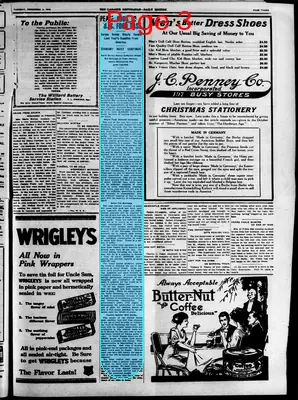
Story
December 3, 1918
The Laramie Republican
Laramie, Albany County, Wyoming
What is this article about?
Post-World War I, the US faces increased food export demands to Europe, nearly doubling previous supplies to 20 million tons to prevent starvation and anarchy. Global survey shows wheat sufficiency but fat shortages; US must continue conservation and production policies.
Clipping

OCR Quality
88%
Good
Full Text
PEACE ADDS TO U. S. FOOD TASK
Europe Needs Nearly Double Last Year's Supplies From America.
ECONOMY MUST CONTINUE.
World Survey Shows Sufficient Wheat But Shortage of Fats Government's Stimulative Program Justified.
With the return of peace America is confronted by a food problem even harder of solution than that with which we coped in time of war. We have an entirely new world situation in food. It will mean essential changes to our domestic program. But more important than this. It must of necessity require increased export
Last year we shipped 11,500,000 tons of foodstuffs to the European Allies.
Had the war continued we would have increased this enormous figure to 17,650,000 tons in the present year. Now, with the responsibility of feeding millions of people liberated from the German yoke, our exports must be brought up to at least 20,000,000 tons-practically the limit of loading capacity at our ports
World Food Demand Increased.
The end of the war will create an enormously increased demand for food.
Humanity demands that the starving millions freed from Prussian oppression shall have sufficient supplies to assure their return to health and prosperity. - If these liberated nations are faced with starvation they cannot establish orderly governments. Hunger breeds anarchy in a people. The war to free the world for democracy will be lost after it has been won. America must continue its work to liberation and by sharing its food make democracy safe in the world
In order to meet this new situation the Food Administration has made a careful survey of the food resources of the whole world in relation to the total demands.
Computing supplies on the basis of the avoidance of waste and war consumption. It is found that wheat and rye may be obtained in sufficient quantities to meet economical world consumption: high protein feed for dairy animals will show a shortage of about 3,000,000 tons, while there will be sufficient supplies of other feeds to allow economical consumption: beans, peas and rice will also be found in sufficient quantities to maintain economy in consumption; there are sufficient supplies of beef to keep pace with the capacity of refrigerating space.
Great Fat Shortage.
The most distinct reversal of policy will come with pork and dairy products, vegetable oils, sugar and coffee.
Utmost economy will be required in the use of fats and oils, in which there is a world shortage of about 3,000,000,000 pounds. There are sufficient supplies for us to return to our normal sugar consumption if other nations continue their present short rations, or even if their rations are slightly increased. If the European countries however, are to resume their normal sugar consumption it will be through our continued conservation in order to share with them. There is a surplus of coffee.
Of the world total required to produce these results North America will furnish more than 80 per cent. The United States, including the West Indies, will be in a position to furnish a total of about 20,000,000 tons- against our pre-war exports of about 6,000,000 tons.
The bread grains situation allows the world to abandon the use of substitutes in wheat bread. Large supplies have accumulated in the Argentine, Australia and other hitherto inaccessible markets. A continued high milling percentage, economy of consumption and elimination of waste make it possible for the world to return to a white wheat loaf
Of all our export possibilities in fats the largest and most important item is pork. While we cannot supply the world deficiency, we will be able to help it enormously because of the past policies of stimulating production and restraining consumption. The government's policy with regard to stimulating the production of wheat and of pork, the readiest source of fats is thus amply justified by the situation upon the return of peace.
Famine Specter Still Stalks
The people of the United States must continue care and wise economy in the use of food in order to complete the work of liberating the world. But even with the utmost conservation and production in this country there will be in Europe for the next year or more starvation beyond all human power to allay. In North Russia there are 40,000,000 people to whom food cannot be made accessible this winter. Their transportation is demoralized in consequence of anarchy. And even if internal transport can be assured their ports of entry would soon be frozen. Millions more who have felt keenly the oppression of war will be beyond reach of assistance.
We must realize that upon our shoulders rests a greater responsibility than we have ever before been to come
We must realize that millions end absolutely cold and starved people that the specter of
t
Europe Needs Nearly Double Last Year's Supplies From America.
ECONOMY MUST CONTINUE.
World Survey Shows Sufficient Wheat But Shortage of Fats Government's Stimulative Program Justified.
With the return of peace America is confronted by a food problem even harder of solution than that with which we coped in time of war. We have an entirely new world situation in food. It will mean essential changes to our domestic program. But more important than this. It must of necessity require increased export
Last year we shipped 11,500,000 tons of foodstuffs to the European Allies.
Had the war continued we would have increased this enormous figure to 17,650,000 tons in the present year. Now, with the responsibility of feeding millions of people liberated from the German yoke, our exports must be brought up to at least 20,000,000 tons-practically the limit of loading capacity at our ports
World Food Demand Increased.
The end of the war will create an enormously increased demand for food.
Humanity demands that the starving millions freed from Prussian oppression shall have sufficient supplies to assure their return to health and prosperity. - If these liberated nations are faced with starvation they cannot establish orderly governments. Hunger breeds anarchy in a people. The war to free the world for democracy will be lost after it has been won. America must continue its work to liberation and by sharing its food make democracy safe in the world
In order to meet this new situation the Food Administration has made a careful survey of the food resources of the whole world in relation to the total demands.
Computing supplies on the basis of the avoidance of waste and war consumption. It is found that wheat and rye may be obtained in sufficient quantities to meet economical world consumption: high protein feed for dairy animals will show a shortage of about 3,000,000 tons, while there will be sufficient supplies of other feeds to allow economical consumption: beans, peas and rice will also be found in sufficient quantities to maintain economy in consumption; there are sufficient supplies of beef to keep pace with the capacity of refrigerating space.
Great Fat Shortage.
The most distinct reversal of policy will come with pork and dairy products, vegetable oils, sugar and coffee.
Utmost economy will be required in the use of fats and oils, in which there is a world shortage of about 3,000,000,000 pounds. There are sufficient supplies for us to return to our normal sugar consumption if other nations continue their present short rations, or even if their rations are slightly increased. If the European countries however, are to resume their normal sugar consumption it will be through our continued conservation in order to share with them. There is a surplus of coffee.
Of the world total required to produce these results North America will furnish more than 80 per cent. The United States, including the West Indies, will be in a position to furnish a total of about 20,000,000 tons- against our pre-war exports of about 6,000,000 tons.
The bread grains situation allows the world to abandon the use of substitutes in wheat bread. Large supplies have accumulated in the Argentine, Australia and other hitherto inaccessible markets. A continued high milling percentage, economy of consumption and elimination of waste make it possible for the world to return to a white wheat loaf
Of all our export possibilities in fats the largest and most important item is pork. While we cannot supply the world deficiency, we will be able to help it enormously because of the past policies of stimulating production and restraining consumption. The government's policy with regard to stimulating the production of wheat and of pork, the readiest source of fats is thus amply justified by the situation upon the return of peace.
Famine Specter Still Stalks
The people of the United States must continue care and wise economy in the use of food in order to complete the work of liberating the world. But even with the utmost conservation and production in this country there will be in Europe for the next year or more starvation beyond all human power to allay. In North Russia there are 40,000,000 people to whom food cannot be made accessible this winter. Their transportation is demoralized in consequence of anarchy. And even if internal transport can be assured their ports of entry would soon be frozen. Millions more who have felt keenly the oppression of war will be beyond reach of assistance.
We must realize that upon our shoulders rests a greater responsibility than we have ever before been to come
We must realize that millions end absolutely cold and starved people that the specter of
t
What sub-type of article is it?
Historical Event
What themes does it cover?
Catastrophe
Survival
What keywords are associated?
Food Exports
Post War Famine
Europe Starvation
Us Food Policy
Fat Shortage
Wheat Surplus
Where did it happen?
United States, Europe, North Russia
Story Details
Location
United States, Europe, North Russia
Event Date
Post War Period
Story Details
With peace after World War I, US must export 20 million tons of food to liberated Europe to prevent starvation and anarchy, despite global shortages in fats; Food Administration survey justifies continued conservation and production.