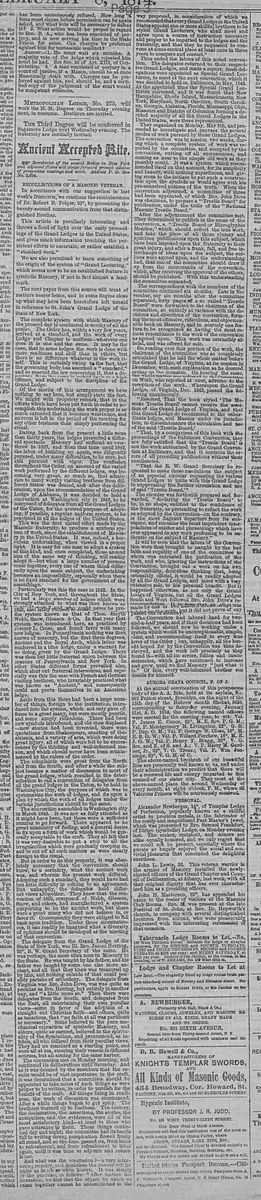
Metropolitan Lodge, No. 273, will work the M. M. Degree on Thursday evening next, in costume. Brethren are invited. The Third Degree will be conferred in Sagamore Lodge next Wednesday evening. The fraternity are cordially invited. Ancient Revered Brethren. Secretaries of the several Bodies in New York and adjacent States will please forward prompt advices of prospective meetings and work. Address P. O. Box No. 2,604. Recollections of a Masonic Veteran. In accordance with our suggestion in last week's Dispatch, we continue the reminiscences of Dr. Robert B. Folger, 33°, by presenting the twenty-second communication from that distinguished Brother. This article is peculiarly interesting and throws a flood of light over the early proceedings of the Grand Lodges in the United States, and gives much information touching the persistent efforts to ascertain, or rather establish a "standard work." We are also permitted to learn something of the origin of the system of "Grand Lecturing," which seems now to be an established feature in symbolic Masonry, if not in fact almost a landmark. The next paper from this source will treat of matters nearer home, and in some degree close up what may have been heretofore left unsaid in reference to St. John's Grand Lodge of the State of New York. The complete system with which Masonry of the present day is conducted is worthy of all the praise. The Order has, within a very few years, arrived at a standard, and the work of every Lodge and Chapter is uniform--wherever one goes it is one and the same. It may be the case, that in some lodges the work is done with more readiness and skill than in others, but there is no difference whatever in the work itself. This is certainly owing to the fact, that the governing body has assumed a "standard, and so enacted the law concerning it, that a deviation is looked upon as a high offence, and subject to the discipline of the Grand Lodge. Of the merits of this arrangement we have nothing to say here, but simply state the fact. We might with propriety remark, that in the efforts which have been put forth in order to accomplish this undertaking the work proper is so much extended that it becomes wearisome, and no room is left in the period of the meeting for any other business than simply performing the ritual. Dating back from the present a little more than thirty years, the lodges presented a different spectacle. Masonry had suffered an overthrow in 1827, and from that time until 1842, the labor of building up again, was diligently pursued, under many difficulties, to be sure, but still pursued with vigor. The confusion throughout the Order, on account of the varied work performed by the different lodges, was becoming very great, so much so, that admission to many worthy visiting brethren from different States was denied, and after due deliberation, upon the recommendation of the Grand Lodge of Alabama, it was decided to hold a convention at Washington city in 1842, to be composed of delegates from all the Grand Lodges of the Union, for the avowed purpose of adopting, if possible, a regular uniform system, to be practiced in all the lodges of the United States. This was the first united effort made by the Masonic fraternity, to produce a uniform system of work, since the establishment of Masonry in the United States. It was, indeed, a herculean undertaking, when viewed in a proper light. It is easy for one man to adopt a system of this kind, and once completed, those around him of the same way of thinking, will readily adopt it -but when a large number of persons come together, every one of whom think differently upon the same subject, the undertaking becomes an impossibility, especially when there is no fixed standard for the government of the assemblage. Particularly was this the case in 1842. In the City of New York, and throughout the State, we had a large number of lodges which were strongly attached to what was then known as 1825, also lately wards who could never be prevailed upon to adopt the system known as that of Thos. Smith Webb, Snow, Gleason & Co. In that year that system was introduced here, as practiced by Jeremy L. Cross, and found favor with many new lodges. In Pennsylvania nothing was then known of masonry but the first three degrees, Ancient and the Royal Arch, which latter was conferred in a blue lodge, under a warrant for so doing, given by the Grand Lodge. There was then but little fraternal union between the masons of Pennsylvania and New York. In other States different forms prevailed also, which shut out fraternal intercourse, and especially was this the case with French and German visiting brethren, who invariably practiced what was known as "Ancient," and consequently could not prove themselves in an American lodge. Aside from this there had been a large number of things, foreign to the institution, introduced into the system, which not only gave offence to a great many, but were mostly puerile, and some simply ridiculous. There had been new symbols introduced, and old ones displaced -new stories had been invented, there were quotations from Shakespeare, enacting of theatricals, and a variety of acts, which were doing great injury, all of which were felt to be excrescences by the thinking and well-informed mason, and which should never have been countenanced by the rulers of the order. The complaints were great from the North and from the South, and after a while the subject became a matter of discussion in most of the grand lodges, which resulted in the determination to call a convention of delegates from all the grand lodges in the Union, to be held in Washington City, the purpose of which was to systematize the work of lodges, and fix upon a plan by which the work of all lodges under the various jurisdictions should be the same. The convention assembled in Washington city in March 1842. It was not as fully attended as it might have been, but there were a sufficient number to go forward. There appeared to be great unanimity of feeling, and a general desire to fix upon a form of work which would be generally acceptable to the craft. They all felt that it was very desirable to put a stop to all the irregularities which were gradually creeping in, and to cut off all such matters as were clearly foreign to the ritual. But in order to do this properly, it was absolutely necessary that the convention should know, to a certainty, what the ancient work was, and wherein the present work differed. Adopting such a standard, they would have had but little difficulty in coming to an agreement. But unhappily, the delegates held different views altogether. They knew that the convention of 1802, composed of Webb, Gleeson, Snow, and others, had manufactured a system purporting to be the ancient work, but there were a great many who did not believe in, or favor it. Consequently they were obliged to fall back upon tradition. Under these circumstances, it can readily be imagined what a diversity of opinions should be developed at the meeting of that convention. The delegate from the Grand Lodge of the State of New York, was Ill. Bro. James Herring, 33°. R. W. Grand Secretary of the same. He was perhaps, the most ultra man in Masonry in the State. He was taught by his father, and his father was taught by some one else more ancient, and all that they knew was treasured up by him, and nothing outside of that could possibly partake of orthodoxy. The delegate from Virginia was Bro. John Dove, was was quite as peculiar as Bro. Herring, but entirely in another way, and "a little more so." Then there were delegates from the South, and delegates from the East, all entertaining their own peculiar views some in favor of the adoption of a straight out Christian faith-and others, quite as tenacious, that "no faith at all was pertinent or necessary." Some believed in the pure mechanical exposition of symbolic Masonry, and others, quite as earnest, believed in the spirituality of the Symbolism, and pronounced, as infidels, all who differed from their peculiar views. They had no standard as a starting point, and were all at sea, steering their vessels in different courses, but all aiming for the same harbor. The convention met on Monday morning, and continued its deliberations until Saturday. And as it was deemed by the members that the results would be of vast importance to the craft, it was determined that a committee should be appointed to take notes of such things as were proper to be written, in order to publish for the benefit of the craft. All things being in readiness, the work of discussion was commenced. After a while things began to get spicy. The brethren warmed up to business. The oratory, the declamation, the assertions, the stories, the antiquities, and the evidences, were all of the most satisfactory kind-at least to those who gave utterance to them. These things continued day and night; the committee had its hands full in writing down; perspiration flowed freely all round, and so the time passed on, from labor to refreshment, and from refreshment to labor again, until it was time to adjourn and return home. And what was the conclusion? a very interesting inquiry, and doubtless the answer will be quite as much so when known. It was simply to the purpose; as follows: "After mature deliberation, we find that the object for which we came together cannot be accomplished in the way proposed, in consideration of which we recommend that every Grand Lodge in the United States appoint one or more skillful brethren to be styled Grand Lecturers, who shall meet and agree upon a course of instruction necessary and proper to be imparted to the lodges and the fraternity, and that they be requested to convene at some central place at least once in three years to compare and correct." Thus ended the labors of this noted convention. The delegates returned to their respective Grand Lodges, and made a report; fresh delegations were appointed as Special Grand Lecturers, to meet at the next convention, which it was decided to hold in Baltimore, in May, 1843. At the appointed time the Special Grand Lecturers convened, and it was found that New Hampshire, Rhode Island, Massachusetts, New York, Maryland, North Carolina, South Carolina, Georgia, Alabama, Florida, Mississippi, Ohio, Missouri and District of Columbia forming a decided majority of all the Grand Lodges in the United States, were there represented. They organized on Monday, May 8th, and proceeded to investigate and canvass the several modes of work pursued by these Grand Lodges. The convention was in session two weeks, during which a complete system of work was reported by the committee, and accepted by the convention, cutting off all excrescences, and coming as near to the simple old work as they possibly could. It was a system which recommended itself on that account, for its simplicity and beauty, with nothing superfluous, and giving room to the initiate to put such a construction upon the symbols as would agree with his pre-conceived notions of the truth. When the convention adjourned, a committee of three had been appointed, of which Bro. John Dove was chairman, to prepare a "Trestle Board" for publication, under the title of the "National Masonic Trestle Board." After the adjournment the committee met. They determined to publish in the name of the convention, a "Trestle Board or Hieroglyphic Monitor," which should reflect the true work, and take the place of all those clumsy and spurious publications upon this subject, which have been imposed upon the fraternity to their great injury, and after a frank, full, and free interchange of ideas upon the subject, the outlines were agreed upon, and the understanding had, that one of the committee should draw it up from the memoranda of the convention, which, after receiving the approval of the others, should be published. With this understanding the committee separated. The correspondence with the members of the committee continued six months. Late in November, say six months after the committee separated, forty pages of a so called "Trestle Board" were forwarded to the chairman of the committee, so entirely at variance with the decisions and directions of the convention, forming the most offensive, ridiculous, and objectionable book on Masonry, and in scarcely one feature to be recognized as having the most remote resemblance to the work of the convention as agreed upon. This work was ostensibly official, and was offered for sale. On reading over this portion of the work, the chairman of the committee was so completely astonished that he laid the whole matter before the Grand Lodge, of Virginia, at its session in December, with such explanation as he deemed proper on the occasion. On hearing the same, the committee on Work, who reported at once, adverse to the reception of the work. Whereupon the Grand Lodge, of Virginia, Dec. 1843, passed the following unanimously. "Resolved, That the book styled 'The Masonic Trestle Board' cannot receive the sanction of the Grand Lodge of Virginia, and that this Grand Lodge do recommend to the subordinate lodges, and Masons under its jurisdiction, to discountenance the circulation and use of the said 'Trestle Board.' "That, by a comparison of this book with the proceedings of the Baltimore Convention, they are fully satisfied that the Trestle Board is not the work authorized by the Grand Convention at Baltimore, and that it contains the errors of all preceding publications without their excellencies. "That the R. W. Grand Secretary be requested to make these resolutions the subject of an especial circular requesting the various Grand Lodges to unite with this Grand Lodge in suppressing the further circulation and use of said Trestle Board.'" The circular was forthwith prepared and forwarded, "declaring the 'Trestle Board' to be, in no shape, entitled to the confidence of the fraternity, as pretending to reflect the work as adopted by the Convention—on the contrary, is the most flagrant departure from its substance, and contains the most imprudent interpolations of matter and phraseology which have ever appeared in any work professing to be authentic on the subject of Masonry." It will be seen that the labors of the Convention were thus brought to naught by the bad faith and cupidity of one of the committee to whom was entrusted the publication of the work, and who, ignoring the instructions of the Convention, brought out a work on his own responsibility, doubtless thinking that, being ostensibly official, it would be readily adopted by all the Grand Lodges, and meet with a very extensive sale, to his personal benefit. But it happened otherwise, as not only the Grand Lodge of Virginia, but all the Grand Lodges South and West followed Bro. John Dove's report, and passed untoward the work; but it did not prove of any permanent injury, as the work of the Convention was adopted by the several Grand Lodges, and has been the standard ever since. The Convention had labored hard for two-and-a-half years, and if their decisions had been followed, we should now be working under a system which would be unexceptionable, simple, clear, and recommending itself to every true lover of the Order ; but, unhappily, all the benefit hoped for by the Convention was thus destroyed, and the work left precisely as they found it-with all its errors, follies and inconsistencies, which have continued to increase and grow, until we find Masonry "just what it is." Of this, every well-informed brother can decide for himself.