Thank you for visiting SNEWPapers!
Sign up free
Story
May 31, 1881
The Spirit Of Democracy
Woodsfield, Monroe County, Ohio
What is this article about?
In 1881 Ireland, landlord Captain Jack Trevor hunts despite threats from agrarian agitators demanding lower rents. His anxious wife Dolly awaits his return, but he is assassinated on the road home, devastating their family amid ongoing land conflicts.
Clipping
OCR Quality
95%
Excellent
Full Text
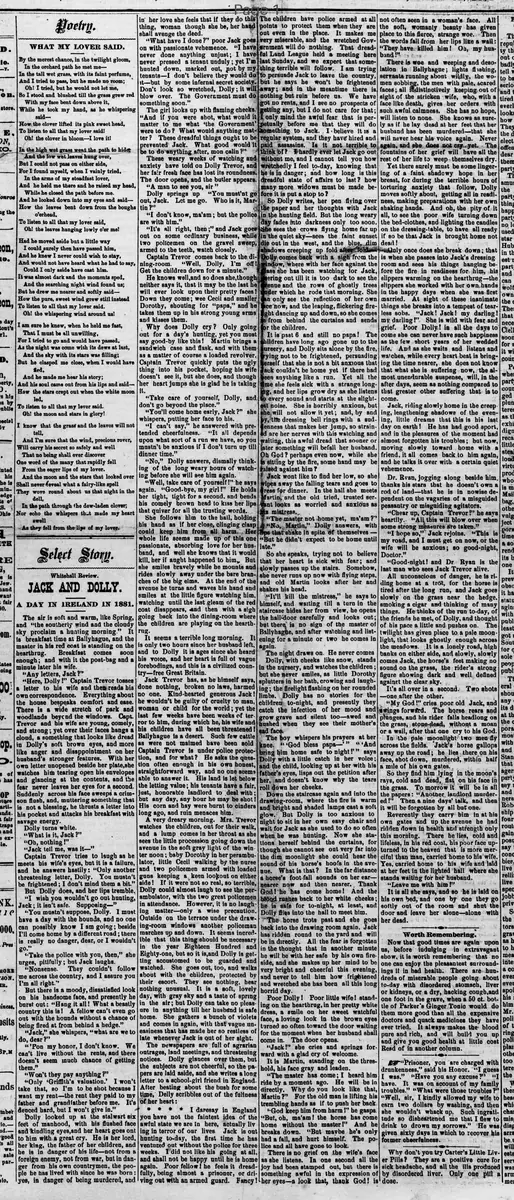
Select Story.
Whitehall Review.
JACK AND DOLLY.
A DAY IN IRELAND IN 1881,
The air is soft and warm, like Spring
and "the southerly wind and the cloudy sky proclaim a hunting morning." It
is breakfast time at Ballybague, and the
master in his red coat is standing on the
hearthrug. Breakfast comes soon
enough; and with it the post-bag and a
minute later his wife.
"Any letters, Jack?"
"Here, Dolly!" Captain Trevor tosses
a letter to his wife and then reads his
own correspondence. Everything about
the house bespeaks comfort and ease.
There is a wide stretch of park and
woodlands beyond the windows. Capt.
Trevor and his wife are young, comely,
and strong; yet over their faces hangs a
cloud, something that looks like dread
in Dolly's soft brown eyes, and more
like anger and disappointment on her
husband's stronger features. With her
own letter unopened beside her plate, she
watches him tearing open his envelopes
and glancing at the contents, and the
fear never leaves her eyes for a second.
Suddenly across his face sweeps a crimson flush, and, muttering something that
is not a blessing, he thrusts a letter into
his pocket and attacks his breakfast with
savage energy.
Dolly turns white.
"What is it, Jack?"
"Oh, nothing!"
"Jack tell me, was it"
Captain Trevor tries to laugh as he
meets his wife's eyes, but it is a failure,
and he answers hastily: "Only another
threatening letter, Dolly. You mustn't
be frightened; I don't mind them a bit."
But Dolly does, and her lips tremble.
"I wish you wouldn't go out hunting,
Jack; it isn't safe. Supposing—"
"You mustn't suppose, Dolly. I must
have a day with the hounds, and no one
can possibly know I am going; beside
I'll come home by a different road; there
is really no danger, dear, or I wouldn't
go."
"Take the police with you, then," she
urges, pitifully; but Jack laughs.
"Nonsense.
They couldn't follow
me across the country, and I assure you
I'm all right."
But there is a moody, dissatisfied look
on his handsome face, and presently he
burst out: "Hang it all! What a beastly
country this is! A fellow can't even go
out with the hounds without a chance of
being fired at from behind a hedge."
"Jack," she whispers, "what are we to
do, dear?"
"'Pon my honor, I don't know. We
can't live without the rents, and there
doesn't seem much chance of getting
them."
"Won't they pay anything?"
"Only 'Griffith's valuation.' I won't
take that, so I'm to be shot because I
want my rent—the rent they paid to my
father and grandfather before me. It's
deuced hard, but I won't give in."
Dolly looked up at the stalwart six
feet of manhood, with his flushed face
and kindling eyes, and her heart goes out
to him with a great cry. He is her lord,
her king, the father of her children, and
he is in danger of his life—not from a
foreign enemy, not from war, but in danger from his own countrymen, the people he has lived with since he was born:
yes, in danger of being murdered, and
in her love she feels that if they do this
thing, woman though she be, her hand
shall avenge the deed.
"What have I done?" poor Jack goes
on with passionate vehemence. "I have
never done anything unjust; I have
never pressed a tenant unduly; yet I'm
hunted down, marked out, not by my
tenants—I don't believe they would do
it—but by some infernal secret society
Don't look so wretched, Dolly: it will
blow over. The Government must do
something soon."
The girl looks up with flaming cheeks
"And if you were shot, what would it
matter to me what 'the Government
were to do? What would anything matter? These dreadful things ought to be
prevented Jack. What good would it
be to do anything after, mon ami?"
These weary weeks of watching and
anxiety have told on Dolly Trevor, and
her fair fresh face has lost its roundness.
The door opens, and the butler appears.
"A man to see you, sir"
Dolly springs up
"You mustn't go
out, Jack. Let me go. Who is it, Martin?"
"I don't know, ma'am; but the police
are with him."
"It's all right, then;" and Jack goes
out on some ordinary business, while
two policemen on the gravel sweep,
armed to the teeth, watch closely.
Captain Trevor comes back to the dining-room. "Well, Dolly, I'm off
Get the children down for a minute."
He knows well, and so does she, though
neither says it, that it may be the last he
will ever look upon their pretty faces!
Down they come; wee Cecil and smaller
Dorothy, shouting for "papa," and he
takes them up in his strong young arms
and kisses them.
Why does Dolly cry? Only going
out for a day's hunting, yet you must
say good-by like this! Martin brings a
sandwich case and flask, and with them
as a matter of course a loaded revolver.
Captain Trevor quickly puts the ugly
thing into his pocket, hoping his wife
doesn't see it, but she does, and though
her heart jumps she is glad he is taking
it.
"Good-bye, Jack!" she whispers, putting her face to his.
"I can't say." he answered with pretended cheerfulness. "It all depends
upon what sort of a run we have, so you
mustn't be anxious if I don't turn up till
dinner time."
"No," Dolly answers, dismally thinking of the long weary hours of watching before she will see him again.
"Well, take care of yourself!" he says
again. "Good-bye, my girl!" He holds
her tight, tight for a second, and bends
his comely brown head to kiss her lips
that quiver for all the trusting words.
She follows him to the hall, holding
his hand as if her close, clinging clasp
could keep him from all harm. Her
whole life seems made up of this one
passionate, absorbing love for her husband, and well she knows that it would
kill her if aught happened to him. But
she smiles bravely while he mounts and
rides slowly away under the bare branches of the big elms. At the end of the
avenue he turns and waves his hand and
smiles at the little figure watching him.
watching until the last gleam of the red
coat disappears, and then with a sigh
going back into the dining-room where
the children are playing on the hearth
rug.
It seems a terrible long morning. It
is only two hours since her husband left,
and to Dolly it is ages since she heard
his voice, and her heart is full of vague
forebodings, and this is a civilized country—free Great Britain.
Jack Trevor has, as he himself says,
done nothing, broken no laws, harmed
no one. Kind-hearted generous Jack!
he wouldn't be guilty of cruelty to man,
woman or child for the world; yet the
last few weeks have been weeks of terror to him, during which he, his wife and
his children have all been threatened!
Ballyhague is a desert. Such few cattle
as were not maimed have been sold
Captain Trevor is under police protection, and for what? He asks the question often enough in his own honest,
straightforward way, and no one seems
able to answer it. His land is let below
the letting value; his tenants have a fair,
just, honorable landlord to deal with:
but any day, any hour he may be shot!
His corn and hay were burnt to cinders
long ago, and ruin menaces him.
A very dreary morning. Mrs. Trevor
watches the children, out for their walk
and a lump comes in her throat as she
sees the little procession going down the
avenue in the soft gray light of the winter noon; baby Dorothy in her perambulator, little Cecil walking by the nurse
and two policemen armed with loaded
guns keeping a keen lookout on either
side! If it were not so real, so terrible,
Dolly could almost laugh to see the perambulator, with the two great policemen
in attendance. However, it is no laughing matter—only a wise precaution.
Outside on the terrace under the drawing-room windows another policeman
marches up and down. It seems incredible that this thing should be necessary in the year Eighteen Hundred and
Eighty-one, but so it is, and Dolly is getting accustomed to be guarded and
watched. She goes out, too, and walks
about with the children, protected by
their escort. They see nothing, hear
nothing unusual. It is a soft, lovely
day, with gray sky and a taste of spring
in the air; but Dolly can take no pleasure in anything till her husband is safe
home. She gathers a bunch of violets
and comes in again, with that vague uneasiness that has made her so restless of
late whenever Jack is out of her sight.
The newspapers are full of agrarian
outrages, land meetings, and threatening
notices. Dolly glances over them, but
the subjects are not cheerful, so the papers are laid aside, and she writes a long
letter to a school-girl friend in England.
After beating about the bush for some
time, Dolly scribbles out of the fullness
of her heart:
I daresay in England
you have not the faintest idea of the
awful state we are in here, actually living in terror of our lives. Jack is out
hunting to-day, the first time he has
ventured out without the police for three
weeks. I did not like his going at all,
and shall not be happy until he is home
again. Poor fellow! he feels it dreadfully, being almost a prisoner, or driving out with an armed guard. Fancy!
out even in the place. It makes me
very miserable, and the wretched Government will do nothing. That dreadful Land League held a meeting here
last Sunday, and we expect that something terrible will follow. I am trying
to persuade Jack to leave the country,
but he says he won't be frightened
away; and in the meantime there is
nothing but ruin before us We have
got no rents, and I see no prospects of
getting any, but I do not care for that;
I only mind the awful fear that is perpetually before me that they will do
something to Jack. I believe it's a regular system, and they have hired and
paid assassins. Is it not terrible to
think of? I hardly ever let Jack go out
without me, and I cannot tell you how
wretchedly I feel to-day, knowing that
he is in danger; and how long is this
dreadful state of affairs to last? how
many more widows must be made before it is put a stop to?
: :'
So Dolly writes, her pen flying over
the paper and her thoughts with Jack
in the hunting field. But the long weary
day fades into darkness only too soon.
She sees the crows flying home far up
in the quiet sky—sees the faint sunset
die out in the west, and the blue, dim
shadows creeping up fold after fold
Dolly comes back with a sigh from the
window, where with her face against the
lass she has been watching for Jack
peering out till it is too dark to see the
avenue and the rows of ghostly trees
under which he rode that morning. She
can only see the reflection of her own
face now; and the leaping, flickering fire-light dancing up and down, so she comes
from behind the curtains and sends
for the children.
It is past 6 and still no papa! The
children have long ago gone up to the
nursery, and Dolly sits alone by the fire,
trying not to be frightened, persuading
herself that she is not a bit anxious that
Jack couldn't be home yet if there had
been anything like a run. Yet all the
time she feels sick with a strange longing, and her lips grow dry as she listens
to every sound and starts at the slightest noise. She is horribly anxious, but
she will not allow it yet; and, by and
by, the dressing bell rings with a suddenness that makes her jump, so strained
are her nerves with this watching and
waiting, this awful dread that sooner or
later something will befall her husband.
Oh God! perhaps even now, while she
is sitting by the fire, some hand may be
raised against him?
Jack won't like to find her low, so she
wipes away the falling tears and goes to
dress for dinner. In the hall she meets
Martin, and the old tried, trusted servant looks as worried and anxious as
his mistress.
"The master not home yet, ma'am?"
"No. Martin," Dolly answers, with
lips that shake in spite of themselves—
"But he didn't expect to be home until
late."
So she speaks, trying not to believe
that her heart is sick with fear; and
slowly passes up the stairs. Somehow,
she never runs up now with flying steps,
and old Martin looks after her and
shakes his head.
"It'll kill the mistress," he says to
himself, and waiting till a turn in the
staircase hides her from view, he opens
the hall door carefully and looks out;
but there is no sign of the master of
Ballyhague, and after watching and listening for a minute or two he comes in
again.
The night draws on. He never comes
Dolly, with cheeks like snow, stands
in the nursery, and watches the children;
but she never smiles, as little Dorothy
splutters in her bath, crowing and laughing; the firelight flashing on her rounded limbs. Dolly has no stories for the
children to-night, and presently they
catch the infection of her mood and
grow grave and silent too—awed and
hushed when they see their mother's
sad face.
The boy whispers his prayers at her
knee. "God bless papa—" "And
bring him home safe to night!" says
Dolly with a little catch in her voice;
and the child, looking up at her with his
father's eyes, lisps out the petition after
her, and doesn't know why the tears
roll down her cheeks.
Down the staircase again and into
drawing-room, where the fire is warm
and bright and shaded lamps cast a soft
glow. But Dolly is too anxious to
night to sit in her own easy chair and
wait for Jack as she used to do so often
when he was hunting. Now she stations herself behind the curtains, for
though she cannot see out very far into
the dim moonlight she could hear the
sound of his horse's hoofs in the avenue. What is that? In the far distance
a horse's foot-fall sounds on her ear—
nearer now and then nearer. Thank
God! he has come home! And the
blood rushes back to her white cheeks;
he is safe for to-night, at least, and
Dolly flies into the hall to meet him.
*The horse trots past and she goes
back into the drawing room again. Jack
has ridden round to the yard and will
be in directly. All the fear is forgotten
in the thought that in another minute
he will be with her safe by his own fire.
side, and she makes up her mind to be
very bright and cheerful this evening,
and never to tell him how frightened
and wretched she has been all this long
horrid day.
Poor Dolly! Poor little wife! standing on the hearthrug, in her pretty white
dress, a smile on her sweet watchful
face, a loving look in the brown eyes
turned so often toward the door waiting for the moment when her husband shall
come in. The door opens.
"Jack!" she cries and springs forward with a glad cry of welcome.
It is Martin, standing on the threshold, his face gray and leaden.
"The master has come; I heard him
ride by a moment ago. He will be in
directly. Why do you look like that,
Martin?" For the old man is lifting his
trembling hands as if to push her back.
"God keep him from harm!" he gasps
"But, oh, ma'am! the horse has come
home without the master!" And he
breaks down. "But maybe he's only
had a fall, and hurt himself. The police and all have gone to look.
There is no grief on the wife's face
as she listens. In one second all the
joy had been stamped out, but there is
something awful in the expression of
her eyes—a look that, thank God! is
not often seen in a woman's face. All
the soft, womanly beauty has given
place to this fierce, strange woe. Then
the words fall from her lips like a wail:
"They have killed him! Oh, my husband!
There is woe and weeping and desolation in Ballyhague; lights flashing,
servants running about wildly, the women sobbing, the men with pale, scared
faces; all instinctively keeping out of
sight of the stricken wife, who, with a
face like death, gives her orders, with
such awful calmness. She has no hope,
will listen to none. She knows as surely as if he lay dead at her feet that her
husband has been murdered—that she
will never hear his voice again. Never
again, and she does not cry yet. The
fountains of her grief will have all the
rest of her life to weep themselves dry.
Yet there surely must be some lingering of a faint shadowy hope in her
breast, for during the terrible hours of
torturing anxiety that follow, Dolly
moves softly about, getting all in readiness, making preparations with her own
shaking hands. And oh, the pity of it
all, to see the poor wife turning down
the bed-clothes, and lighting the candles on the dressing-table, to have all ready if so be that Jack is brought home not
dead!
Only once does she break down: that
is when she passes into Jack's dressing
room and sees his things hanging before the fire in readiness for him, his
slippers warming on the hearthrug—the
slippers she worked with her own hands
in the happy days when she was first
married. At sight of these inanimate
things she breaks into a tempest of tearless sobs. "Jack! Jack! my darling!
my darling!". She is wild with fear and
grief. Poor Dolly! in all the days to
come she can never have such happiness
as the few short years of her wedded
life. And as she waits and listens and
watches, while every heart beat is bringing the time nearer, she does not know
that what she is suffering now, the almost unendurable suspense, will, in the
after days, seem as nothing compared to
that greater other suffering that is to
come.
Jack, riding slowly home in the creeping, lengthening shadows of the evening, little dreams that this is his last
day on earth! He has had good sport
and in the pleasures of the moment had
almost forgotten his troubles; but now,
moving slowly toward home with a
friend, it all comes back to him again.
and he talks it over with a certain quiet
vehemence.
Dr. Ryan, jogging along beside him
thanks his stars that he doesn't own a
rod of land—that he is in nowise dependent on the vagaries of a misguided
peasantry or misguiding agitators.
"Cheer up, Captain Trevor!" he says
heartily. "All this will blow over when
some strong measures are taken."
"I hope so." Jack rejoins. "This is
my road, and I must get on now, or the
wife will be anxious; so good-night,
Doctor."
"Good-night!" and Dr. Ryan is the
last man who sees Jack Trevor alive.
All unconscious of danger, he is riding home at a trot, for the horse is
tired after the long run, and Jack goes
slowly on the grass near the hedge,
smoking a cigar and thinking of many
things. He thinks of the run to-day, of
the friends he met, of Dolly, and thought
of his place a little and pushes on. The
twilight has given place to a pale moonlight, that looks ghostly enough across
the meadows. It is a lonely road, high
banks on either side, and slowly, slowly
comes Jack, the horse's feet making no
sound on the grass, the rider's strong
figure showing dark and well defined
against the clear sky.
It's all over in a second. Two shots
—one after the other.
"My God!" cries poor old Jack, and
swings forward. The horse rears and
plunges, and his rider falls headlong on
the grass, stone-dead, without a moan
or a wail, after that one cry to his God
—In the pale moonlight two men fly
across the fields. Jack's horse gallops
away up the road; he lies there on his
face, shot down, murdered, within half
a mile of his own gates.
So they find him lying in the moon's
rays, cold and dead, flat on his face in
the grass. To-morrow it will be in all
the papers: "Another landlord murdered!" Then a nine days' talk, and then
it will be forgotten by all but one.
Reverently they carry him in at his
own gates and up the avenue he had
ridden down in health and strength only
this morning. There he lies, cold and
lifeless, in his red coat, his poor face up-turned to the heaven that is more merciful than man, carried home to his wife.
Yes, carried home to his wife and laid
at her feet in the lighted hall where she
stands waiting for her husband.
"Leave me with him!"
It is all she says, and so he is laid on
his own bed, and one by one they go
softly out of the room and shut the
door and leave her alone—alone with
her dead.
Whitehall Review.
JACK AND DOLLY.
A DAY IN IRELAND IN 1881,
The air is soft and warm, like Spring
and "the southerly wind and the cloudy sky proclaim a hunting morning." It
is breakfast time at Ballybague, and the
master in his red coat is standing on the
hearthrug. Breakfast comes soon
enough; and with it the post-bag and a
minute later his wife.
"Any letters, Jack?"
"Here, Dolly!" Captain Trevor tosses
a letter to his wife and then reads his
own correspondence. Everything about
the house bespeaks comfort and ease.
There is a wide stretch of park and
woodlands beyond the windows. Capt.
Trevor and his wife are young, comely,
and strong; yet over their faces hangs a
cloud, something that looks like dread
in Dolly's soft brown eyes, and more
like anger and disappointment on her
husband's stronger features. With her
own letter unopened beside her plate, she
watches him tearing open his envelopes
and glancing at the contents, and the
fear never leaves her eyes for a second.
Suddenly across his face sweeps a crimson flush, and, muttering something that
is not a blessing, he thrusts a letter into
his pocket and attacks his breakfast with
savage energy.
Dolly turns white.
"What is it, Jack?"
"Oh, nothing!"
"Jack tell me, was it"
Captain Trevor tries to laugh as he
meets his wife's eyes, but it is a failure,
and he answers hastily: "Only another
threatening letter, Dolly. You mustn't
be frightened; I don't mind them a bit."
But Dolly does, and her lips tremble.
"I wish you wouldn't go out hunting,
Jack; it isn't safe. Supposing—"
"You mustn't suppose, Dolly. I must
have a day with the hounds, and no one
can possibly know I am going; beside
I'll come home by a different road; there
is really no danger, dear, or I wouldn't
go."
"Take the police with you, then," she
urges, pitifully; but Jack laughs.
"Nonsense.
They couldn't follow
me across the country, and I assure you
I'm all right."
But there is a moody, dissatisfied look
on his handsome face, and presently he
burst out: "Hang it all! What a beastly
country this is! A fellow can't even go
out with the hounds without a chance of
being fired at from behind a hedge."
"Jack," she whispers, "what are we to
do, dear?"
"'Pon my honor, I don't know. We
can't live without the rents, and there
doesn't seem much chance of getting
them."
"Won't they pay anything?"
"Only 'Griffith's valuation.' I won't
take that, so I'm to be shot because I
want my rent—the rent they paid to my
father and grandfather before me. It's
deuced hard, but I won't give in."
Dolly looked up at the stalwart six
feet of manhood, with his flushed face
and kindling eyes, and her heart goes out
to him with a great cry. He is her lord,
her king, the father of her children, and
he is in danger of his life—not from a
foreign enemy, not from war, but in danger from his own countrymen, the people he has lived with since he was born:
yes, in danger of being murdered, and
in her love she feels that if they do this
thing, woman though she be, her hand
shall avenge the deed.
"What have I done?" poor Jack goes
on with passionate vehemence. "I have
never done anything unjust; I have
never pressed a tenant unduly; yet I'm
hunted down, marked out, not by my
tenants—I don't believe they would do
it—but by some infernal secret society
Don't look so wretched, Dolly: it will
blow over. The Government must do
something soon."
The girl looks up with flaming cheeks
"And if you were shot, what would it
matter to me what 'the Government
were to do? What would anything matter? These dreadful things ought to be
prevented Jack. What good would it
be to do anything after, mon ami?"
These weary weeks of watching and
anxiety have told on Dolly Trevor, and
her fair fresh face has lost its roundness.
The door opens, and the butler appears.
"A man to see you, sir"
Dolly springs up
"You mustn't go
out, Jack. Let me go. Who is it, Martin?"
"I don't know, ma'am; but the police
are with him."
"It's all right, then;" and Jack goes
out on some ordinary business, while
two policemen on the gravel sweep,
armed to the teeth, watch closely.
Captain Trevor comes back to the dining-room. "Well, Dolly, I'm off
Get the children down for a minute."
He knows well, and so does she, though
neither says it, that it may be the last he
will ever look upon their pretty faces!
Down they come; wee Cecil and smaller
Dorothy, shouting for "papa," and he
takes them up in his strong young arms
and kisses them.
Why does Dolly cry? Only going
out for a day's hunting, yet you must
say good-by like this! Martin brings a
sandwich case and flask, and with them
as a matter of course a loaded revolver.
Captain Trevor quickly puts the ugly
thing into his pocket, hoping his wife
doesn't see it, but she does, and though
her heart jumps she is glad he is taking
it.
"Good-bye, Jack!" she whispers, putting her face to his.
"I can't say." he answered with pretended cheerfulness. "It all depends
upon what sort of a run we have, so you
mustn't be anxious if I don't turn up till
dinner time."
"No," Dolly answers, dismally thinking of the long weary hours of watching before she will see him again.
"Well, take care of yourself!" he says
again. "Good-bye, my girl!" He holds
her tight, tight for a second, and bends
his comely brown head to kiss her lips
that quiver for all the trusting words.
She follows him to the hall, holding
his hand as if her close, clinging clasp
could keep him from all harm. Her
whole life seems made up of this one
passionate, absorbing love for her husband, and well she knows that it would
kill her if aught happened to him. But
she smiles bravely while he mounts and
rides slowly away under the bare branches of the big elms. At the end of the
avenue he turns and waves his hand and
smiles at the little figure watching him.
watching until the last gleam of the red
coat disappears, and then with a sigh
going back into the dining-room where
the children are playing on the hearth
rug.
It seems a terrible long morning. It
is only two hours since her husband left,
and to Dolly it is ages since she heard
his voice, and her heart is full of vague
forebodings, and this is a civilized country—free Great Britain.
Jack Trevor has, as he himself says,
done nothing, broken no laws, harmed
no one. Kind-hearted generous Jack!
he wouldn't be guilty of cruelty to man,
woman or child for the world; yet the
last few weeks have been weeks of terror to him, during which he, his wife and
his children have all been threatened!
Ballyhague is a desert. Such few cattle
as were not maimed have been sold
Captain Trevor is under police protection, and for what? He asks the question often enough in his own honest,
straightforward way, and no one seems
able to answer it. His land is let below
the letting value; his tenants have a fair,
just, honorable landlord to deal with:
but any day, any hour he may be shot!
His corn and hay were burnt to cinders
long ago, and ruin menaces him.
A very dreary morning. Mrs. Trevor
watches the children, out for their walk
and a lump comes in her throat as she
sees the little procession going down the
avenue in the soft gray light of the winter noon; baby Dorothy in her perambulator, little Cecil walking by the nurse
and two policemen armed with loaded
guns keeping a keen lookout on either
side! If it were not so real, so terrible,
Dolly could almost laugh to see the perambulator, with the two great policemen
in attendance. However, it is no laughing matter—only a wise precaution.
Outside on the terrace under the drawing-room windows another policeman
marches up and down. It seems incredible that this thing should be necessary in the year Eighteen Hundred and
Eighty-one, but so it is, and Dolly is getting accustomed to be guarded and
watched. She goes out, too, and walks
about with the children, protected by
their escort. They see nothing, hear
nothing unusual. It is a soft, lovely
day, with gray sky and a taste of spring
in the air; but Dolly can take no pleasure in anything till her husband is safe
home. She gathers a bunch of violets
and comes in again, with that vague uneasiness that has made her so restless of
late whenever Jack is out of her sight.
The newspapers are full of agrarian
outrages, land meetings, and threatening
notices. Dolly glances over them, but
the subjects are not cheerful, so the papers are laid aside, and she writes a long
letter to a school-girl friend in England.
After beating about the bush for some
time, Dolly scribbles out of the fullness
of her heart:
I daresay in England
you have not the faintest idea of the
awful state we are in here, actually living in terror of our lives. Jack is out
hunting to-day, the first time he has
ventured out without the police for three
weeks. I did not like his going at all,
and shall not be happy until he is home
again. Poor fellow! he feels it dreadfully, being almost a prisoner, or driving out with an armed guard. Fancy!
out even in the place. It makes me
very miserable, and the wretched Government will do nothing. That dreadful Land League held a meeting here
last Sunday, and we expect that something terrible will follow. I am trying
to persuade Jack to leave the country,
but he says he won't be frightened
away; and in the meantime there is
nothing but ruin before us We have
got no rents, and I see no prospects of
getting any, but I do not care for that;
I only mind the awful fear that is perpetually before me that they will do
something to Jack. I believe it's a regular system, and they have hired and
paid assassins. Is it not terrible to
think of? I hardly ever let Jack go out
without me, and I cannot tell you how
wretchedly I feel to-day, knowing that
he is in danger; and how long is this
dreadful state of affairs to last? how
many more widows must be made before it is put a stop to?
: :'
So Dolly writes, her pen flying over
the paper and her thoughts with Jack
in the hunting field. But the long weary
day fades into darkness only too soon.
She sees the crows flying home far up
in the quiet sky—sees the faint sunset
die out in the west, and the blue, dim
shadows creeping up fold after fold
Dolly comes back with a sigh from the
window, where with her face against the
lass she has been watching for Jack
peering out till it is too dark to see the
avenue and the rows of ghostly trees
under which he rode that morning. She
can only see the reflection of her own
face now; and the leaping, flickering fire-light dancing up and down, so she comes
from behind the curtains and sends
for the children.
It is past 6 and still no papa! The
children have long ago gone up to the
nursery, and Dolly sits alone by the fire,
trying not to be frightened, persuading
herself that she is not a bit anxious that
Jack couldn't be home yet if there had
been anything like a run. Yet all the
time she feels sick with a strange longing, and her lips grow dry as she listens
to every sound and starts at the slightest noise. She is horribly anxious, but
she will not allow it yet; and, by and
by, the dressing bell rings with a suddenness that makes her jump, so strained
are her nerves with this watching and
waiting, this awful dread that sooner or
later something will befall her husband.
Oh God! perhaps even now, while she
is sitting by the fire, some hand may be
raised against him?
Jack won't like to find her low, so she
wipes away the falling tears and goes to
dress for dinner. In the hall she meets
Martin, and the old tried, trusted servant looks as worried and anxious as
his mistress.
"The master not home yet, ma'am?"
"No. Martin," Dolly answers, with
lips that shake in spite of themselves—
"But he didn't expect to be home until
late."
So she speaks, trying not to believe
that her heart is sick with fear; and
slowly passes up the stairs. Somehow,
she never runs up now with flying steps,
and old Martin looks after her and
shakes his head.
"It'll kill the mistress," he says to
himself, and waiting till a turn in the
staircase hides her from view, he opens
the hall door carefully and looks out;
but there is no sign of the master of
Ballyhague, and after watching and listening for a minute or two he comes in
again.
The night draws on. He never comes
Dolly, with cheeks like snow, stands
in the nursery, and watches the children;
but she never smiles, as little Dorothy
splutters in her bath, crowing and laughing; the firelight flashing on her rounded limbs. Dolly has no stories for the
children to-night, and presently they
catch the infection of her mood and
grow grave and silent too—awed and
hushed when they see their mother's
sad face.
The boy whispers his prayers at her
knee. "God bless papa—" "And
bring him home safe to night!" says
Dolly with a little catch in her voice;
and the child, looking up at her with his
father's eyes, lisps out the petition after
her, and doesn't know why the tears
roll down her cheeks.
Down the staircase again and into
drawing-room, where the fire is warm
and bright and shaded lamps cast a soft
glow. But Dolly is too anxious to
night to sit in her own easy chair and
wait for Jack as she used to do so often
when he was hunting. Now she stations herself behind the curtains, for
though she cannot see out very far into
the dim moonlight she could hear the
sound of his horse's hoofs in the avenue. What is that? In the far distance
a horse's foot-fall sounds on her ear—
nearer now and then nearer. Thank
God! he has come home! And the
blood rushes back to her white cheeks;
he is safe for to-night, at least, and
Dolly flies into the hall to meet him.
*The horse trots past and she goes
back into the drawing room again. Jack
has ridden round to the yard and will
be in directly. All the fear is forgotten
in the thought that in another minute
he will be with her safe by his own fire.
side, and she makes up her mind to be
very bright and cheerful this evening,
and never to tell him how frightened
and wretched she has been all this long
horrid day.
Poor Dolly! Poor little wife! standing on the hearthrug, in her pretty white
dress, a smile on her sweet watchful
face, a loving look in the brown eyes
turned so often toward the door waiting for the moment when her husband shall
come in. The door opens.
"Jack!" she cries and springs forward with a glad cry of welcome.
It is Martin, standing on the threshold, his face gray and leaden.
"The master has come; I heard him
ride by a moment ago. He will be in
directly. Why do you look like that,
Martin?" For the old man is lifting his
trembling hands as if to push her back.
"God keep him from harm!" he gasps
"But, oh, ma'am! the horse has come
home without the master!" And he
breaks down. "But maybe he's only
had a fall, and hurt himself. The police and all have gone to look.
There is no grief on the wife's face
as she listens. In one second all the
joy had been stamped out, but there is
something awful in the expression of
her eyes—a look that, thank God! is
not often seen in a woman's face. All
the soft, womanly beauty has given
place to this fierce, strange woe. Then
the words fall from her lips like a wail:
"They have killed him! Oh, my husband!
There is woe and weeping and desolation in Ballyhague; lights flashing,
servants running about wildly, the women sobbing, the men with pale, scared
faces; all instinctively keeping out of
sight of the stricken wife, who, with a
face like death, gives her orders, with
such awful calmness. She has no hope,
will listen to none. She knows as surely as if he lay dead at her feet that her
husband has been murdered—that she
will never hear his voice again. Never
again, and she does not cry yet. The
fountains of her grief will have all the
rest of her life to weep themselves dry.
Yet there surely must be some lingering of a faint shadowy hope in her
breast, for during the terrible hours of
torturing anxiety that follow, Dolly
moves softly about, getting all in readiness, making preparations with her own
shaking hands. And oh, the pity of it
all, to see the poor wife turning down
the bed-clothes, and lighting the candles on the dressing-table, to have all ready if so be that Jack is brought home not
dead!
Only once does she break down: that
is when she passes into Jack's dressing
room and sees his things hanging before the fire in readiness for him, his
slippers warming on the hearthrug—the
slippers she worked with her own hands
in the happy days when she was first
married. At sight of these inanimate
things she breaks into a tempest of tearless sobs. "Jack! Jack! my darling!
my darling!". She is wild with fear and
grief. Poor Dolly! in all the days to
come she can never have such happiness
as the few short years of her wedded
life. And as she waits and listens and
watches, while every heart beat is bringing the time nearer, she does not know
that what she is suffering now, the almost unendurable suspense, will, in the
after days, seem as nothing compared to
that greater other suffering that is to
come.
Jack, riding slowly home in the creeping, lengthening shadows of the evening, little dreams that this is his last
day on earth! He has had good sport
and in the pleasures of the moment had
almost forgotten his troubles; but now,
moving slowly toward home with a
friend, it all comes back to him again.
and he talks it over with a certain quiet
vehemence.
Dr. Ryan, jogging along beside him
thanks his stars that he doesn't own a
rod of land—that he is in nowise dependent on the vagaries of a misguided
peasantry or misguiding agitators.
"Cheer up, Captain Trevor!" he says
heartily. "All this will blow over when
some strong measures are taken."
"I hope so." Jack rejoins. "This is
my road, and I must get on now, or the
wife will be anxious; so good-night,
Doctor."
"Good-night!" and Dr. Ryan is the
last man who sees Jack Trevor alive.
All unconscious of danger, he is riding home at a trot, for the horse is
tired after the long run, and Jack goes
slowly on the grass near the hedge,
smoking a cigar and thinking of many
things. He thinks of the run to-day, of
the friends he met, of Dolly, and thought
of his place a little and pushes on. The
twilight has given place to a pale moonlight, that looks ghostly enough across
the meadows. It is a lonely road, high
banks on either side, and slowly, slowly
comes Jack, the horse's feet making no
sound on the grass, the rider's strong
figure showing dark and well defined
against the clear sky.
It's all over in a second. Two shots
—one after the other.
"My God!" cries poor old Jack, and
swings forward. The horse rears and
plunges, and his rider falls headlong on
the grass, stone-dead, without a moan
or a wail, after that one cry to his God
—In the pale moonlight two men fly
across the fields. Jack's horse gallops
away up the road; he lies there on his
face, shot down, murdered, within half
a mile of his own gates.
So they find him lying in the moon's
rays, cold and dead, flat on his face in
the grass. To-morrow it will be in all
the papers: "Another landlord murdered!" Then a nine days' talk, and then
it will be forgotten by all but one.
Reverently they carry him in at his
own gates and up the avenue he had
ridden down in health and strength only
this morning. There he lies, cold and
lifeless, in his red coat, his poor face up-turned to the heaven that is more merciful than man, carried home to his wife.
Yes, carried home to his wife and laid
at her feet in the lighted hall where she
stands waiting for her husband.
"Leave me with him!"
It is all she says, and so he is laid on
his own bed, and one by one they go
softly out of the room and shut the
door and leave her alone—alone with
her dead.
What sub-type of article is it?
Tragedy
Family Drama
Historical Event
What themes does it cover?
Tragedy
Misfortune
Family
What keywords are associated?
Landlord Murder
Irish Agrarian Unrest
Family Tragedy
Hunting Day
Secret Society Threats
What entities or persons were involved?
Captain Jack Trevor
Dolly Trevor
Cecil
Dorothy
Martin
Dr. Ryan
Where did it happen?
Ballyhague, Ireland
Story Details
Key Persons
Captain Jack Trevor
Dolly Trevor
Cecil
Dorothy
Martin
Dr. Ryan
Location
Ballyhague, Ireland
Event Date
1881
Story Details
Captain Jack Trevor, an Irish landlord facing threats from secret societies over rent disputes, goes hunting despite his wife Dolly's fears. He is shot and killed by assassins on his way home, leaving Dolly in profound grief as his body is brought back to their home.