Thank you for visiting SNEWPapers!
Sign up free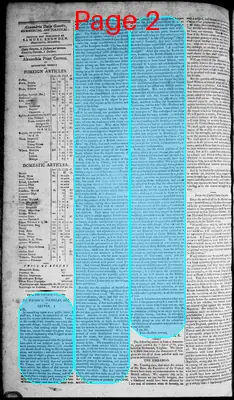
Letter to Editor
October 24, 1808
Alexandria Daily Gazette, Commercial & Political
Alexandria, Virginia
What is this article about?
A letter to Wilson C. Nicholas criticizing his public letter for emphasizing British aggressions while minimizing French ones during the Napoleonic era. The author details French violations against US trade and neutrality, urges impartiality, and warns that anti-British sentiment risks war and subjugation.
Clipping
OCR Quality
98%
Excellent
Full Text
FROM THE VIRGINIA GAZETTE
TO WILSON C. NICHOLAS, ESQ.
LETTER
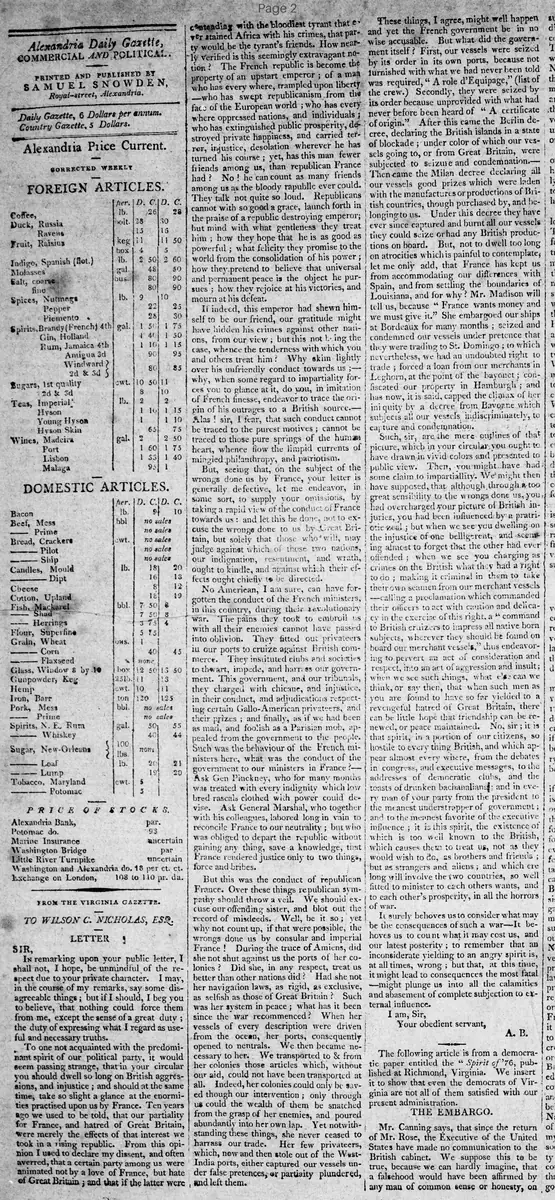
In remarking upon your public letter, I shall not, I hope, be unmindful of the respect due to your private character. I may, in the course of my remarks, say some disagreeable things; but if I should, I beg you to believe, that nothing could force them from me, except the sense of a great duty; the duty of expressing what I regard as useful and necessary truths.
To one not acquainted with the predominant spirit of our political party, it would seem passing strange, that in your circular you should dwell so long on British aggressions, and injustice; and should at the same time, take so slight a glance at the enormities practised upon us by France. Ten years ago we used to be told, that our partiality for France, and hatred of Great Britain, were merely the effects of that interest we took in a rising republic. From this opinion I used to declare my dissent, and often averred, that a certain party among us were animated not by a love of France, but hate of Great Britain; and that if the latter were dethroned, and the former seated in her stead, as the presiding power of the world, that party would be the tyrant's friends. How nearly verified is this seemingly extravagant notion? The French republic is become the property of an upstart emperor; of a man who has every where, trampled upon liberty --who has swept republicanism from the face of the European world; who has every where oppressed nations, and individuals; who has extinguished public prosperity, destroyed private happiness, and carried terror, injustice, desolation wherever he has turned his course; yet, has this man fewer friends among us, than republican France had? No! he can count as many friends among us as the bloody republic ever could. They talk not quite so loud. Republicans cannot with so good a grace, launch forth in the praise of a republic destroying emperor; but mark with what gentleness they treat him; how they hope that he is as good as powerful; what felicity they promise to the world from the consolidation of his power; how they pretend to believe that universal and permanent peace is the object he pursues; how they rejoice at his victories, and mourn at his defeat.
If indeed, this emperor had shewn himself to be our friend, our gratitude might have hidden his crimes against other nations, from our view; but this not being the case, whence the tenderness with which you and others treat him? Why skim lightly over his unfriendly conduct towards us ;-- why, when some regard to impartiality forces you to glance at it, do you, in imitation of French finesse, endeavor to trace the origin of his outrages to a British source.-- Alas! sir, I fear, that such conduct cannot be traced to the purest motives; cannot be traced to those pure springs of the human heart, whence flow the limpid currents of mingled philanthropy, and patriotism.
But, seeing that, on the subject of the wrongs done us by France, your letter is generally defective, let me endeavor, in some sort, to supply your omissions, by taking a rapid view of the conduct of France towards us: and let this be done, not to excuse the wrongs done to us by Great Britain, but solely that those who will, nay must judge against which of those two nations, our indignation, resentment, and wrath, ought to kindle, and against which their effects ought chiefly to be directed.
No American, I am sure, can have forgotten the conduct of the French ministers, in this country, during their revolutionary war. The pains they took to embroil us with all their enemies cannot have passed into oblivion. They fitted out privateers in our ports to cruize against British commerce. They instituted clubs and societies to thwart, impede, and harrass our government. This government, and our tribunals, they charged with chicane, and injustice, in their conduct, and adjudications respecting certain Gallo-American privateers, and their prizes; and finally, as if we had been as mad, and foolish as a Parisian mob, appealed from the government to the people.
Such was the behaviour of the French ministers here, what was the conduct of the government to our ministers in France ?- Ask Gen Pinckney, who for many months was treated with every indignity which low bred rascals clothed with power could devise. Ask General Marshall, who together with his colleagues, labored long in vain to reconcile France to our neutrality; but who was obliged to depart the republic without gaining any thing, save a knowledge, that France rendered justice only to two things, force and bribes.
But this was the conduct of republican France. Over these things republican sympathy should throw a veil. We should excuse our offending sister, and blot out the record of misdeeds. Well, be it so; yet why not count up, if that were possible, the wrongs done us by consular and imperial France! During the truce of Amiens, did she not shut against us the ports of her colonies? Did she, in any respect, treat us better than other nations did? Had she not her navigation laws, as rigid, as exclusive, as selfish as those of Great Britain? Such was her system in peace; what has it been since the war recommenced? When her vessels of every description were driven from the ocean, her ports, consequently opened to neutrals. We then became necessary to her. We transported to & from her colonies those articles which, without our aid, could not have been transported at all. Indeed, her colonies could only be saved through our intervention; only through us could the wealth of them be snatched from the grasp of her enemies, and poured abundantly into her own lap. Yet notwithstanding these things, she never ceased to harrass our trade. Her few privateers, which, now and then stole out of the West-India ports, either captured our vessels under false pretences, or partially plundered, and left them.
These things, I agree, might well happen and yet the French government be in no wise accusable. But what. did the government itself? First, our vessels were seized by its order in its own ports, because not furnished with what we had never been told was required, "A role d'Equipage." (list of the crew.) Secondly, they were seized by its order because unprovided with what had never before been heard of "A certificate of origin." After this came the Berlin decree, declaring the British islands in a state of blockade; under color of which our vessels going to, or from Great Britain, were subjected to seizure and condemnation.-- Then came the Milan decree declaring all our vessels good prizes which were laden with the manufactures or productions of British countries, though purchased by, and belonging to us. Under this decree they have ever since captured and burnt all our vessels they could seize or had any British productions on board. But, not to dwell too long on atrocities which is painful to contemplate: let me only add, that France has kept us from accommodating our differences with Spain, and from settling the boundaries of Louisiana, and for why? Mr. Madison will tell us, because "France wants money and we must give it." She embargoed our ships at Bordeaux for many months; seized and condemned our vessels under pretence that they were trading to St. Domingo; to which nevertheless, we had an undoubted right to trade; forced a loan from our merchants in Leghorn, at the point of the bayonet; confiscated our property in Hamburgh; and has now, it is said, capped the climax of her iniquity by a decree from Bayonne which subjects all our vessels indiscriminately, to capture and condemnation.
Such, sir, are the mere outlines of that picture, which in your circular, you ought to have drawn in vivid colors and presented to public view. Then, you might have had some claim to impartiality. We might then have supposed, that although through a too great sensibility to the wrongs done us, you had overcharged your picture of British injuries, you had been influenced by a patriotic zeal; but when we see you dwelling on the injustice of one belligerent; and seeming almost to forget that the other had ever offended; when we see you charging as crimes on the British what they had a right to do; making it criminal in them to take their own seamen from our merchant vessels --calling a proclamation which commanded their officers to act with caution and delicacy in the exercise of this right, a "command to British cruizers to impress all native born subjects, wherever they should be found on board our merchant vessels," thus endeavoring to pervert an act of consideration and respect, into an act of aggression and insult: when we see such things, what else can we think, or say then, that when such men as you are found to have so far yielded to a revengeful hatred of Great Britain, there can be little hope that friendship can be renewed, or peace maintained. No, sir; it is that spirit, in a portion of our citizens, so hostile to every thing British, and which appears almost every where, from the debates in congress, and executive messages, to the addresses of democratic clubs, and the toasts of drunken bacchanalians; and in every man of your party from the president to the meanest understrapper of government; and to the meanest favorite of the executive influence; it is this spirit, the existence of which is too well known to the British, which causes them to treat us, not as they would wish to do. as brothers and friends: but as strangers and aliens; and which ere long will involve the two countries, so well fitted to minister to each others wants, and to each other's prosperity, in all the horrors of war.
It surely behoves us to consider what may be the consequences of such a war-It behoves us to count what it may cost us, and our latest posterity; to remember that an inconsiderate yielding to an angry spirit is, at all times, wrong; but that, at this time, it might lead to consequences the most fatal --might plunge us into all the calamities and abasement of complete subjection to external influence.
I am, Sir,
Your obedient servant,
A. B.
TO WILSON C. NICHOLAS, ESQ.
LETTER
In remarking upon your public letter, I shall not, I hope, be unmindful of the respect due to your private character. I may, in the course of my remarks, say some disagreeable things; but if I should, I beg you to believe, that nothing could force them from me, except the sense of a great duty; the duty of expressing what I regard as useful and necessary truths.
To one not acquainted with the predominant spirit of our political party, it would seem passing strange, that in your circular you should dwell so long on British aggressions, and injustice; and should at the same time, take so slight a glance at the enormities practised upon us by France. Ten years ago we used to be told, that our partiality for France, and hatred of Great Britain, were merely the effects of that interest we took in a rising republic. From this opinion I used to declare my dissent, and often averred, that a certain party among us were animated not by a love of France, but hate of Great Britain; and that if the latter were dethroned, and the former seated in her stead, as the presiding power of the world, that party would be the tyrant's friends. How nearly verified is this seemingly extravagant notion? The French republic is become the property of an upstart emperor; of a man who has every where, trampled upon liberty --who has swept republicanism from the face of the European world; who has every where oppressed nations, and individuals; who has extinguished public prosperity, destroyed private happiness, and carried terror, injustice, desolation wherever he has turned his course; yet, has this man fewer friends among us, than republican France had? No! he can count as many friends among us as the bloody republic ever could. They talk not quite so loud. Republicans cannot with so good a grace, launch forth in the praise of a republic destroying emperor; but mark with what gentleness they treat him; how they hope that he is as good as powerful; what felicity they promise to the world from the consolidation of his power; how they pretend to believe that universal and permanent peace is the object he pursues; how they rejoice at his victories, and mourn at his defeat.
If indeed, this emperor had shewn himself to be our friend, our gratitude might have hidden his crimes against other nations, from our view; but this not being the case, whence the tenderness with which you and others treat him? Why skim lightly over his unfriendly conduct towards us ;-- why, when some regard to impartiality forces you to glance at it, do you, in imitation of French finesse, endeavor to trace the origin of his outrages to a British source.-- Alas! sir, I fear, that such conduct cannot be traced to the purest motives; cannot be traced to those pure springs of the human heart, whence flow the limpid currents of mingled philanthropy, and patriotism.
But, seeing that, on the subject of the wrongs done us by France, your letter is generally defective, let me endeavor, in some sort, to supply your omissions, by taking a rapid view of the conduct of France towards us: and let this be done, not to excuse the wrongs done to us by Great Britain, but solely that those who will, nay must judge against which of those two nations, our indignation, resentment, and wrath, ought to kindle, and against which their effects ought chiefly to be directed.
No American, I am sure, can have forgotten the conduct of the French ministers, in this country, during their revolutionary war. The pains they took to embroil us with all their enemies cannot have passed into oblivion. They fitted out privateers in our ports to cruize against British commerce. They instituted clubs and societies to thwart, impede, and harrass our government. This government, and our tribunals, they charged with chicane, and injustice, in their conduct, and adjudications respecting certain Gallo-American privateers, and their prizes; and finally, as if we had been as mad, and foolish as a Parisian mob, appealed from the government to the people.
Such was the behaviour of the French ministers here, what was the conduct of the government to our ministers in France ?- Ask Gen Pinckney, who for many months was treated with every indignity which low bred rascals clothed with power could devise. Ask General Marshall, who together with his colleagues, labored long in vain to reconcile France to our neutrality; but who was obliged to depart the republic without gaining any thing, save a knowledge, that France rendered justice only to two things, force and bribes.
But this was the conduct of republican France. Over these things republican sympathy should throw a veil. We should excuse our offending sister, and blot out the record of misdeeds. Well, be it so; yet why not count up, if that were possible, the wrongs done us by consular and imperial France! During the truce of Amiens, did she not shut against us the ports of her colonies? Did she, in any respect, treat us better than other nations did? Had she not her navigation laws, as rigid, as exclusive, as selfish as those of Great Britain? Such was her system in peace; what has it been since the war recommenced? When her vessels of every description were driven from the ocean, her ports, consequently opened to neutrals. We then became necessary to her. We transported to & from her colonies those articles which, without our aid, could not have been transported at all. Indeed, her colonies could only be saved through our intervention; only through us could the wealth of them be snatched from the grasp of her enemies, and poured abundantly into her own lap. Yet notwithstanding these things, she never ceased to harrass our trade. Her few privateers, which, now and then stole out of the West-India ports, either captured our vessels under false pretences, or partially plundered, and left them.
These things, I agree, might well happen and yet the French government be in no wise accusable. But what. did the government itself? First, our vessels were seized by its order in its own ports, because not furnished with what we had never been told was required, "A role d'Equipage." (list of the crew.) Secondly, they were seized by its order because unprovided with what had never before been heard of "A certificate of origin." After this came the Berlin decree, declaring the British islands in a state of blockade; under color of which our vessels going to, or from Great Britain, were subjected to seizure and condemnation.-- Then came the Milan decree declaring all our vessels good prizes which were laden with the manufactures or productions of British countries, though purchased by, and belonging to us. Under this decree they have ever since captured and burnt all our vessels they could seize or had any British productions on board. But, not to dwell too long on atrocities which is painful to contemplate: let me only add, that France has kept us from accommodating our differences with Spain, and from settling the boundaries of Louisiana, and for why? Mr. Madison will tell us, because "France wants money and we must give it." She embargoed our ships at Bordeaux for many months; seized and condemned our vessels under pretence that they were trading to St. Domingo; to which nevertheless, we had an undoubted right to trade; forced a loan from our merchants in Leghorn, at the point of the bayonet; confiscated our property in Hamburgh; and has now, it is said, capped the climax of her iniquity by a decree from Bayonne which subjects all our vessels indiscriminately, to capture and condemnation.
Such, sir, are the mere outlines of that picture, which in your circular, you ought to have drawn in vivid colors and presented to public view. Then, you might have had some claim to impartiality. We might then have supposed, that although through a too great sensibility to the wrongs done us, you had overcharged your picture of British injuries, you had been influenced by a patriotic zeal; but when we see you dwelling on the injustice of one belligerent; and seeming almost to forget that the other had ever offended; when we see you charging as crimes on the British what they had a right to do; making it criminal in them to take their own seamen from our merchant vessels --calling a proclamation which commanded their officers to act with caution and delicacy in the exercise of this right, a "command to British cruizers to impress all native born subjects, wherever they should be found on board our merchant vessels," thus endeavoring to pervert an act of consideration and respect, into an act of aggression and insult: when we see such things, what else can we think, or say then, that when such men as you are found to have so far yielded to a revengeful hatred of Great Britain, there can be little hope that friendship can be renewed, or peace maintained. No, sir; it is that spirit, in a portion of our citizens, so hostile to every thing British, and which appears almost every where, from the debates in congress, and executive messages, to the addresses of democratic clubs, and the toasts of drunken bacchanalians; and in every man of your party from the president to the meanest understrapper of government; and to the meanest favorite of the executive influence; it is this spirit, the existence of which is too well known to the British, which causes them to treat us, not as they would wish to do. as brothers and friends: but as strangers and aliens; and which ere long will involve the two countries, so well fitted to minister to each others wants, and to each other's prosperity, in all the horrors of war.
It surely behoves us to consider what may be the consequences of such a war-It behoves us to count what it may cost us, and our latest posterity; to remember that an inconsiderate yielding to an angry spirit is, at all times, wrong; but that, at this time, it might lead to consequences the most fatal --might plunge us into all the calamities and abasement of complete subjection to external influence.
I am, Sir,
Your obedient servant,
A. B.
What sub-type of article is it?
Persuasive
Political
Provocative
What themes does it cover?
Politics
Commerce Trade
Military War
What keywords are associated?
French Aggressions
British Relations
Foreign Policy
Napoleon Bonaparte
Impressment
Berlin Decree
Milan Decree
Us Neutrality
What entities or persons were involved?
A. B.
Wilson C. Nicholas, Esq.
Letter to Editor Details
Author
A. B.
Recipient
Wilson C. Nicholas, Esq.
Main Argument
the letter rebukes nicholas for biased emphasis on british aggressions while understating french ones, details extensive french violations against us commerce and neutrality, and warns that unchecked anti-british sentiment will lead to war and subjugation to foreign powers.
Notable Details
References French Berlin And Milan Decrees
Mentions Xyz Affair Via Pinckney And Marshall
Criticizes Impressment Portrayal
Discusses Napoleon's Rise And Us Party Support