Thank you for visiting SNEWPapers!
Sign up free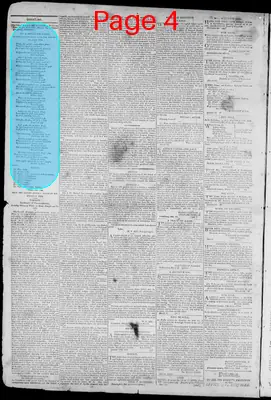
Poem
March 28, 1805
The Enquirer
Richmond, Henrico County, Virginia
What is this article about?
Robert Burns' poem 'To a Mountain Daisy' reflects on crushing a flower with the plough in April 1786, using it as a metaphor for the fates of artless maidens, simple bards, suffering worth, and the poet himself, emphasizing vulnerability and ruin amid life's hardships.
Clipping
OCR Quality
95%
Excellent
Full Text
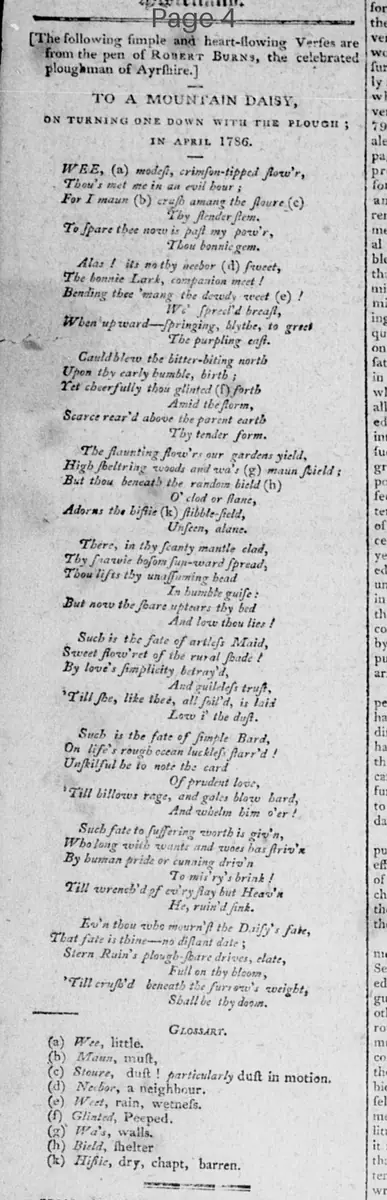
[The following simple and heart-flowing Verses are from the pen of Robert Burns, the celebrated ploughman of Ayrshire.]
TO A MOUNTAIN DAISY,
ON TURNING ONE DOWN WITH THE PLOUGH,
IN APRIL 1786.
WEE, modest, crimson-tipped flow'r,
Thou's met me in an evil hour;
For I maun crush amang the stoure
Thy slender stem:
To spare thee now is past my pow'r,
Thou bonnie gem.
Alas! it's no thy neebor sweet,
The bonnie lark, companion meet,
Bending thee 'mang the dewy weet!
Wi' spreckl'd breast,
When upward-springing, blythe, to greet
The purpling east.
Cauld blew the bitter-biting north
Upon thy early, humble birth;
Yet cheerfully thou glinted forth
Amid the storm,
Scarce rear'd above the parent-earth
Thy tender form.
The flaunting flow'rs our gardens yield,
High sheltering woods and wa's maun shield,
But thou, beneath the random bield
O' clod or stane,
Adorns the histie stibble-field,
Unseen, alane.
There, in thy scanty mantle clad,
Thy snavie bosom sun-ward spread,
Thou lifts thy unassuming head
In humble guise;
But now the share uptears thy bed,
And low thou lies!
Such is the fate of artless Maid,
Sweet flow'ret of the rural shade!
By love's simplicity betray'd,
And guileless trust,
Till she, like thee, all soil'd, is laid
Low i' the dust.
Such is the fate of simple Bard,
On life's rough ocean luckless starr'd!
Unskillful he to note the card
Of prudent lore,
Till billows rage, and gales blow hard,
And whelm him o'er!
Such fate to suffering worth is giv'n,
Who long with wants and woes has striv'n,
By human pride or cunning driv'n
To mis'ry's brink,
Till wrench'd of ev'ry stay but Heav'n,
He, ruin'd, sink.
Ev'n thou who mourn'st the Daisy's fate,
That fate is thine-no distant date;
Stern Ruin's plough-share drives, elate,
Full on thy bloom,
Till crush'd beneath the furrow's weight
Shall be thy doom!
GLOSSARY.
Wee, little.
Maun, must.
Stoure, dust; particularly dust in motion.
Neebor, a neighbour.
Weet, rain, wetness.
Glinted, peeped.
Wa’s, walls.
Bield, shelter.
Histie, dry, chapt, barren.
TO A MOUNTAIN DAISY,
ON TURNING ONE DOWN WITH THE PLOUGH,
IN APRIL 1786.
WEE, modest, crimson-tipped flow'r,
Thou's met me in an evil hour;
For I maun crush amang the stoure
Thy slender stem:
To spare thee now is past my pow'r,
Thou bonnie gem.
Alas! it's no thy neebor sweet,
The bonnie lark, companion meet,
Bending thee 'mang the dewy weet!
Wi' spreckl'd breast,
When upward-springing, blythe, to greet
The purpling east.
Cauld blew the bitter-biting north
Upon thy early, humble birth;
Yet cheerfully thou glinted forth
Amid the storm,
Scarce rear'd above the parent-earth
Thy tender form.
The flaunting flow'rs our gardens yield,
High sheltering woods and wa's maun shield,
But thou, beneath the random bield
O' clod or stane,
Adorns the histie stibble-field,
Unseen, alane.
There, in thy scanty mantle clad,
Thy snavie bosom sun-ward spread,
Thou lifts thy unassuming head
In humble guise;
But now the share uptears thy bed,
And low thou lies!
Such is the fate of artless Maid,
Sweet flow'ret of the rural shade!
By love's simplicity betray'd,
And guileless trust,
Till she, like thee, all soil'd, is laid
Low i' the dust.
Such is the fate of simple Bard,
On life's rough ocean luckless starr'd!
Unskillful he to note the card
Of prudent lore,
Till billows rage, and gales blow hard,
And whelm him o'er!
Such fate to suffering worth is giv'n,
Who long with wants and woes has striv'n,
By human pride or cunning driv'n
To mis'ry's brink,
Till wrench'd of ev'ry stay but Heav'n,
He, ruin'd, sink.
Ev'n thou who mourn'st the Daisy's fate,
That fate is thine-no distant date;
Stern Ruin's plough-share drives, elate,
Full on thy bloom,
Till crush'd beneath the furrow's weight
Shall be thy doom!
GLOSSARY.
Wee, little.
Maun, must.
Stoure, dust; particularly dust in motion.
Neebor, a neighbour.
Weet, rain, wetness.
Glinted, peeped.
Wa’s, walls.
Bield, shelter.
Histie, dry, chapt, barren.
What sub-type of article is it?
Ode
What themes does it cover?
Nature Seasons
Moral Virtue
What keywords are associated?
Robert Burns
Mountain Daisy
Plough
Fate
Rural Shade
Simple Bard
Ruin
April 1786
What entities or persons were involved?
Robert Burns, The Celebrated Ploughman Of Ayrshire.
Poem Details
Title
To A Mountain Daisy, On Turning One Down With The Plough, In April 1786.
Author
Robert Burns, The Celebrated Ploughman Of Ayrshire.
Subject
On Turning One Down With The Plough, In April 1786.
Key Lines
Wee, Modest, Crimson Tipped Flow'r,
Thou's Met Me In An Evil Hour;
For I Maun Crush Amang The Stoure
Thy Slender Stem:
To Spare Thee Now Is Past My Pow'r,
Thou Bonnie Gem.
Such Is The Fate Of Artless Maid,
Sweet Flow'ret Of The Rural Shade!
By Love's Simplicity Betray'd,
And Guileless Trust,
Till She, Like Thee, All Soil'd, Is Laid
Low I' The Dust.
Such Is The Fate Of Simple Bard,
On Life's Rough Ocean Luckless Starr'd!
Unskillful He To Note The Card
Of Prudent Lore,
Till Billows Rage, And Gales Blow Hard,
And Whelm Him O'er!
Ev'n Thou Who Mourn'st The Daisy's Fate,
That Fate Is Thine No Distant Date;
Stern Ruin's Plough Share Drives, Elate,
Full On Thy Bloom,
Till Crush'd Beneath The Furrow's Weight
Shall Be Thy Doom!