Thank you for visiting SNEWPapers!
Sign up free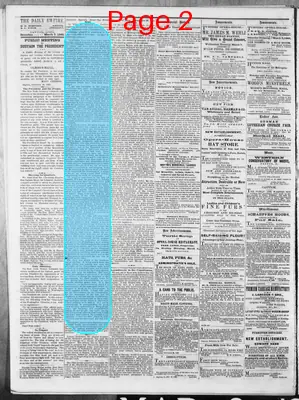
The Daily Empire
Dayton, Montgomery County, Ohio
What is this article about?
President Andrew Johnson receives a committee from Baltimore presenting resolutions supporting his policy. In his response, he defends his reconstruction approach as principled, vows unwavering commitment to preserving the Union and Constitution against both rebellion and centralization of power, and expresses hope for national reconciliation post-Civil War.
Clipping

OCR Quality
Full Text
"Gentlemen: I cannot make any speech in reply, but in response to what has been said, I will simply remark that my policy, to which you have alluded as before the country, was not announced as the result of impulse, nor was it thrown for any ad captandum purposes. It was announced as the result of conviction, of mature consideration, as a necessary consequence of the principles upon which this Government rests. That policy, which I honestly regard as being the best for the country, will continue before the people, without the slightest deviation, and without being swerved from on my part. I do not say this in a spirit of menace or threat to anybody, but simply to give assurance that there will be no abandonment and no shrinking from that policy, because it is believed that the very existence and perpetuity of the Government depend on the maintenance of the principles which have thus been enunciated.
I am not insensible to the remarks which have been made accompanying the presentation of these resolutions. The mind and soul of a man who would not feel more or less inspired and impressed by what you have said must be extremely dull and barren. I feel the full force of what you have said, and I think I know how to appreciate it, and so feeling, I am impressed with the conviction that my duty must be performed without regard to the consequences. Your encouragement at this particular time seems to be peculiarly appropriate. Your countenance and proffers of support under the present circumstances inspire me with a confidence, and a strength, and a hope, that the country will ultimately triumph, and those great principles will be sustained.
It is not necessary for me to remark to you that I entered this contest at its very incipiency, and I have not deviated a single hair's breadth from the line of policy I then laid down. I stand now precisely on the same ground I stood on in the Senate on the 18th and 19th days of December, 1860. I know that it has been said, and no doubt by many designedly said, that here is a President who was elected by a party, and who on coming into power, abandoned that party; that he has Tylerized his Administration; that he has joined the Copperheads, and things of that kind. Those things have no influence upon me. They fail wholly to drive me from the discharge of my duty. But if you and I, with others, have been employed for four years in resisting a separation and dissolution of the Union, and now have reached a point when resistance has ceased, if we can be instrumental in conciliating and bringing back all the people to an honest, loyal, and thorough support of the Government, it seems to me we are doing a good deed and accomplishing the work we undertook.
It happens sometimes, in the best of families, if I may be permitted to use the illustration, that there are differences and feuds, but when these differences are understood and arranged, and when the feuds subside, the parties can approach each other feeling more kindly toward those from whom they had been estranged than they did before. Then I do not think we are doing wrong, if we, while maintaining principle, while trying to preserve the Government, have succeeded in convincing of their error and bringing back to the fold of their fathers, those who strayed. I think this is a result of which all would be proud, and for which we should not be taunted. If I know myself, my only object is to preserve the Government. I want it to continue in loyal hands, and none others.
I hope that the time will soon come when the country will be thoroughly reconciled; but to secure all that is necessary for this purpose, will require a severe struggle, for I am free to say to you—it is not worth while to disguise it—that the very same spirit which animated the rebellion at one end of the line, now exists at the other, to some extent. Before the recent rebellion, there were one set of gentlemen who were trying to dissolve and break up the Government for the purpose of preserving the institution of slavery, and another set of gentlemen were willing to break up the Government for the purpose of destroying slavery, and they so avowed. Though these respective parties disagreed in the object they wished to accomplish, they agreed in one thing, and that was the destruction of the Government, and so far as that point is concerned, the one was as culpable as the other.
The blow was struck at the Southern end of the line. It being struck there, the spirit which was making war upon the principles of the Government must have something to vent itself upon, and it joined with those who were for the Union against those who were for rebellion. But now, when the rebellion is put down, if we find an attempt to change the character of the Government, we must equally resist it. The attempt now is to consolidate, to concentrate absolute power here. It is the destruction of the Government, and it is a manifestation of the same spirit which attempted to break up the Government. I stand opposed to both. I stand with you for the Government, for the Constitution, for the supremacy of the law, and for obedience to the law and the Constitution.
Let it be understood that so far as making candidates for the future is concerned, I have nothing to do with it. If I can be instrumental in accomplishing the great work we have undertaken to bring about, peace, and harmony, and reconciliation among all our people, and again placing this Government upon its firm basis, I shall feel that I have reached the summit of my ambition. I have no other object in view, if I know my own heart and my own feelings.
Gentlemen, permit me to thank you most sincerely for the encouragement you have given me, and for the countenance you have shown by coming forward in this great struggle for the first principle of free government."
What sub-type of article is it?
What themes does it cover?
What keywords are associated?
What entities or persons were involved?
Story Details
Key Persons
Event Date
Thursday Morning Last; Resolutions Adopted On The 26th Of February
Story Details
President Johnson responds to a Baltimore committee's resolutions by defending his Reconstruction policy as rooted in conviction and necessary for the government's preservation, rejecting accusations of party abandonment, advocating reconciliation with the South while opposing both secession and centralization of power, and expressing commitment to constitutional principles.