Thank you for visiting SNEWPapers!
Sign up free
Story
July 3, 1926
The Watchman And Southron
Sumter, Sumter County, South Carolina
What is this article about?
Humorous newspaper commentary on 'near-beer bars' appearing in rural U.S. prohibition areas, serving non-alcoholic beer substitutes that look and taste like beer but lack its effects, viewed as harmless innovation.
Clipping
OCR Quality
98%
Excellent
Full Text
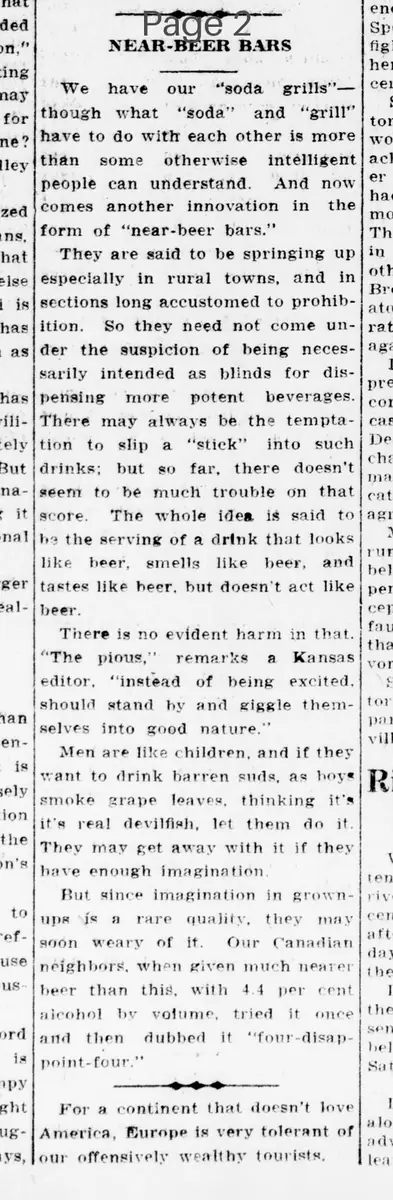
NEAR-BEER BARS
We have our soda grills" though what "soda" and "grill" have to do with each other is more than some otherwise intelligent people can understand. And now comes another innovation in the form of "near-beer bars."
They are said to be springing up especially in rural towns, and in sections long accustomed to prohibition. So they need not come under the suspicion of being necessarily intended as blinds for dispensing more potent beverages.
There may always be the temptation to slip a "spike" into such drinks; but so far, there doesn't seem to be much trouble on that score. The whole idea is said to be the serving of a drink that looks like beer, smells like beer, and tastes like beer, but doesn't act like beer.
There is no evident harm in that. "The pious," remarks a Kansas editor, instead of being excited, should stand by and giggle themselves into good nature."
Men are like children, and if they want to drink barren suds, as boys smoke grape leaves, thinking it's real devilfish, let them do it. They may get away with it if they have enough imagination.
But since imagination in grown-ups is a rare quality, they may soon weary of it. Our Canadian neighbors, when given much nearer beer than this, with 2.4 per cent alcohol by volume, tried it once and then dubbed it "two-disappoint-four."
For a continent that doesn't love America, Europe is very tolerant of our offensively wealthy tourists.
We have our soda grills" though what "soda" and "grill" have to do with each other is more than some otherwise intelligent people can understand. And now comes another innovation in the form of "near-beer bars."
They are said to be springing up especially in rural towns, and in sections long accustomed to prohibition. So they need not come under the suspicion of being necessarily intended as blinds for dispensing more potent beverages.
There may always be the temptation to slip a "spike" into such drinks; but so far, there doesn't seem to be much trouble on that score. The whole idea is said to be the serving of a drink that looks like beer, smells like beer, and tastes like beer, but doesn't act like beer.
There is no evident harm in that. "The pious," remarks a Kansas editor, instead of being excited, should stand by and giggle themselves into good nature."
Men are like children, and if they want to drink barren suds, as boys smoke grape leaves, thinking it's real devilfish, let them do it. They may get away with it if they have enough imagination.
But since imagination in grown-ups is a rare quality, they may soon weary of it. Our Canadian neighbors, when given much nearer beer than this, with 2.4 per cent alcohol by volume, tried it once and then dubbed it "two-disappoint-four."
For a continent that doesn't love America, Europe is very tolerant of our offensively wealthy tourists.
What sub-type of article is it?
Curiosity
What themes does it cover?
Social Manners
What keywords are associated?
Near Beer Bars
Prohibition
Soda Grills
Rural Towns
Alcohol Imitation
Where did it happen?
Rural Towns In Prohibition Areas
Story Details
Location
Rural Towns In Prohibition Areas
Story Details
Editorial commentary on the emergence of 'near-beer bars' in rural towns accustomed to prohibition, presenting them as harmless places serving beer-like drinks without alcohol effects, with humorous observations on public reaction and comparison to Canadian experience.