Thank you for visiting SNEWPapers!
Sign up free
The Washington Times
Washington, District Of Columbia
What is this article about?
The Court of Appeals reversed a circuit court default judgment in the Sturgis-Hancock case, ruling that the court violated procedural rules by entering judgment before the full 10-day appearance period expired, despite the small amount involved (under $100).
Clipping
OCR Quality
Full Text
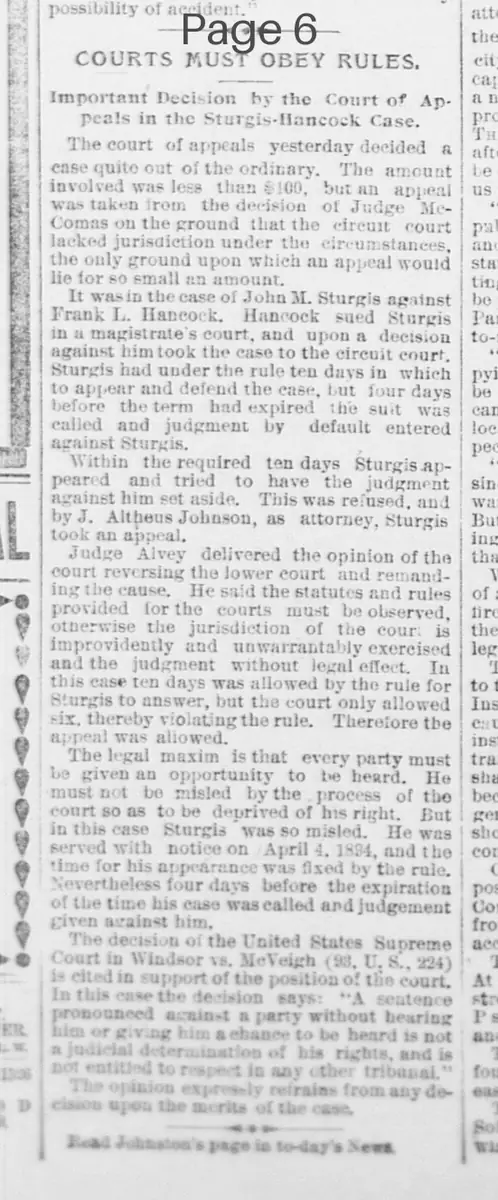
Important Decision by the Court of Appeals in the Sturgis-Hancock Case.
The court of appeals yesterday decided a case quite out of the ordinary. The amount involved was less than $100, but an appeal was taken from the decision of Judge McComas on the ground that the circuit court lacked jurisdiction under the circumstances, the only ground upon which an appeal would lie for so small an amount.
It was in the case of John M. Sturgis against Frank L. Hancock. Hancock sued Sturgis in a magistrate's court, and upon a decision against him took the case to the circuit court. Sturgis had under the rule ten days in which to appear and defend the case, but four days before the term had expired the suit was called and judgment by default entered against Sturgis.
Within the required ten days Sturgis appeared and tried to have the judgment against him set aside. This was refused, and by J. Altheus Johnson, as attorney, Sturgis took an appeal.
Judge Alvey delivered the opinion of the court reversing the lower court and remanding the cause. He said the statutes and rules provided for the courts must be observed, otherwise the jurisdiction of the court is improvidently and unwarrantably exercised and the judgment without legal effect. In this case ten days was allowed by the rule for Sturgis to answer, but the court only allowed six, thereby violating the rule. Therefore the appeal was allowed.
The legal maxim is that every party must be given an opportunity to be heard. He must not be misled by the process of the court so as to be deprived of his right. But in this case Sturgis was so misled. He was served with notice on April 4, 1894, and the time for his appearance was fixed by the rule. Nevertheless four days before the expiration of the time his case was called and judgment given against him.
The decision of the United States Supreme Court in Windsor vs. McVeigh (91 U. S., 224) is cited in support of the position of this court. In this case the decision says: "A sentence pronounced against a party without hearing him or giving him a chance to be heard is not a judicial determination of his rights, and is not entitled to respect in any other tribunal."
The opinion expressly refrains from any decision upon the merits of the case
Paul Janate's page in to-day's News
What sub-type of article is it?
What keywords are associated?
What entities or persons were involved?
Domestic News Details
Event Date
Yesterday (Decision); April 4, 1894 (Service)
Key Persons
Outcome
lower court reversed and remanded; appeal allowed due to procedural violation
Event Details
In the case of John M. Sturgis against Frank L. Hancock, involving less than $100, Hancock sued in magistrate's court and appealed to circuit court after losing. Judgment by default was entered against Sturgis after six days, despite a ten-day rule for appearance. Sturgis's motion to set aside was refused, leading to appeal. Judge Alvey ruled that courts must obey rules, citing lack of opportunity to be heard and a U.S. Supreme Court precedent, without addressing merits.